 Skip to content

Nurses are the most trusted professionals in America. For the 22nd consecutive year since 1999, they claimed the top spot in Gallup’s annual ethics poll in 2025 (except for that one time in 2001). In today’s verging-on-dystopian world, it’s a remarkable achievement. And one they richly deserve.

However, even nurses have lost 14 percentage points of public trust since the pandemic peak of 2020. Meanwhile, physicians have hemorrhaged 20 over the same period.
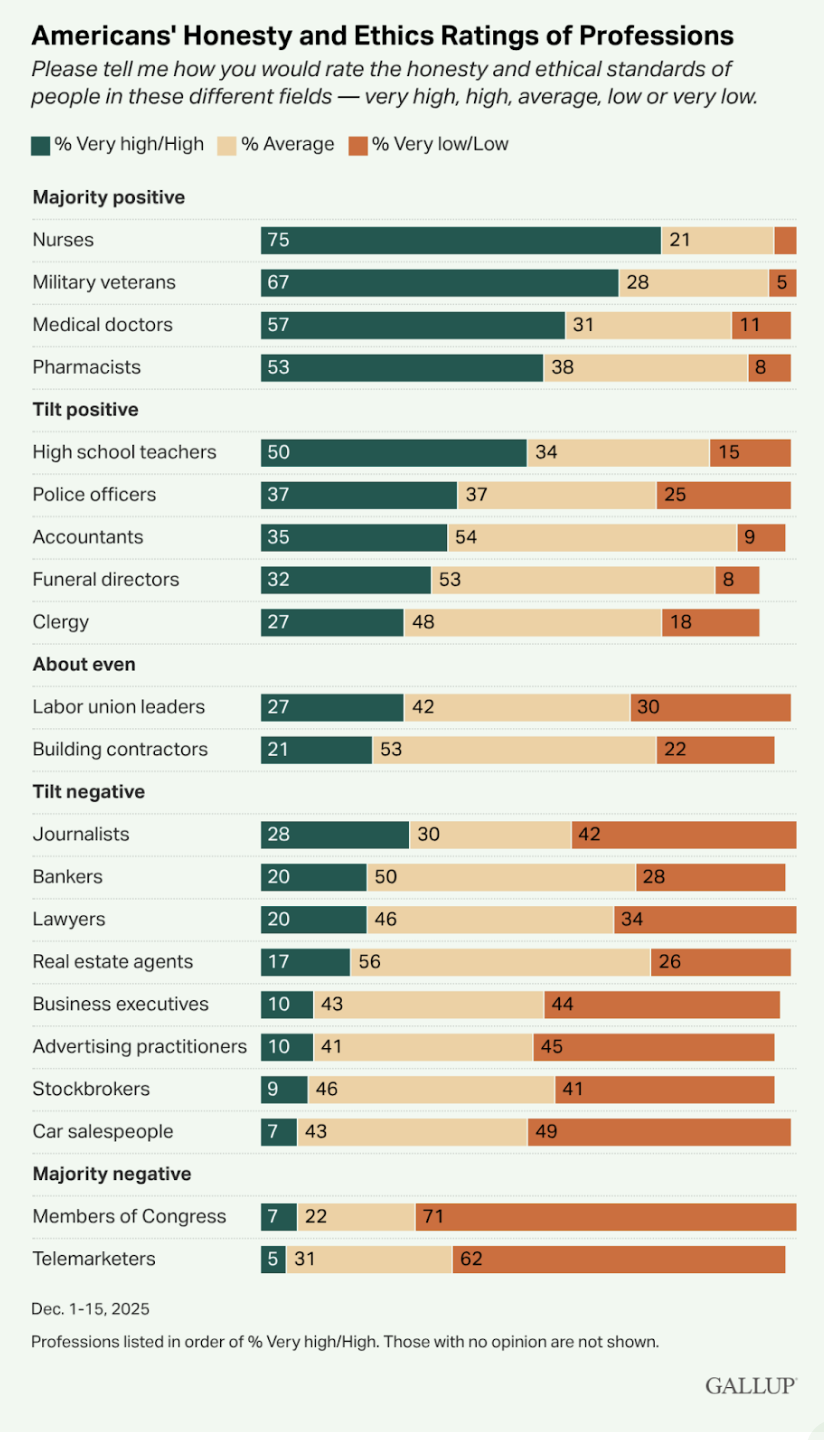
The 2025 Gallup data shows that only 57% of Americans now rate doctors as honest and ethical. Less than six in ten Americans trust the professionals who are tasked with saving their lives.
Can we chalk it up to just a pandemic hangover?
For those of us who trained for a decade, sacrificed our twenties and early thirties to master this craft, and carry six-figure debt and moral injury in equal measure, these numbers are a gut punch.
But they’re also a reality check. And the memo ain’t pretty.
In case you missed it: Your 2026 Financial Reset
Houston, We Have a Problem
Pharmacists have lost 18 points since 2020. As mentioned, doctors are down 20 points. Even nurses, still wearing the crown at 75% positive ratings in 2025, have dropped from 89% just five years ago.
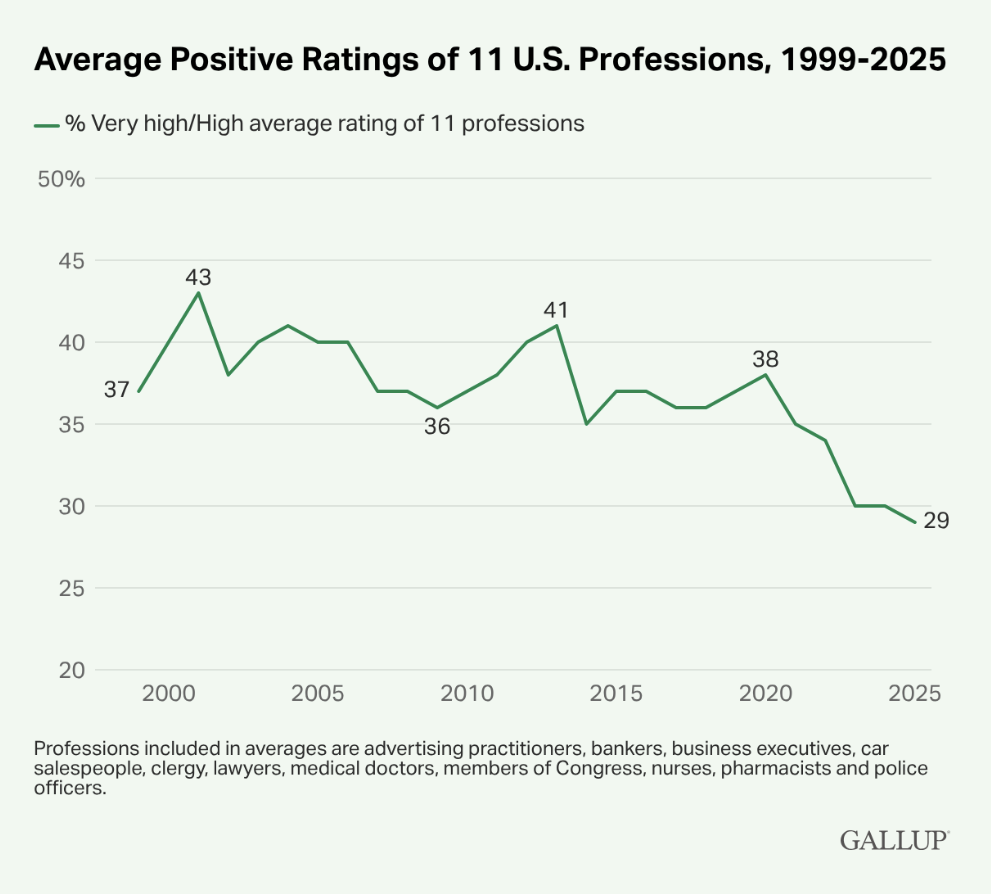
Meanwhile, the average positive rating across 11 core professions has hit a record low of 29%. For context, that’s lower than Americans’ love for pizza.
Jennifer Mensik Kennedy, president of the American Nurses Association, hit the nail on the head on why nurses still have the edge.
“We’re the translators in the healthcare system,” she says. “A physician might come in to a patient for a couple of minutes and say something, and we’re with them. And then the provider might leave, and then we translate what that meant. Because, again, we know that person in their situation and who they are, and so we can help provide the context and the meaning for that piece of information for that individual.”
Nurses take the time to hang out at the bedside while doctors play speed chess with their schedules. They bridge the gap between doctor-speak and human-speak. They provide context and meaning for medical information that’s tailored to each person.

So why are nurses holding steady-ish while physicians are falling off a cliff?
Why Your Doctor Is Basically Bigfoot
Dr. Cynda Hylton Rushton from Johns Hopkins says that patients trust nurses because they’re actually there. “I think patients trust nurses because of their close proximity, their ability to translate clinical information after physician rounds, and their approachability.”
Physicians, on the other hand, have become cryptids. We materialize briefly, drop some medical jargon that sounds like Latin, order tests, and then vanish. Even if it’s not entirely our fault. We’re just pressed for time because the system has turned us into hamsters on a productivity wheel.
We’re seeing 20–30 patients a day, documenting everything for insurance companies who definitely aren’t reading it, fighting with prior authorizations like we’re in a cage match with bureaucracy, and somehow supposed to maintain that warm, fuzzy doctor-patient relationship our professors told us about in medical school.
A UChicago study found that primary care physicians would require 26.7 hours per day to see the average number of patients.
Unfortunately, we don’t live in a perfect world where all that is possible can be achieved all at once. Patients barely know us, and you can’t blame them for not trusting ghosts. You can’t connect with someone who’s got one foot out the door before they’ve finished asking about your bowel movements.
Healthcare’s Version of Replacing Coke with RC Cola
A while back, we wrote about hospitals swapping out physicians for nurse practitioners. That rabbit hole goes deeper than I thought — and it’s directly connected to our trust problem.
Back in 2022, a single NP cost the hospital around $156,500 annually but generated over $424,900 in revenue. Those numbers are music to the ears of hospital administrators. It sounds so good, it makes them giddy. Many systems are replacing two MDs with three NPs and banking the difference.
Now, before the pitchforks come out, I’m not trashing NPs. Never that. Many are rock-solid clinicians who care deeply about their patients. This is me calling out a system that’s discovered it can play Moneyball with healthcare, except instead of winning championships, we’re running a dangerous experiment in cost-cutting.
And it’s happening without the safety nets that would make this remotely okay. Bloomberg’s investigation documented preventable deaths at HCA facilities where night shifts were being covered by NPs who were basically still wet behind the ears.
Mission Health in Asheville? Two-thirds of their physicians quit after HCA restructured staffing to maximize NP coverage while treating physician oversight as optional.
Preventable deaths occurred. Federal investigations got launched. It was a whole thing.

The punchline is that patients often have no clue. Scrubs all look the same. When someone in the ER introduces themselves as ‘your provider’ (a vague term), patients assume they’re seeing a doctor. They’re not.
That deliberate ambiguity destroys any chance of building trust from the get-go.
Read more about cost-cutting: The Refill Machine
The Dumpster Fire of Misinformation
Meanwhile, physicians are out here fighting a misinformation war that would’ve seemed like science fiction ten years ago.
Vaccine skepticism has gone from fringe conspiracy theory to mainstream dinner table conversation. Federal health guidance has been politicized so hard that it makes partisan cable news look tame.
The U.S. Department of Health and Human Services has undergone a complete overhaul. Wholesale changes have been made to the federal vaccine policy, and qualified experts have been replaced with people who share the Secretary’s views.
21 US Senators have signed a letter demanding a reversal of the vaccine policy. Medical societies are gearing up for a battle, calling this action out as anti-science, but here we are, living in the timeline where this is actually happening.
Nurses are showing us the way. Because they’re trusted, they can have these conversations. They can meet patients where they are, without judgment, and actually move the needle.
As Kennedy from the ANA pointed out, telling someone they’re wrong just slams the door on communication. But sitting down to listen and work through the information together can actually work.
The Burnout Express (Population: Everyone)
Okay, but how are physicians supposed to rebuild trust when we’re all running on fumes and spite? The American Nurses Foundation’s 2024 survey shows 56% of nurses are experiencing burnout.
One in four nurses has symptoms of moral injury. So basically, their sense of professional identity is getting shredded because they have to implement terrible decisions made by suits who’ve never touched a patient.
Physicians are inn the same boat, except our boat is also on fire and someone just asked us to see one more patient before we can evacuate. We’re exhausted, depleted, and increasingly cynical about a system that values quarterly earnings over anything resembling patient care.
One in four nurses has faced workplace violence. Physicians deal with the same baggage. When patients literally turn on the people trying to help them, it creates an existential crisis that would make Sartre weep.
“When our patients turn against us, it really leaves a gap of, why am I here?’ Some of these problems have been around for decades, but the pandemic put a spotlight on them,” says Dr. Rushton.
Patients are experiencing the consequences of understaffing — they’re getting subpar care in impossible situations. And because nurses and physicians are the ones they actually see, we catch all the anger meant for the system. It’s like being a customer service rep for a company you don’t even run.
Also read: Softer Roads: Notes on Physician Job Satisfaction and Survival
So What Do We Actually Do About This?
Look, the solutions aren’t sexy. They’re not quick. But they’re essential if we want to stop this nosedive:
Stop playing hide-and-seek with credentials
Patients deserve to know who’s treating them. No more calling everyone a ‘provider’ like we’re all interchangeable widgets. If you’re an NP, say you’re an NP. If you’re a resident, own it. If you’re an attending physician, then be one.
Since when do we care about hierarchy flexing in the warzone that is healthcare? Being clear equals informed consent, which is Healthcare 101.
Proper training and supervision
If we’re deploying NPs in high-stakes settings, we need to make sure they’re ready. No more tossing fresh graduates into ICU night shifts solo like it’s some kind of medical Hunger Games. Our NPs deserve better training and better hours.
Structured residencies should be mandatory for acute care, and physician oversight needs to be real, not just a checkbox on a compliance form that nobody reads.

Invest in humans like they matter
We need more nurses. More physicians. Better working conditions for everyone. Safe staffing ratios that don’t require sacrificing your firstborn to achieve.
Burnout needs actual systemic fixes, not another wellness app or ‘resilience training’ that basically amounts to ‘have you tried not being sad?’
Pay people fairly. Protect them from violence. Give them the tools to actually do their jobs.
Rebuild relationships one patient at a time
This means slowing down. Making eye contact. Actually listening instead of just waiting for our turn to talk. Treating patients like partners, not problems to solve before lunch.
Yes, the system makes this nearly impossible. That’s exactly why we need to change it.
Tag-team the misinformation problem
Nurses have cracked the code on this. Having empathetic, judgment-free conversations actually works. We need to copy their homework until we can do it on our own. Being dismissive or condescending doesn’t win anyone over. It just makes us look like arrogant jerks who care more about being right than keeping people alive.
Why Trustbuilding Actually Matters
Trust is the entire operating system that medicine runs on. Without it, patients ignore symptoms until they’re coding in the ER. They skip medications. They get their medical advice from a podcaster who sells essential oils. They fall down YouTube rabbit holes that end with them thinking ivermectin cures everything.
Without trust, the whole healthcare system starts falling apart like a Jenga tower.
Nurses are still holding the line, and we should absolutely give them their flowers for that. But physicians can’t just shrug and accept declining trust as the new normal. We need to fight for systemic change, not because we’re precious about our egos, but because patients deserve better.
The trust we lost wasn’t stolen. It was eroded by a system that values profit margins over people, productivity metrics over empathy, and quarterly earnings over clinical excellence. And until we call that out, the numbers will keep tanking.
This isn’t on us. But fixing it is.
Nurses earned the crown of most-trusted through showing up, caring deeply, and being genuinely competent. They’ve held onto it through a pandemic that broke a lot of people.
Physicians used to have similar trust. We can get it back…but it’s going to require confronting some ugly truths about the system we’re working in.
Do we have what it takes to fix this before the whole thing collapses?
I mean, I don’t know about you, but I didn’t spend a decade of my life training for this job just to watch it turn into a corporate-owned free fall.
Our patients deserve better than this. And somewhere between the bureaucracy and the burnout, we need to remember that this profession used to mean something.
Frequently Asked Questions
Why are doctors losing trust in America?
Physician trust has declined 20 percentage points since 2020, dropping to just 57% in the 2025 Gallup poll. The primary causes include reduced face-to-face time with patients, increased administrative burdens, credential confusion with mid-level providers, widespread misinformation, and systemic healthcare problems that physicians get blamed for but don’t control.
Are nurses more trusted than doctors?
Yes. Nurses have been ranked as the most trusted profession for 22 consecutive years (except 2001), with 75% of Americans rating them as honest and ethical in 2025. However, even nurse trust ratings have fallen 14 points since 2020. Nurses maintain higher trust due to their proximity to patients, ability to translate medical information, and greater accessibility.
How much do nurse practitioners cost hospitals compared to doctors?
In 2022, a single nurse practitioner cost the hospital approximately $156,500 annually but generated over $424,900 in revenue. This economic incentive has led many hospital systems to replace two physicians with three NPs to increase profit margins, often without adequate oversight or training protocols.
What percentage of nurses experience burnout?
According to the American Nurses Foundation’s 2024 survey, 56% of nurses experience burnout with emotional exhaustion. Additionally, one in four nurses reports symptoms of moral injury, and one in four has faced workplace violence. These statistics mirror similar burnout rates among physicians.
How can doctors rebuild patient trust?
Physicians can rebuild trust by ensuring transparency in credentials, spending more time listening to patients, explaining medical information in plain language, adopting non-judgmental approaches to misinformation (similar to nurses), and advocating for systemic changes that allow adequate staffing ratios and reduced administrative burdens.
What did RFK Jr. change about vaccine c?
As Secretary of the U.S. Department of Health and Human Services, Robert F. Kennedy Jr. made wholesale changes to federal vaccine policy, replacing qualified experts on advisory panels with vaccine skeptics. These changes prompted 21 U.S. Senators to sign a letter demanding reversal, and medical societies have denounced the actions as anti-scientific.
Why don’t patients know if they’re seeing a doctor or nurse practitioner?
Many healthcare facilities use the generic term “provider” for all clinicians, creating deliberate ambiguity. Scrubs look identical, and patients often aren’t clearly informed about their clinician’s credentials. This lack of transparency undermines informed consent and erodes trust in the healthcare system.





4 thoughts on “Physicians are Losing America’s Trust — But is it Our Fault?”
This was powerful and honestly a bit unsettling. The trust gap makes sense—less time with doctors, more system pressure, and growing confusion for patients.
The point about transparency and human connection really stands out. Feels like rebuilding trust starts with simply showing up and being clear.
I would say the physician population has no ethic for defending other physicians . If a physician pipes up and objects to any of the dozen things that the MBA/Hedge Fund/IT- Surveillance class has done to subjugate physicians and harm our practices and our patients, then immediately OUR own people, other doctors, come out of the woodwork to stone him, fire him, blackball him, censor him, take away his license, take away his certification (an academic degree (!))
Certainly websites like POF work to counter these injustices, if I am not deluded about what I read here. But the trend of hiring lackey academic chairmen and lackey private group leaders, whose allegiance is to the MBA/Hedge Fund/ IT-Surveillance class, is a sin and has been a cancer on our profession. We should have been always striving to protect our patients’ lives, health, privacy, and access to inexpensive care. We failed at all this.
So things like the Covid-19 epidemic and the horrible mRNA shot catastrophe and economic ruin that happened with it, happened unopposed. Physicians who piped up were destroyed. The rest became more feckless and silent.
Our profession is ancient. Somewhere between 5 and 10 thousand years. I maintain that it still attracts the most positive and best-motivated, dedicated, decent, and moral people to it. It absolutely must realize this and be highly protective of it. It has not done this.
We do not antagonize other professions allied with us, but we have in the past guarded our sacred status as advocates for the patient AGAINST other competing forces. We have lost this. Proof of this is the mRNA catastrophe, the autism epidemic, the obesity epidemic, the abortion holocaust (yes I said it — read the Hippocratic Oath), the minors being sexually ‘transitioned’. These are unspeakable, obscene failures on our part. And we have failed at other things, too. We must acknowledge these truths and then, redouble our efforts to regain the public trust and restore our profession as a sacred one.
You’re hitting on something real and painful — the culture of physician self-cannibalism is genuinely one of our most self-destructive traits. A doctor speaks up, and before the MBA class even has to act, our own colleagues are sharpening the knives. That’s not collegiality. That’s Stockholm syndrome with a white coat.
And the academic chair problem? Spot on. When department heads owe their positions to administrators rather than to their faculty or their patients, you’ve already lost the battle. Institutional capture is real, it’s been happening for decades, and we’ve largely let it happen without meaningful resistance.
But I have to be straight with you here, because that’s what this site is about.
You’re mixing legitimate systemic grievances with claims that the evidence doesn’t support. The mRNA vaccines were not a catastrophe — they saved an estimated several million lives in the U.S. alone, and that’s not an opinion, it’s modeled data from peer-reviewed sources. Vaccines don’t cause autism — that link was fabricated in a retracted, fraudulent study, and every rigorous investigation since has confirmed it. Conflating these with the very real problems of physician silencing and administrative capture actually undermines your credibility on the points where you’re right.
The trust problem we’re describing in this article is partly *because* physicians have sometimes abandoned evidence when it became politically or ideologically inconvenient — in both directions.
Physician advocacy has to be anchored in science, or it’s just another opinion column. Our ancient profession survives because we follow evidence even when it’s uncomfortable.
You’re right that we’ve failed to protect our patients from administrative greed and systemic dysfunction. Let’s fight that battle — loudly, together. But we can’t win it by trading one set of bad evidence for another.
Excellent article!