Skip to content


This article was originally published in December 2023 and updated in January 2026 to reflect the latest compensation data and trends in dermatology.
Data sources show that the average salary of a dermatologist is roughly $400,000 to $530,000 annually.
According to the latest Doximity report, dermatology was the sixteenth-highest specialty in 2025, with an average salary of approximately $508,401 a year.
In the 2024 Medscape report, Dermatology was seventh highest-paying specialty, with an average salary of $479,000. In the 2023 Medscape report, dermatology was the tenth highest-paying specialty, with an average salary of $443,000. And in the 2022 Medscape compensation report, dermatologists earned an average salary of $438,000, the eighth highest-paying specialty.
Medscape’s 2025 compensation report lists the average salary of a dermatologist as approximately $454,000, coming in 10th on the list, compared to being the 8th highest-paid back in 2022.
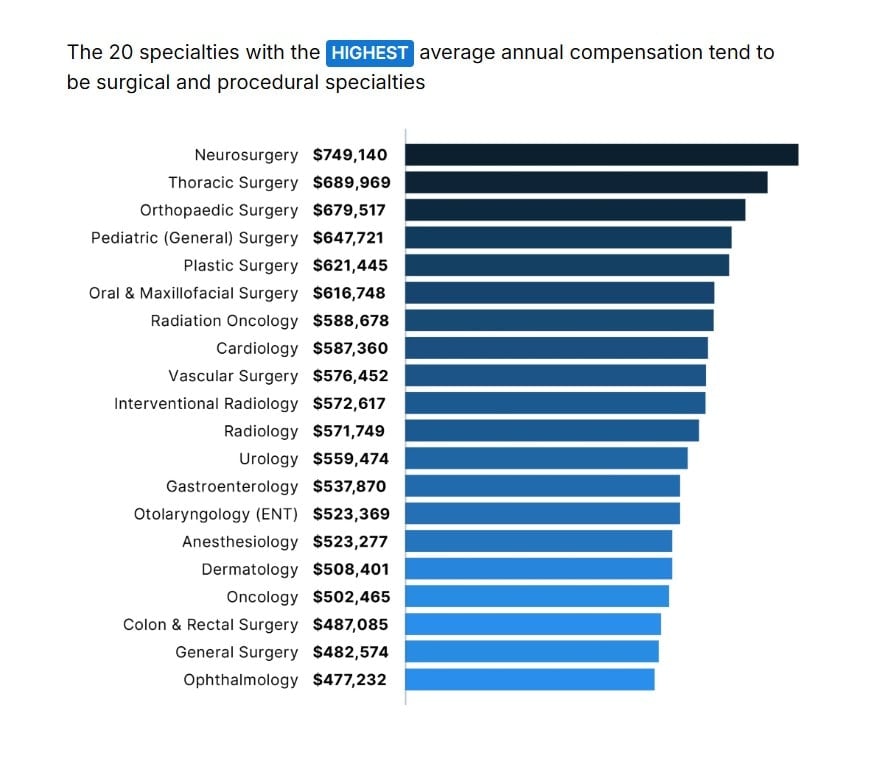
When reading these numbers, it’s vital to recognize that dermatologists’ compensation can vary significantly due to different factors such as specialties, sub-specialties, and geographic location.

For example, dermatologists in Washington earn an average annual salary of $490,820 according to the Bureau of Labor Statistics, while dermatologists in Montana make an average annual salary of $358,880.
Learn more: Physician Salaries: Latest Compensation Benchmarks Revealed
Are Dermatologist’s Salary Increasing or Decreasing?
Dermatologist salaries have experienced notable volatility in recent years, departing from the steady, modest growth pattern previously observed. The specialty experienced an 8% increase from 2023 to 2024, only to see a subsequent decline of 5% in the most recent reporting period.
In the 2023 Medscape compensation report, dermatologists’ salaries only increased by one percent.
In particular, in 2023, dermatologists reported earning an average salary of $443,000, while in 2022, their average salary was $438,000; this was only a $5,000 increase in salary from the previous year.
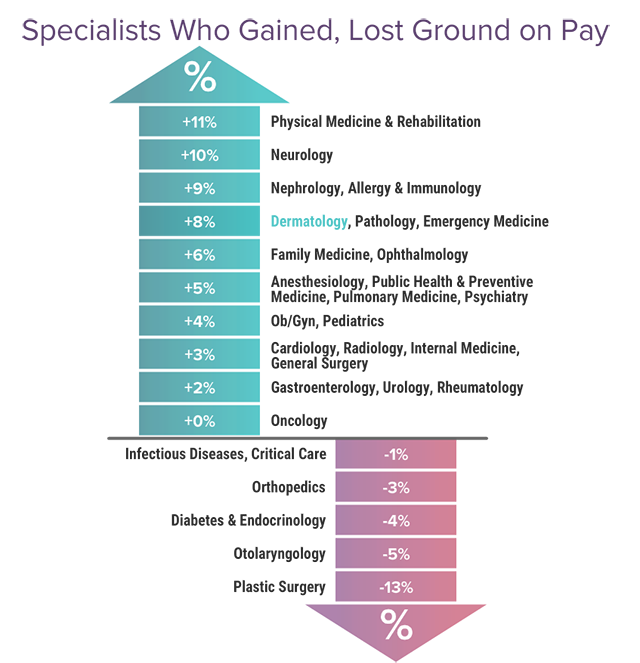
Unfortunately, dermatologists’ salaries were not able to keep up with inflation in recent years. In 2022, the US Dollar experienced a 4.7% inflation rate, but dermatologist salaries only experienced a 1% increase in salary from 2022 to 2023.
While specific inflation figures vary year to year, the recent declines mean real purchasing power for dermatologists has diminished compared to previous compensation levels.
As mentioned earlier, dermatology experienced the biggest decline among all physician specialties, with a 5% drop from 2023 to 2024. The 2025 report also shows that dermatologists now average around $454,000, down from their 2024 peak ($479,000).
This decline is particularly notable given that the overall physician compensation across all specialties increased by 3% during the same period, though this was the lowest growth rate since 2011.
Several factors appear to be contributing to this decline. The general consensus is that private equity’s increasing influence in dermatology may be playing a role in the compensation changes.
Additionally, payer reimbursement cuts have particularly affected specialists, creating downward pressure on dermatology compensation.
The specialty’s compensation trajectory stands in contrast to some other fields. For instance, diabetes and endocrinology specialists led all physician specialties with a 7% increase while orthopedics maintained its position at the top of the earnings scale at $564,000 annually with a mere 1% increase.
It is also important to note that around half of medical specialties reported a 2% compensation increase, or no changes at all; rheumatologists, gastroenterologists, and ophthalmologists saw flat pays.

Do Dermatologists Receive Incentives or Bonuses?
Yes, dermatologists do receive incentives and bonuses. Unfortunately, there are not many reports that document the average amount that dermatologists receive in incentives and bonuses.
While there is no data to support an annual figure, it is clear that, similar to many physicians, dermatologists also receive bonuses and incentives. Many physicians earn sign-on bonuses in addition to having an annual incentive/bonus package program.
Sign-on bonuses in dermatology can range anywhere from $10,000 to $100,000 depending on the practice, location, and candidate qualifications.
Some common dermatology bonus packages include performance-based plans or profit-sharing models or RVU-based compensation models.
Dermatologists may encounter various pay structures, including RVU-based compensation where relative value units measure the complexity and volume of services provided, salary plus RVUs hybrid models that combine base pay with productivity incentives, and collections-based compensation that ties earnings directly to revenue generated from services.
Also read: Understanding RVU Compensation Models
Do dermatologists take extra work for additional income?
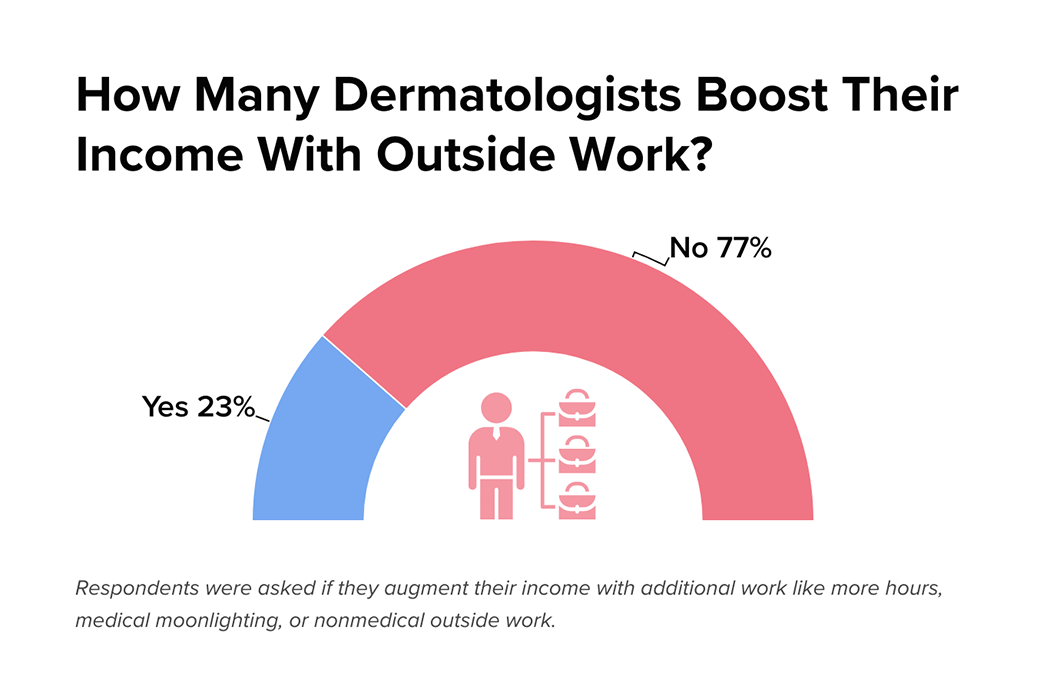
Strangely enough, the shrinking paycheck isn’t translating into dermatologist adding extra work to their plate. At least according to the data.
Approximately 23% of dermatologists currently boost their income with outside work in comparison to 35% of dermatologists report taking on additional work for supplemental income in 2023.
This decrease suggests a downward trend of dermatologists seeking additional income streams.
In 2023, 27% of those dermatologists reported that they either moonlight or perform other medical-related work for supplemental income. Another 5% reported that they work additional hours to earn additional income, and finally, 4% of dermatologists reported that they perform non-related medical work for supplemental income.
These results are very similar to the 2022 results, where 37% of dermatologists report taking on additional work for supplemental income.

Do dermatologists feel fairly compensated?
Only 55% of dermatologists feel fairly compensated according to Medscape’s 2025 report, representing a significant decline from previous years. This is down from 62% in 2024 and 65% in 2023, indicating growing dissatisfaction with compensation levels.
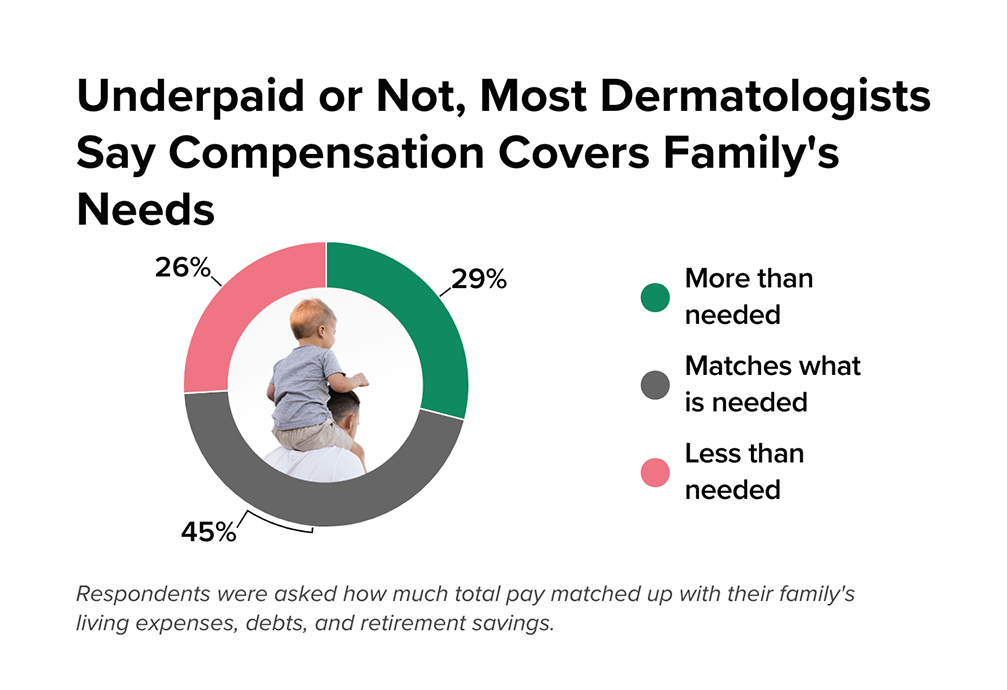
This decline is particularly notable because dermatologists historically reported among the highest satisfaction rates.
In 2023, dermatology had one of the highest rates of compensation satisfaction, coming in with the second-highest rating out of the 29 specialties surveyed.
In 2022, the specialty ranked as the fifth highest specialty for compensation satisfaction.
The current 55% satisfaction rate now falls below the overall physician average, marking a substantial shift.
This change correlates with the recent compensation declines and may reflect concerns about private equity influence, reimbursement cuts, and the overall economic pressures affecting the specialty.
The declining satisfaction suggests that despite dermatology remaining a relatively high-paying specialty, practitioners increasingly feel their compensation does not adequately reflect the complexity, training requirements, and demands of their work.
In case you missed it: Physician Salaries: Why Transparency Is Important (And What We’re Doing About It)
Factors Affecting dermatologists’s Salary
Experience Level
As with any position, a dermatologist’s experience influences their salary.
An entry-level dermatologist will earn less than someone with more training, experience, and skills.

There isn’t much data to show how the salary of a dermatologist evolves as they gain more experience. However, if we use available salary databases, we can estimate the following median annual salary at different levels of experience (keeping in mind these figures should be adjusted upward to reflect current 2025 market conditions):
- Entry-Level (less than 1 year): $390,473
- Early Career (1-2 years): $392,145
- Mid-Level (2-4 years): $393,816
- Senior-Level (5-8 years): $396,157
- Expert (over 8 years): $402,515
As an entry-level dermatologist, your starting pay is about 60% of the national average.
But as dermatologists gain experience from entry-level to mid-career, they can expect to reach the national average and earn nearly $100,000 more.
Finally, when a dermatologist is fully experienced and in a senior role, they can expect to earn nearly $500,000 annually or nearly an additional $100,000 from their mid-career salary levels.
It’s important to note that these figures represent general trends, and actual compensation can vary significantly based on practice setting, geographic location, and subspecialty focus.
Location
Where you decide to practice dermatology will influence your salary. This is not a phenomenon unique to dermatologist but to all physicians.
A recent study by Doximity found that the average physician compensation increased in 54 out of 60 metropolitan areas examined in 2024, with about two-thirds seeing growth of at least 3%.
Dermatologists in different states can see substantial variation in earnings. According to recent MGMA data, top-paying states include Utah, South Dakota, and Washington, while states like Massachusetts and Kentucky report lower median salaries.
Here’s a list of available data:
| State | Dermatologist Compensation (According to MGMA) |
| Massachusetts | $395,165 |
| Kentucky | $400,348 |
| Indiana | $411,703 |
| Louisiana | $452,084 |
| New York | $454,950 |
| Colorado | $478,825 |
| Ohio | $491,962 |
| Illinois | $511,825 |
| Pennsylvania | $520,860 |
| Florida | $527,138 |
| Texas | $531,020 |
| Wisconsin | $540,274 |
| Minnesota | $546,811 |
| California | $577,044 |
| Washington | $672,607 |
| South Dakota | $709,496 |
| Utah | $732,517 |
| State | Annual Salary |
|---|---|
| New York | $417,984 |
| Vermont | $410,790 |
| California | $403,464 |
| Maine | $391,809 |
| Idaho | $387,606 |
| Washington | $384,581 |
| Pennsylvania | $382,812 |
| Massachusetts | $378,130 |
| Alaska | $375,736 |
| New Jersey | $374,345 |
| New Hampshire | $373,458 |
| Oregon | $371,445 |
| North Dakota | $371,076 |
| Wisconsin | $368,704 |
| Wyoming | $365,397 |
| Hawaii | $364,033 |
| Colorado | $362,070 |
| Indiana | $358,997 |
| Nevada | $355,272 |
| New Mexico | $354,287 |
| Minnesota | $353,792 |
| Arizona | $351,574 |
| South Dakota | $350,707 |
| Montana | $346,277 |
| Ohio | $344,572 |
| Rhode Island | $344,050 |
| Delaware | $343,410 |
| Alabama | $341,952 |
| Virginia | $339,682 |
| Connecticut | $337,334 |
| Iowa | $336,698 |
| Illinois | $334,142 |
| Mississippi | $333,696 |
| Maryland | $332,886 |
| Tennessee | $328,977 |
| Utah | $328,133 |
| Nebraska | $326,672 |
| Missouri | $322,302 |
| South Carolina | $319,039 |
| Georgia | $318,554 |
| Oklahoma | $316,356 |
| Texas | $315,939 |
| Kansas | $314,148 |
| North Carolina | $312,455 |
| Louisiana | $308,889 |
| Kentucky | $300,127 |
| Michigan | $300,010 |
| West Virginia | $295,651 |
| Arkansas | $285,133 |
| Florida | $281,918 |
Some factors that influence the salary differences between states are the supply of dermatologists, the demand for dermatologists, the cost of living, and the number of opportunities available.
That said, it’s essential to recognize that these states also vary in cost of living. The cost of living dramatically varies across the country, with metropolitan areas generally being more expensive.
This means that while some states offer higher compensation for cardiologists, the buying power of that salary may be severely diminished by higher basic living expenses.
Interestingly, states like California and New York, while having high costs of living, may not necessarily offer the highest base salaries but can compensate through higher patient volume, opportunities for cosmetic work, and access to affluent patient populations.
Type of Workplace
The type of hospital or medical facility where you work can also affect your salary as a dermatologist. Working at a large, well-known healthcare institution or private hospital often comes with different compensation structures than smaller hospitals or clinics.
The Bureau of Labor Statistics performs a great analysis that demonstrates the difference in wages depending on the workplace or industry you are working in.
The most common workplaces for dermatologists include:
- Offices of Physicians
- General Medical and Surgical Hospitals
- Medical and Diagnostic Laboratories
- Outpatient Care Centers
- Other Healthcare Offices
The highest-paying workplace was physician offices, with an average annual salary of approximately $339,000.

The report did not disclose the average salary for outpatient care centers. However, they did disclose that general medical and surgical hospitals earn an average annual salary of approximately $274,000. The lowest-earning dermatologist worked in other healthcare offices with an average annual salary of $208,000.
This report shows a large salary difference depending on the industry and workplace. By working at a physician’s office, you can earn nearly $150,000 more in annual salary than a dermatologist at other healthcare offices.
Also read: Medicare Physician Payment Cuts 2025: 2.8% Reduction Impact and What Doctors Need to Know
Frequently Asked Questions
How much do dermatologists make in California?
California dermatologists’ salaries vary depending on the source and specific location within the state. According to Salary.com for 2025, dermatologists in California earn around $440,600 on average, which aligns more closely with higher national averages.
However, it’s crucial to consider that California has among the highest costs of living in the nation, particularly in major metropolitan areas like San Francisco, Los Angeles, and San Diego. While the nominal salary may be high, the purchasing power can be significantly reduced by housing costs, taxes, and other living expenses.
California also offers unique opportunities for cosmetic dermatology given the state’s large population, aesthetic-focused culture, and concentration of affluent patients, which can significantly boost earnings for dermatologists who incorporate cosmetic procedures into their practice.
How much do dermatologists make in Tennessee?
According to various salary reporting sources, dermatologists in Tennessee earn an average annual salary of approximately $373,300. Tennessee ranks in the middle tier of states for dermatologist compensation.
Tennessee offers a relatively moderate cost of living compared to coastal states, and the state has no income tax, which can make the effective purchasing power of a dermatologist’s salary quite competitive. The state’s growing healthcare sector and expanding population, particularly in cities like Nashville and Memphis, continue to drive demand for dermatological services.
How much do dermatologists make in Florida?
Florida presents an interesting case for dermatologist compensation. Various sources report Florida dermatologists earning approximately $378,000 annually.
Florida offers several unique advantages. The state has no income tax, which significantly increases take-home pay. The large and growing retiree population creates strong demand for dermatological care, particularly for skin cancer screening and treatment. The climate and outdoor lifestyle also contribute to steady patient volume.
Florida’s lower base salaries may be offset by high patient volume opportunities, robust cosmetic dermatology demand in affluent areas, and the favorable tax environment. Dermatologists practicing in coastal areas or affluent communities may find opportunities for cosmetic work that substantially increase their total compensation beyond reported base salary figures.
How much do dermatologists make in New York?
New York remains one of the higher-paying states for dermatologists. Dermatologists in New York earn approximately $424,700 on average, with significant variation depending on whether they practice in New York City or elsewhere in the state.
New York City offers unique advantages including access to a large, diverse patient population, opportunities for academic medicine at prestigious institutions, and significant demand for both medical and cosmetic dermatology services. However, practitioners must also contend with among the highest costs of living in the nation, significant state and city taxes, and higher practice overhead costs.
Dermatologists in upstate New York or suburban areas may see different compensation structures, often with lower nominal salaries but also substantially lower living costs, resulting in comparable or superior purchasing power and quality of life.
This article was originally published in December 2023 and updated in January 2026 to reflect the latest compensation data and trends in dermatology.