Skip to content

Somewhere along the Appalachian Trail, a hiker in his early forties boils water over a burner. His pack is battered, his boots are worn thin, and his tent is patched from a dozen small repairs.

He hasn’t checked his email in days. He doesn’t have a gym membership, a streaming subscription, or a five-year plan.
Many of us would think he’s broke, homeless, and down on his luck. But by many definitions, he is wealthy and free. And luck had nothing to do with it.
Contrast that with a hospitalist finishing a 14-year shift in suburban Atlanta. She’s earning just under half a million dollars a year, owns two homes, drives a European SUV, and hasn’t had a week without meetings since residency.
Her net worth is positive but modest. Her time, more than anything, is not her own. She sometimes jokes that if she got fired, it would take three jobs for her to maintain her current lifestyle.
This is not a moral tale. Nor is it about asceticism or excess. It’s about a certain dissonance many of us are familiar with.
High earners, especially in medicine, law, and tech, inhabit a strange financial terrain. From the outside looking in, they appear affluent. On paper, they are.
But in lived experience? Many of us carry the weight of precarity. Because high incomes mean high obligations. Debt, taxes, lifestyle pressure, and social expectations all collide to dilute the financial power that six- or seven-figure salaries should theoretically offer.
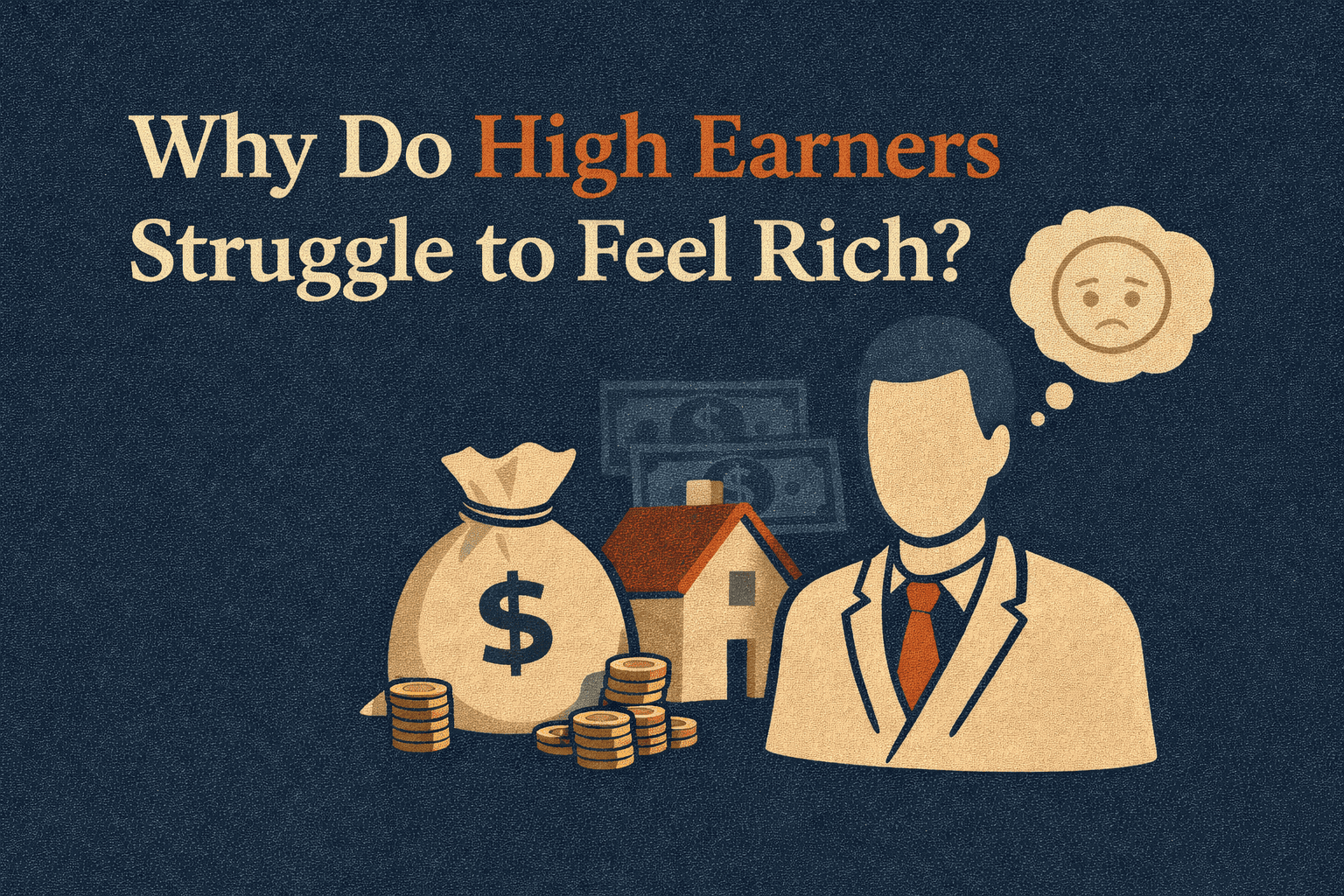
Even the data increasingly confirms what many of these high-earning professionals already feel: income does not equal wealth.
More often than not, it doesn’t even equal freedom.
Learn about the 7 Ways You Can Find More Work-life Balance as a Physician
The Income Illusion
One of the most enduring myths in modern American life is that earning more solves everything. More money means more options, more security, and ultimately more happiness.
There’s certainly no shortage of this idea floating around in the zeitgeist. Career counselors, commercials, salary negotiations, and the social media we consume daily— all make us believe that higher income equals wealth.
But income is a stream, not a reservoir. It flows in, and unless it is channeled with intention, it flows right back out.
Here’s a perspective check: While billionaires dominate headlines and Fortune 500 CEOS rake in millions. The global bar for being considered affluent is much lower than most of us assume.
The threshold to land in the top 1% of income earners worldwide is just $60,000 to $70,000 per year in net income.

By that metric, many mid-career professionals in the U.S., like engineers, teachers, and even residents still paying off medical school, already qualify.
Doesn’t that just completely shake up the meaning of richness? To think that a resident is part of the global 1%?
Most of us don’t feel remotely rich until we’re playing in the millions. And that’s the paradox: being among the global elite while still checking your balance before a vacation or deferring retirement savings because of your kids’ preschool tuition.
It’s neither greed, nor ignorance either.
It’s just how warped our benchmarks have become.
36% of Americans earning over $200,000 live paycheck to paycheck. Many of those are millennials with huge student loans to pay off. In some Bay Area counties, a six-figure income is categorized as “low-income.”
A six-figure income used to mean something. But this WSJ article from 2015 is proof that this hasn’t been the case for the past decade. A salary that was once considered successful now barely covers rent and utilities.
The problem is partly semantic. We confuse wealth with income. But real wealth, the kind that cushions, liberates, and endures, is measured not by what you make, but by what you keep.
A modest schoolteacher with a paid-off mortgage and a funded retirement account may be better positioned for long-term stability than the marketing executive leasing a $90,000 car and financing a lifestyle.
And for physicians, the gap between appearance and reality is often especially stark. Years of delayed earning, staggering student loans, and social comparison create a potent cocktail of pressure and catch-up spending. The income arrives, but the wealth lags. Or in some cases. never materializes.
Don’t miss out on the Five Factors That Determine Success in Retirement
Why We Spend Like We’re Rich
Every rung on the career ladder invites another step up the lifestyle chain. A nicer home, better schools, a second car, a more efficient commute.

The gains feel incremental — until they’re not. Suddenly, a promotion that came with a $40,000 raise has been absorbed by a $6,000 property tax bump, private kindergarten tuition, and a two-week vacation that felt like a reward for surviving the last quarter.
For many professionals, spending rises in parallel with earning. This causes the baseline to reset. Suddenly, luxuries become necessities, and the goalposts move further away.
Looking the Part
In professions where trust is currency, optics matter. Patients want a doctor who looks successful. Clients want an advisor who appears prosperous. Colleagues expect a certain polish.
And so, high earners begin dressing, driving, and dining in ways that reinforce those expectations. Not necessarily because they enjoy it, but because they fear the consequences of not doing it.
And thus, portraying affluence becomes a professional expense.
The “I Deserve It” Mentality
After years of sacrifice, the impulse to reward oneself is natural. And frankly, understandable.
But when indulgence becomes routine, or a way to compensate for time scarcity, it can turn corrosive. Retail therapy, luxury travel, and high-end dining — none of it is inherently harmful.
But when it becomes a substitute for rest, connection, or meaning, it costs us more than money.
Overconfidence in Continued Earnings
Perhaps the most insidious assumption among high earners is that the money will always be there. That their jobs will stay secure, that their salaries will keep climbing.
But careers detour, health falters…and economies? They slow.
The confidence that fuels ambition can also breed complacency. And so financial planning becomes reactive instead of proactive, built on optimism instead of strategy.
The Professional Trap
Different professions impose different flavors of financial pressure. But the common thread is role-based expectation.
Medicine, for instance, is a delayed gratification marathon. Physicians start earning in their 30s, after a decade of training, missed compounding, and a mountain of debt. The pressure to “live like a doctor” kicks in early, often before the ink on the first attending contract has dried.
And so, many enter the workforce with a double burden of the urge to spend and the obligation to repay.
That combination keeps net worth low and stress high, even at salaries most Americans would envy. The veneer of success then conceals a life of high-stakes overhead, lingering student loans, and very little margin for error.
Meanwhile, in dual-income households, particularly those where both partners are high earners, the pressure shifts but doesn’t lessen.
Two six-figure incomes don’t always mean twice the comfort. More often, they translate into two packed calendars, two commutes, overlapping responsibilities, and an entire infrastructure of outsourced life: nannies, meal kits, cleaners, dog walkers.
The money looks impressive, but the lifestyle is so operationally complex and so time-starved that it still feels like survival mode. What should feel like abundance ends up running a quiet deficit of time, energy, and peace.
A Faulty Curriculum…By Design?
It’s no accident that high earners often feel unprepared for wealth-building.
Our education system trains for productivity, not autonomy. We learn to solve for grades, to memorize facts, to follow directions. But few of us graduate understanding compound interest, marginal tax rates, or how to build a portfolio that outpaces inflation.
We know how to diagnose, how to investigate, how to heal. But we don’t know how to allocate bonuses toward long-term capital. Or how to build a life that scales down, not up.

We call it education, but in practice, it’s vocational programming. A pipeline into white-collar professionalism. A track that leads straight into the upper-middle class, and keeps us right there. Too busy, too tired, or too indebted to ever really leave it.
This isn’t a conspiracy, no, it’s culture. Capitalism doesn’t require us to be poor, only productive. And as long as the system keeps its best-paid participants financially insecure, it keeps them working.
Because true financial literacy — the kind that leads to independence — might encourage an exit.
And that’s not what the machine is built for.
A Chance to Reimagine
A leased luxury car, however glossy its paint or prestigious its emblem, is not wealth. Neither is the sprawling kitchen with imported marble countertops, the immaculate Montessori wardrobe for a toddler who’d rather be barefoot, nor the travel-stamped passport that tells of five-star resorts.
These things, dazzling though they may be, are artifacts of spending rather than emblems of surplus. They offer a curated glimpse into affluence without disclosing anything about what’s quietly growing, compounding, or safeguarded in the background.
True wealth, by contrast, is rarely photogenic.
It lives in unassuming brokerage accounts, in the quiet equity of a mortgage that no longer needs attention, in calendars with wide-open mornings and Tuesdays without meetings.
It expresses itself not through visible abundance, but through the subtler, more enduring power to decline, to step away from toxic clients or lopsided partnerships, to say no to yet another obligation that demands your time but offers no return, to leave a lucrative job that pays handsomely but starves your spirit.
Real wealth manifests as freedom. The freedom to choose what responsibility you take.
Wealth, then, is not how much you earn or how much you spend. It’s how much you’re able to keep, and how you keep it.
For many high-earners, especially those who inhabit industries where image and influence can carry heavy price tags, the space between earnings and accumulation remains alarmingly low.
Even for those who do manage to accumulate a respectable portfolio, the realization often comes late and quietly. The realization that no dollar amount, however vast, can resolve the disquiet that comes from living in a state of persistent overextension.
Because what many high-earners eventually discover is that it is entirely possible to achieve every income milestone, to collect all the outward badges of success, to arrive at the long-promised land of “having made it,” and still feel a gnawing sense of scarcity.
Not of money, but of peace.
Material wealth, by its very nature, is outward-facing. It can be itemized and flaunted, discussed over dinner, or chronicled in spreadsheets.
But the kind of wealth that endures, the kind that fulfills rather than inflates the ego, is inwards.
It is found in unquantifiable spaces where fear is absent, where the mornings are unhurried and spent with loved ones, where the energy (both physical and emotional) to invest in relationships without looking at the clock ot calculating the opportunity cost.
It is the capacity to sleep soundly, to give generously, and to spend a Wednesday simply hanging out in the garden.
And at its core, real wealth is deeply, almost stubbornly, relational. It cannot be built in isolation, and it does not endure in loneliness. No brokerage account, no matter how diversified or tax-optimized, can sit beside you in grief or toast your quiet triumphs or notice when your spirit is fraying.
A full portfolio, while comforting in practical terms, is a poor substitute for a life rich in laughter, forgiveness, and companionship. Because even when the money is working, the soul can still feel bankrupt if it is starved of connection.
In the end, money is a tool, and like any tool, its value is determined not by how much of it you possess but by how well you understand its purpose. It can insulate you from chaos, yes. It can also buy you back your time. It can even unlock doors.
But it cannot restore meaning. It cannot teach you how to be still. It cannot, by itself, make your life feel whole. That deliberate and sacred work is beyond the reach of any paycheck.
As it always has been.
Is Driving a Honda Smarter Than Flexing a Ferrari? Click to find out.
The Escape Plan
So, how do you course-correct when income alone no longer feels like a safety net?
You begin by discarding the illusion that a high salary guarantees security, and instead, build a system that actually serves your future self. That means:
- Tracking your net worth, not your paycheck, not your spending, but the tally of assets minus liabilities.
- Elevating your savings rate to something meaningful. For high-earners, 20-30% of gross income should be the baseline, with 50% or more being a worthy target. Especially in those early years when the kids are younger and compounding is on your side.
- Choosing assets over aesthetics. Index funds, real estate, and business equity should all take precedence over leased vehicles or lifestyle upgrades that exist only to broadcast success.
- Partnering with a fee-only fiduciary who understands physician finances and isn’t incentivized to sell you anything. Someone who can help you optimize taxes, clarify your goals, and stay the course.
- Designing for autonomy. Build a life that doesn’t revolve around how much you can earn, but how little you truly need. And by that, I mean a paid-off home, a flexible calendar, and work that doesn’t feel like torture. Because in the end, those are the real dividends of financial independence.
If you’re earning more than 95% of the country and still feel behind, it’s not a personal failure. It’s the inevitable outcome of a system built on comparison, consumption, and financial fragility.
But you can opt out. And you should start now.