



Physicians have gotten better about entering retirement with serious financial muscle. Yet many still struggle with peace about actually spending it.

Many doctors are on track to build serious nest eggs by the time they retire, with averages in the low millions and some specialties like cardiology reporting roughly $2.5 million in current savings on average.
A significant chunk of seasoned physicians are sitting well inside the multi-million range, even as they chase higher targets for comfort and longevity.
Read: Why Most Doctors Retire With Too Much Money (And What to Do About It)
Despite that, many physicians still feel guilty about spending.
It’s my understanding that guilt is a psychological artifact of a career built on restraint. A remnant of our early years that never quite leaves us. From med school onward we learned that delay equals discipline.
We pushed through debt, long nights, and postponed vacations because saving was survival and spending felt premature. We became expert savers in a culture that equates frugality with virtue and indulgence with weakness.
Surveys show a strange disconnect between objective savings and subjective confidence. Doctors report having roughly $1.6 million on hand on average toward a retirement goal north of $4 million, yet only a minority feel fully confident they’ve hit their mark.
A notable share still feels behind, despite sitting well above typical American retirement savings
This tension between having money and feeling uneasy about using it is a human reaction rooted in habit.
Many of us are wired to prioritize future outcomes over present enjoyment, to defer gratification, and to find meaning in sacrifice. That mindset served us well for decades. But in retirement, it becomes a barrier to actually living.
Are we foolish for feeling this way? Well, no. But for anyone close to retirement or perhaps struggling to spend peacefully, here are my two cents.
In case you missed it: The Physician’s Guide to a Regret-Free Retirement: Three Steps to Financial Freedom
When More Feels Like Less
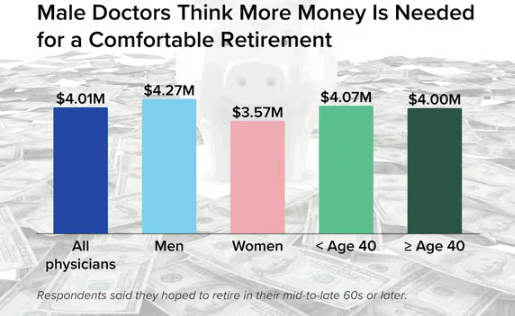
According to Medscape’s 2025 retirement survey, US physicians think their family needs $4.01 million saved for a comfortable retirement, and they are around 40% toward that goal.
Female physicians have accumulated $1.1 million in savings on average, while male physicians have amassed $1.9 million in retirement assets so far.
Source: Medscape
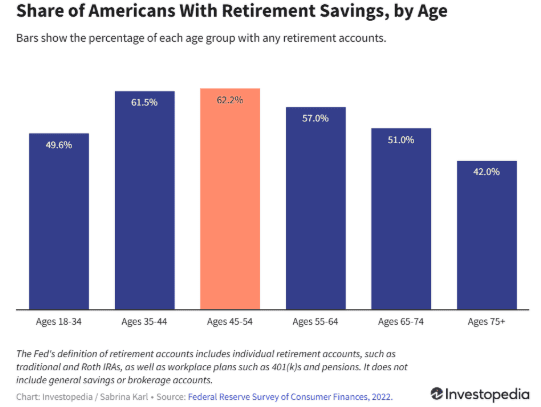
These figures place most physicians well above the general population. According to Federal Reserve data, retirement savings peak at a median of $200,000 for those aged 65–74, then drop to $130,000 for those 75 and older.
Source: Investopedia
48% of American workers think they’ll need at least $1 million for retirement, while physicians aim for $4 million. This is, of course, a reflection of both higher living standards during their careers and legitimate concerns about healthcare costs and longevity.
Yet it’s not so simple, is it? The broader American retirement landscape reveals troubling trends. More than half of Americans (51%) have either stopped or reduced their retirement savings in the past six months due to the current economic environment.

66% say they have not been able to contribute to their savings as much in the past six months, with concerns about rising healthcare costs driving many to prioritize health-related savings over other financial goals.
While physicians may not face such dire circumstances, many have felt the squeeze. The average physician earned $374,000 in 2024, but only 48% felt fairly compensated. That is the lowest satisfaction rate in a decade. After adjusting for inflation, real physician compensation dropped 3.1% between 2017 and 2023.
Add burnout rates of 47% in 2024, and you have a profession where many are actively considering early retirement.
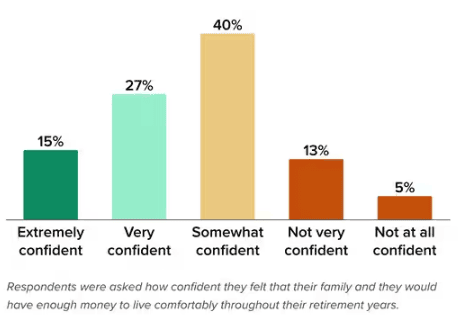
Given all of that, it makes sense that many of us hesitate to chip away at the nest egg we so carefully crafted with our blood, sweat, and tears. And why only 82% of us feel very to somewhat confident that our savings will outlast retirement.
Source: Medscape
But, there’s more…
The Six-Figure Hole
To understand physician spending guilt, you need to understand the financial gauntlet of medical training. The average medical student graduated in 2025 carrying $216,659 in debt, and 84% of physicians (class of 2024) held over $100,000 in medical school debt.
This means most physicians spend their twenties and early thirties not building wealth, but digging out of a six-figure hole while their college peers in business or tech are already maxing out retirement accounts and buying homes.
The delayed gratification doesn’t end with medical school. Residency and fellowship years (often extending into the mid-thirties) mean living on approximately $65,557 annually while friends from college are earning multiples of that amount.
By the time physicians reach attending salaries, they’re often a decade behind on retirement savings, homeownership, and family planning. The psychological imprint of those years isn’t easy to shake off.
This extended period of financial constraint creates what behavioral economists call a “scarcity mindset.” A fear-driven approach to resources that persists even after scarcity ends. It’s the same phenomenon observed in children who grew up during the Great Depression, who continued hoarding and saving compulsively even during prosperous times.
For physicians, a decade or more of counting every dollar creates neural pathways that don’t simply switch off when the attending paycheck finally arrives.
Interestingly, 70% of American retirees wish they had started saving more and earlier for retirement. This regret compounds the psychological complexity of retirement spending.
Having delayed gratification for so long, many physicians find it nearly impossible to give themselves permission to actually enjoy their savings.
Revenge Spending (and Regret)
The transition from residency to practice represents one of the most dramatic income jumps in any profession. Overnight, physicians can go from earning approximately $60,000 to $250,000 or more.
This creates “lifestyle inflation”, the tendency to increase spending proportionally with income increases.
A physician who increases annual spending from $120,000 to $200,000 must grow their nest egg from $3 million to $5 million using the standard 4% withdrawal rule. Depending on savings rate and investment returns, this lifestyle decision could extend working years by 17 to 42 years.
Yet after making these lifestyle adjustments (the larger home, private schools, and luxury vehicles), many physicians find themselves trapped on what feels like a treadmill. They’ve structured their lives around a high income, making it difficult to save aggressively.
The average physician savings rate is 16%, but nearly one-third save less than 10% (which is below the recommended 20% minimum).
A little over 30% of doctors in their early 60s have $2–$5 million saved up while those who exceed $5 million are only about 10%.
The cruel irony is that those spending patterns, which felt justified during high-earning years, become sources of guilt in retirement.
The physician who bought the lake house and sent three kids to private college now questions whether they should be spending $8,000 on a European vacation, even with $3 million in investments.
My Retirement Drawdown Strategy: Why I Don’t Follow the 4% Rule
Permission to Spend
Moving from guilt-driven financial paralysis to intentional, values-based spending requires both psychological work and practical systems.
You’ve Got The Money
The wrong question in retirement is “Can I afford this?” With $2–$4 million in investable assets, the answer to most reasonable spending questions is obviously yes. The right question is “Is this something that really matters to me?”
With this shift in thinking, you can move spending decisions from scarcity-based (I must hoard resources against uncertain threats) to value-based (I should use resources in ways that align with what I care about).

One purchase might be frivolous even at a low dollar amount; another might be deeply meaningful at a much higher cost.
Income Floors and Freedom Ceilings
Research shows that retirees spend guaranteed income sources comfortably but struggle to withdraw from portfolios.
One way to work around this is by creating a guaranteed income floor that covers essential expenses like housing, utilities, food, insurance, and basic transportation.
Social Security provides an average monthly benefit of $2,071 as of January 2026. For most physician couples, this provides approximately $49,700 annually.
With essentials covered, discretionary spending can come from portfolio withdrawals without the psychological weight. You won’t be depleting resources you need for survival.
Some retirees find it helpful to create a monthly “discretionary transfer”, which is a fixed amount that moves from investment accounts to checking each month, designated for enjoyment, travel, hobbies, and experiences.
This amount is guilt-free by definition.
50/30/20 4eva
The classic 50/30/20 budget allocates 50% to needs, 30% to wants, and 20% to savings.
In retirement, this can mean that 50% of your monthly “income” goes to essentials (housing, healthcare, food), 30% to lifestyle (travel, hobbies, entertainment, dining), and 20% to future security or legacy (continued growth, emergency reserves, inheritance planning, charitable giving).
This framework explicitly gives permission for 30% of spending to be purely discretionary. For a retiree spending $120,000 annually, that’s $36,000 (or $3,000 monthly) for pure enjoyment with zero guilt attached.
Understanding where retirees actually spend their money provides helpful context. Households led by individuals aged 65 and older spent an average of $57,818 in 2022, which is $20,000 less than the annual spending of households headed by those 55–64.
Here’s the breakdown (BLS):
- Housing costs are the largest expense at $20,362 annually, making up 35.2% of spending
- Transportation costs total $8,172 annually, accounting for 14.1% of spending
- Food rounds out the top three at 12.6% of annual spending ($7,306)
- Entertainment averages $2,672, about 4.6% of annual spending
Most retirees (79%) follow a monthly spending plan, with nearly half of lower-income retirees (48%) sticking to their plan closely. However, 29% of retirees say their spending is higher than they can afford, highlighting the delicate balance between enjoying retirement and maintaining financial security.
A Line In The Sand
The 4% rule gets treated as gospel. Withdraw 4% of your portfolio in year one of retirement, then adjust for inflation annually. This requires a 25X multiplier (if you spend $100,000 annually, you need $2.5 million saved).
But this rule was designed for worst-case scenarios wherein retirees hit a major market crash immediately after retirement. For most retirees, it’s said to be overly conservative.
A more sophisticated approach would be to use “guardrails” instead of immovable boundaries. This involves allowing spending to fluctuate within a safe range based on portfolio performance. If the market has a great year, you can increase spending by 5% to 10%. If it drops significantly, you reduce spending temporarily.
This creates permission to enjoy prosperity while maintaining safety during downturns.
For physicians with $3 million to $4 million in retirement assets, even a 5% withdrawal rate ($150,000 to $200,000 annually) is sustainable in most scenarios. It’s all a matter of flexibility and annual review rather than sticking to a rigid number.
Go-Go, Slow-Go, No-Go
Retirement can typically be split up into three distinct periods with different spending patterns and capabilities.
The go-go years are when you’re healthiest, most active, and capable of ambitious travel and physical activities. This is when spending typically peaks, often 20% to 30% above baseline. It’s also when you should be least guilty about spending as these are your highest-return years for experience-based expenditures.
The slow-go years bring reduced activity but continued independence. Travel becomes less frequent and less adventurous. Spending often drops back to baseline levels. Healthcare costs begin rising, but excessive spending in other categories naturally declines.
And finally, the no-go years typically involve significant health limitations and often facility-based care. Spending patterns shift dramatically toward healthcare and assistance, with little discretionary spending on experiences or travel.
Planning spending around these phases means front-loading enjoyment when health permits, rather than hoarding resources for a period when you’ll have fewer opportunities to use them meaningfully.
Hack Your Mind
Knowledge isn’t enough to overcome spending guilt. Physicians understand compound interest, withdrawal rates, and life expectancy tables. It’s safe to say that the barrier that separates data and guilt-free spending is emotional. Dealing with that…requires both psychological tools and, sometimes, external help.
Start simple. Remember when #YOLO was a thing? I think we need a revival but with one slight modification.
If something isn’t a clear yes, it’s a no. But that $15,000 safari you’ve dreamed about for 30 years? That’s a “hell yes”. The $5,000 handbag you’d buy just because you can? Nope. Skip.
This removes spending from moral frameworks (good vs. bad) and places it in preference frameworks (meaningful vs. not meaningful).
Ask yourself what you’ll regret more in your final years, having spent 5% too much, or having missed experiences you could afford? Create an explicit list of retirement experiences you don’t want to miss. If you’re two years into retirement without checking anything off because you’re worried about money, that’s your data point.
Additionally, you can try the 10% rule in reverse. Each year your portfolio grows beyond your spending rate, allow yourself a 10% increase in discretionary spending. A retiree spending $120,000 annually from a $3 million portfolio that grows to $3.3 million could increase spending to $132,000 the following year.
Over five good market years, this compounds into a meaningfully improved lifestyle without endangering security.
Sometimes the most valuable investment is a financial advisor who can serve as an external permission-giver. The value comes from having someone to tell you that you can afford it when you’re paralyzed by second-guessing.
Look for advisors who specialize in physician finances, understand delayed career trajectories and debt burdens, and can speak credibly about the psychological dimension of retirement spending.
You’ve Earned This
Spending in retirement doesn’t come easy. The money sitting in your retirement accounts represents tens of thousands of hours in clinics, hospitals, and operating rooms. It represents missed soccer games, postponed vacations, and relationships strained by 80-hour weeks.
The purpose of that sacrifice wasn’t to accumulate the largest possible number in your brokerage account. It was to create security and freedom for this exact phase of life.
Spending guilt in retirement often masquerades as financial prudence, but it’s actually a failure to recognize that the optimization phase has changed. During your career, optimizing meant maximizing savings and minimizing spending.
In retirement, optimizing means maximizing meaningful experiences and life satisfaction while maintaining reasonable financial security.
The data shows you’re likely in better financial shape than you think. So it’s not the lack of money that’s the problem. It’s hesitation and lack of permission.
Your hard-earned money exists to be used thoughtfully. The question is whether you can bring yourself to actually spend it.
So tell me, dear reader, are you already retired but struggling to loosen the purse strings? Or maybe you’re years away from retirement but already anxious about whether you’ll have enough? Drop a comment, I’d love to hear from you.
Frequently Asked Questions
How much do I really need to retire comfortably as a physician?
The short answer: it depends on your lifestyle. Physicians average around $1.6 million saved with a target of $4 million, but your number depends on your annual spending. Use the 4% rule as a starting point: multiply your desired annual spending by 25. If you want to spend $150,000 per year, aim for $3.75 million. But remember, this is conservative — you can likely adjust based on market performance and use guardrails instead of rigid rules.
What if I’ve already fallen into the lifestyle inflation trap?
You’re not alone, and it’s not too late. Start by auditing your actual spending. Most physicians have no idea where their money goes each month. Focus on the big stuff like housing, cars, private schools, and travel. Small changes to these categories make far more impact than skipping lattes. Read this cautionary tale about lifestyle inflation to see what happens when spending goes unchecked — and what you can do to course-correct.
How do I know if my spending guilt is normal or problematic?
Ask yourself this are you skipping meaningful experiences or making yourself miserable to preserve wealth you’ll likely never spend? If you have $3+ million saved and you’re agonizing over a $10,000 vacation, that’s guilt, not prudence. Normal caution means having a plan and sticking to it. Problematic guilt means no amount of money feels like enough. If you can’t spend without anxiety despite having adequate resources, consider working with a financial advisor who specializes in physician retirement planning.
What about healthcare costs? Shouldn’t I be hoarding money for that?
Yes and no. Healthcare costs are real. You can expect to spend $165,000 to $300,000+ in lifetime expenses depending on your coverage choices. But the key is to budget for it separately. Create a dedicated healthcare fund ($200K–$300K) so your travel and lifestyle spending don’t feel like they’re stealing from future medical needs. Don’t let legitimate healthcare concerns prevent you from living now.
Is the 4% withdrawal rule too conservative for physicians?
Probably. The 4% rule was designed for worst-case scenarios (like retiring right before a market crash and living 30+ years). Many physicians can safely withdraw 5% or even adjust spending based on market performance using guardrails. The key is flexibility.
How can I tell if I’m ready to retire financially?
Run the numbers. Can you cover your annual spending with 4–5% portfolio withdrawals plus Social Security? Do you have 25–30X your annual spending saved? Have you accounted for healthcare costs separately? If yes to all three, you’re probably ready. But emotional readiness is different — many physicians struggle with identity loss after retiring. Consider a phased retirement or part-time work to ease the transition.
What’s the biggest mistake physicians make with retirement spending?
Lifestyle inflation during earning years, followed by excessive frugality in retirement. It’s the double whammy of spending too much when you should save, then refusing to spend when you can afford it. The solution? Live on half your income during earning years, then give yourself explicit permission to spend in retirement using the frameworks outlined above — the 50/30/20 split, the “hell yes” filter, and the mortality scorecard.
Should I be giving money to my kids now or waiting until I die?
$50,000 given to a 35-year-old struggling with student loans or a down payment has far more impact than the same amount inherited at 65. If you can afford it without compromising your security, strategic gifting during your lifetime allows you to see the impact, help when it matters most, and potentially reduce estate taxes.








2 thoughts on “Physician Spending Guilt During Retirement: How to Make the Most of Your Hard-Earned Money”
AMERICA SHOULD BE ASKING A VERY SIMPLE QUESTION:
Why are U.S. consumers trusting a foreign bank that admitted massive anti-money laundering failures inside the United States?
TD Bank pleaded guilty in 2024 after investigations by the:
• U.S. Department of Justice (DOJ)
• Financial Crimes Enforcement Network (FinCEN)
• Office of the Comptroller of the Currency (OCC)
Regulators described stunning failures in anti-money laundering controls — failures serious enough to result in MORE THAN $3 BILLION in penalties, oversight, restrictions, audits, and federal scrutiny.
Think about that.
A bank operating in the United States was found to have compliance failures so severe that federal authorities stepped in with historic enforcement action.
And now let’s talk mortgages.
In multiple recent doctor loan comparisons, TD Bank pricing has reportedly come in as much as ~1.00% HIGHER than competing U.S. banks.
So let me get this straight:
• Higher mortgage payments
• Less competitive doctor loan pricing
• Federal monitoring and regulatory punishment
• A guilty plea tied to anti-money laundering failures
And somehow this is supposed to represent “trusted banking”?
Doctors, dentists, veterinarians, and other medical professionals are community heroes. They work brutal hours, save lives, sacrifice family time, and carry enormous student debt burdens.
They deserve elite mortgage programs, competitive rates, transparency, and integrity — not overpriced loan structures from a bank operating under the shadow of one of the most embarrassing AML enforcement actions in modern banking history.
Read the DOJ reports.
Read the FinCEN findings.
Compare rates yourself.
Then decide who deserves your business. And no one needs the above agencies combing through thier transactions!!! Take a hike back to Canada TD – we do not need you. 🇺🇸
And then there are some that are in mid-40s with 8 figure networth and on their way to 9 figure networth in 20-25 years and 10 figure networth in 40-45 years, just based of early hustling/side-gigs/cre/wealth building with extreme savings/aggressive investing & let compounding do the rest !!