The Problem Every Passive Investor Faces
Physicians are among the most disciplined professionals in the world. You operate in an environment where process is everything – checklists save lives, second opinions protect patients, and rigorous protocols prevent catastrophic errors. Yet when it comes to passive real estate investing, most physicians are asked to do the one thing that would be unacceptable in medicine: trust someone else’s process without ever seeing it.

At Realberry, we’ve been evaluating real estate investment opportunities for over 35 years. In that time, we’ve reviewed hundreds of deals annually and closed a small fraction of them. That pass rate isn’t a failure of deal flow. It’s the most important feature of our process. The discipline to say no is what has allowed us to build a portfolio with long-term value.
The Selectivity Standard
When we evaluate a deal, the process begins before a spreadsheet is ever opened. In any given year, we may review more than 100 opportunities. Roughly 40 pass an initial evaluation. We submit offers on around 10. Two or three actually close.
That ratio is not a sign of a slow pipeline. It reflects what a meaningful standard of care looks like in practice.
For a passive investor, that distinction matters. You’re not evaluating each of those 100 deals. You’re trusting that the sponsor is. Before you invest, the most important question to answer is not what the sponsor is buying, but how they decide what not to buy.
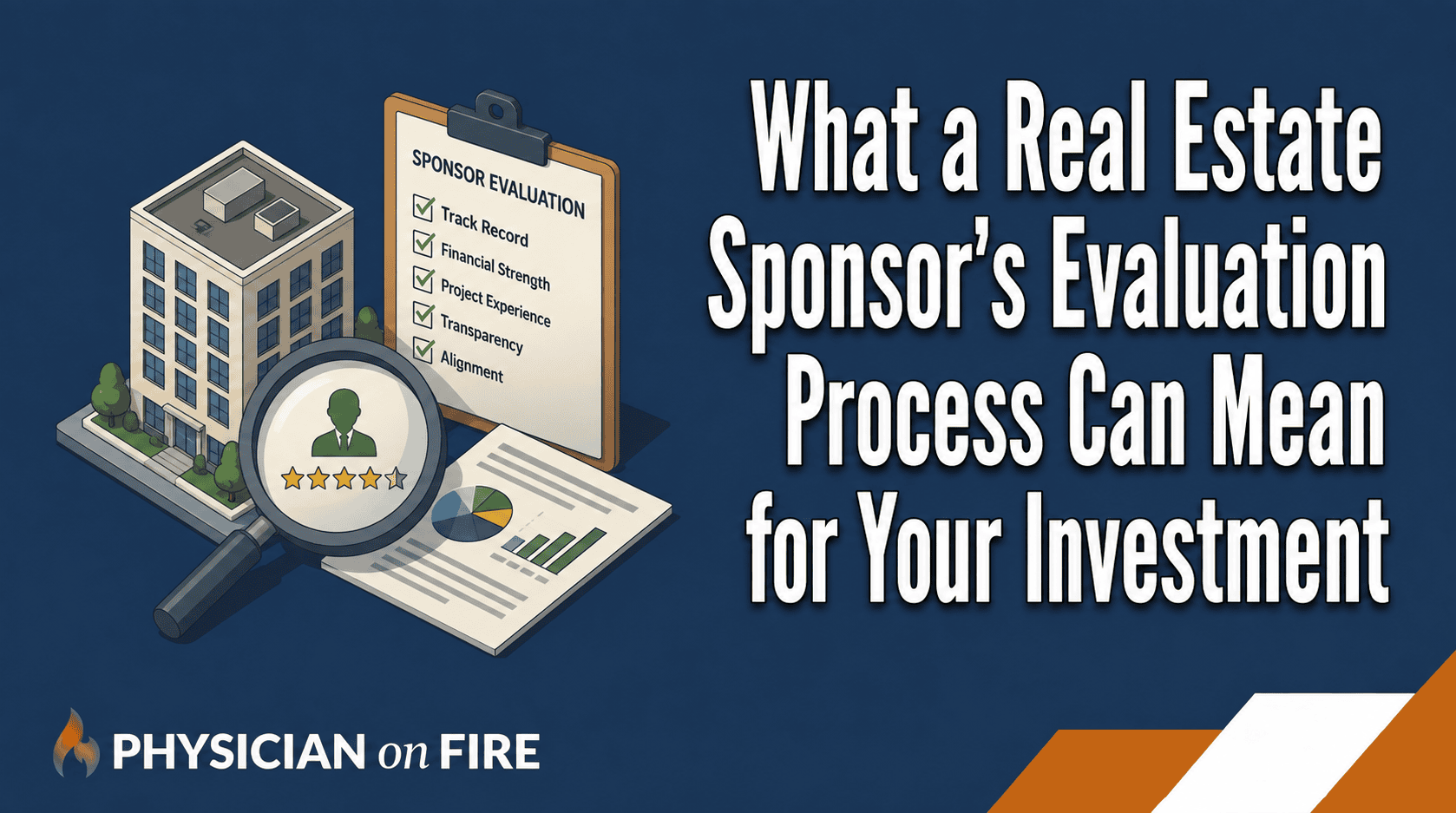
The following five areas tend to reveal whether a sponsor’s process is substantive or performed.
Does the Sponsor Have a Defined Lane?
One of the most reliable early indicators of a disciplined sponsor is whether they have a clear, consistent scope and whether they stay within it.
A sponsor who focuses on specific asset types in specific markets and a sponsor who describes themselves as “opportunistic across all asset types nationally” are not offering the same thing. The first has a defined edge they can articulate and defend. The second may be chasing volume.
In our experience, the sponsors who perform well across cycles tend to be those who understand their markets at a granular level, have operational infrastructure already in place there, and have navigated a downturn in that geography before. That depth of knowledge is difficult to replicate on the fly, and it rarely appears in a pitch deck.
When evaluating a sponsor, investors might ask: what product types do you focus on, which markets, and at what deal size? Then ask what deals they have passed on because those fell outside that scope. The answers will tell you whether the focus is genuine or simply marketing language.
Do They Have Real Market Conviction?
Once you understand a sponsor’s focus, the next question is whether their market conviction is substantive or surface-level. There is a meaningful difference between a sponsor who can explain why they are in a particular submarket and one who simply points to a favorable recent trend.
Credible location conviction tends to include several elements. A sponsor should be able to explain the demand drivers that may persist over the hold period, not just the ones that look favorable today. They should understand the barriers to new supply and what those barriers could mean for the competitive position of the asset. They should also have a clear view on the micro-location, because two assets in the same ZIP code can perform very differently depending on traffic patterns, proximity to demand generators, and access.

One practical way to test this: ask a sponsor what happens to the business plan if rents in the submarket come in flat for the first two years of the hold. The quality of that answer reveals how much of the return assumption depends on market tailwinds versus the sponsor’s own operational execution.
Does the Underwriting Hold Up Under Pressure?
Financial underwriting is where the gap between careful sponsors and careless ones tends to become most visible. The question is not whether the base case looks attractive. It’s whether the deal may still work in a downside scenario.
Disciplined underwriting typically means modeling what happens when vacancy comes in higher than projected, when rents grow more slowly than anticipated, or when the exit cap rate expands beyond the base assumption. In each of those scenarios, an investor should be able to see how the return profile changes and whether the deal may still produce an adequate return relative to the risk taken.
The line items worth scrutinizing include construction costs, real estate taxes, insurance assumptions, and the cap rate used at exit. These are the areas where optimistic assumptions tend to cluster. A well-underwritten deal should be able to absorb assumptions that are less favorable than current market conditions without requiring a perfect outcome to produce an acceptable return.
If a sponsor can only show you the upside case, that is worth noting. A deal that requires every assumption to perform as modeled is a fundamentally different risk profile than one that has been stress-tested against a range of realistic outcomes.
What Happens Before the Numbers?
Site and entitlement risk are areas where many passive investors have limited visibility, and where problems tend to surface late if they are not identified early in the evaluation process.
Before any financial analysis is meaningful, a sponsor needs to understand the physical realities of the asset or site: existing conditions, topography, utility infrastructure, and any environmental factors. A deal that looks strong on paper can fall apart when physical due diligence reveals complications the financial model did not account for.
Zoning and entitlements deserve particular attention. An asset that requires a rezone introduces a layer of timing and political risk that changes the character of the investment in ways that are difficult to price accurately. Entitlement timelines are unpredictable, and delays carry a real cost that may not be reflected in the original underwriting.
For deals that involve a co-sponsor or operating partner, that relationship warrants the same scrutiny as the deal itself. The co-sponsor’s track record in the specific product type and market, their alignment in terms of capital committed to the deal, and whether their incentive structure creates genuine shared accountability are all material considerations.
Are You the Right Investor for This Deal?
This is the filter most sponsors skip, and its absence is a meaningful signal.
Investors have their own specific investment objectives. Not every deal is suited to every investor, and a disciplined sponsor should think carefully about the fit between the opportunity and the investor before presenting it.

The hold period shapes nearly everything, including how the deal is structured, when distributions are expected to flow, and how liquidity is handled if circumstances change. An investor who may need capital returned in three to five years has different needs than one who can comfortably hold for seven to ten. These are not minor details to be resolved at the subscription documents stage. They should be part of the conversation before a commitment is made.
Physician-specific considerations worth raising include how the investment may be structured for tax efficiency, K-1 timing and whether the sponsor provides clear documentation, and how the passive income structure aligns with your broader financial situation. These questions don’t necessarily require deep real estate expertise to ask. They do require a sponsor who takes investor fit seriously enough to answer them directly.
The Discipline to Say ‘No’
In medicine, the value of a protocol is not tested when everything goes smoothly. It’s tested at the margins, when pressure is high and the temptation to skip a step is real.
The same is true in real estate investment. The value of an evaluation process is not in how it handles the straightforward cases. It is in whether it holds up when a deal looks attractive on the surface but fails one of the core filters.
A sponsor who declines to bring a deal to market because the entitlement timeline is too uncertain, because the underwriting only works in the optimistic scenario, or because the operating partner does not have the right track record in that market is demonstrating something important about their discipline. They have prioritized investor protection over the short-term incentive to deploy capital and collect fees.
Over 35 years, the pattern that stands out most clearly is not the deals that got done. It’s the ones that didn’t. The willingness to walk away from a deal that doesn’t fully clear the standard is what allows a sponsor to maintain consistent quality across market cycles, rather than accepting lower-quality opportunities during periods when better options are harder to find.
What Alignment Actually Looks Like
Alignment between a sponsor and a passive investor is often described in general terms. What it means in practice is worth being specific about.
Co-investment by the sponsor means the firm is putting its own capital into the same deal, on the same terms, as outside investors. When that’s the case, the downside consequences of a deal performing below expectations are shared. That’s a different structure than a fee-dependent model where a sponsor earns income from deploying capital regardless of how the investment performs.

It’s worth asking any sponsor directly: do you co-invest in every deal, and at what level? If co-investment is selective or token, the incentive structure looks different than if it is consistent and material across all opportunities.
Track record across market cycles is the other form of demonstrated alignment. A sponsor who has been operating through multiple economic cycles, not just in a recent favorable environment, has navigated the conditions where alignment is most tested. Performance through periods of dislocation reveals more about how a firm manages risk than performance during expansionary years.
Long-term investor relationships are also a useful signal. A sponsor whose investor base returns across multiple deals over many years is demonstrating that the experience of being an investor in their deals holds up over time.
Questions Worth Asking
Passive investing doesn’t mean uninformed investing. Before committing capital to any real estate sponsor, the following questions tend to produce useful signal:
How many deals did you review last year, and how many did you pass on?
The ratio between deals evaluated and deals closed reveals whether stated standards translate into actual selectivity.
Can you walk me through a deal you declined and why?
This reveals whether the evaluation criteria are real and consistently applied or retroactively used to justify decisions already made on other grounds.
What happens to the return if rents come in flat for the first two years?
This tests whether the underwriting has been stress-tested against realistic downside scenarios or whether it depends on assumptions that have to work out in order to produce an adequate return.
What’s the hold period, and under what circumstances could it change?
This surfaces the liquidity structure and whether the sponsor has thought carefully about the investor experience over the full life of the deal.
Do you co-invest in every deal, and at what level?
This gets to the alignment question directly and establishes whether the sponsor’s capital is actually at risk alongside yours.
How have you communicated with investors when a deal did not perform as expected?
Transparency during a difficult period is a better indicator of a sponsor’s character than communication during a period of outperformance.
A sponsor who answers each of these questions directly and with specifics is worth continued diligence. A sponsor who deflects, qualifies extensively, or cannot point to clear examples is giving you equally important information.
A Final Note
The discipline that makes a physician excellent at medicine and the discipline required to evaluate a passive real estate investment are not that different in kind. Both require a defined process, a commitment to following it consistently, and the judgment to recognize when the right answer is to pass.
As a passive investor, your role is not to replicate the sponsor’s process. It’s to evaluate whether their process is real. The questions above give you a framework to do that without requiring a background in commercial real estate.
The goal isn’t to find a perfect deal. It’s to find a sponsor whose process you can understand and trust.
This content is for educational purposes only. Securities offered through North Capital Private Securities, Member FINRA/SIPC. Its Form CRS may be found here and its BrokerCheck profile may be found here. NCPS does not make investment recommendations and no communication, through this platform, Realberry’s website or in any other medium, should be construed as a recommendation for any security offered on or off this investment platform. Realberry’s website is intended solely for qualified investors. Certain statements may be forward-looking and involve risks and uncertainties, and actual results may differ. Investments in private offerings are speculative, illiquid, and may result in a complete loss of capital. Past performance is not indicative of future results. Neither Realberry nor NCPS provide investment, legal, tax, or accounting advice and do not act as a fiduciary to you. Prospective investors should conduct their own due diligence and are encouraged to consult with a financial advisor, attorney, accountant, and any other professional that can help them to understand and assess the risks associated with any investment opportunity.