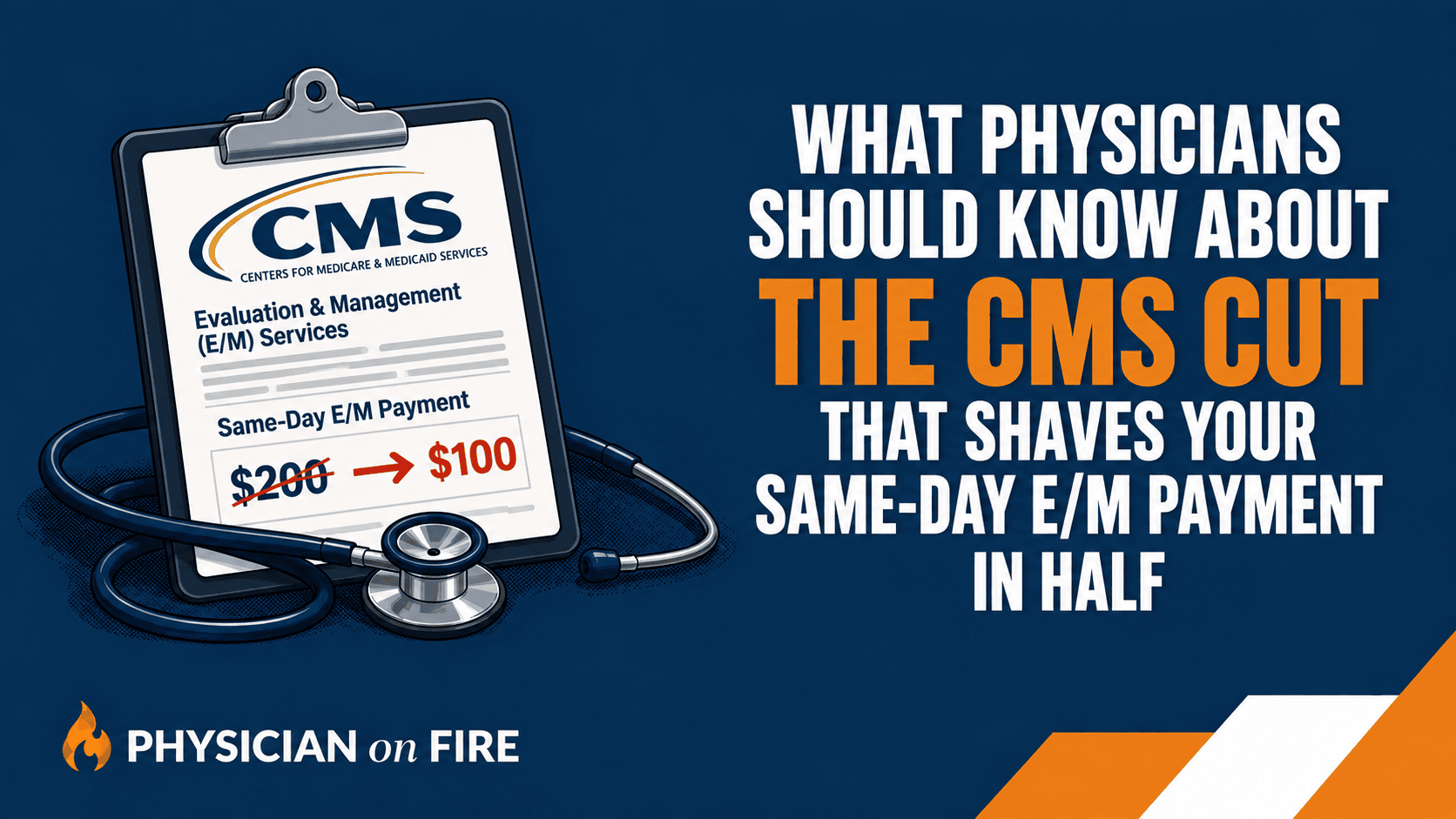
By now you must have heard that CMS wants to cut your reimbursement for a same-day office visit by 50%. This proposal was sneakily tucked inside a routine fee schedule update but is anything but.

If it survives, it would reach into exam rooms nationwide and directly affect how physicians get paid for seeing a patient with more than one problem in a single visit.
Let’s talk about what this means for you and the FIRE plan building on the basis of your physician income.
Also read:
- The Medicaid Cuts Are Already Hurting Healthcare Jobs
- How States Are Tackling America’s Physician Shortage
- Mid-Year Financial Checkup for Physicians: Are You on Track in Big 2026?
- “I’d Testify, But I’m Not Senior Enough” and Other Physician Misconceptions About Expert Witness Roles
The Proposed CMS Cuts
On July 14, 2026, the Centers for Medicare & Medicaid Services released its Calendar Year 2027 Medicare Physician Fee Schedule proposed rule.
Buried inside is a provision CMS calls “accounting for overlap between stand-alone E/M visits and global periods,” which relates to modifier 25. Modifier 25 is a medical billing code that indicates a significant, separately identifiable evaluation and management (E/M) service provided by the same physician on the same day as a procedure.

Currently, physicians append modifier 25 when they perform a significant, separately identifiable office or outpatient E/M visit on the same day as a procedure carrying a 0-, 10-, or 90-day global surgical period.
Medicare pays both services in full when the documentation supports it. The proposed rule states that whichever service costs more, the E/M visit or the procedure, will be paid in full (100%), while every other service billed that same day will only be paid in half (50%).
Today, a dermatologist who evaluates a new, unrelated rash and removes a suspicious mole during the same visit will be reimbursed for both services in full. Under the proposal, only the higher-valued code will be paid in full.
CMS is accepting public comments until September 14, 2026. The final rule will be announced in November with changes taking effect the following January 1 if adopted as written.
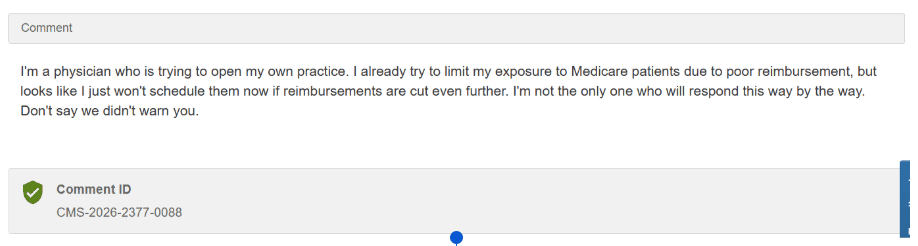
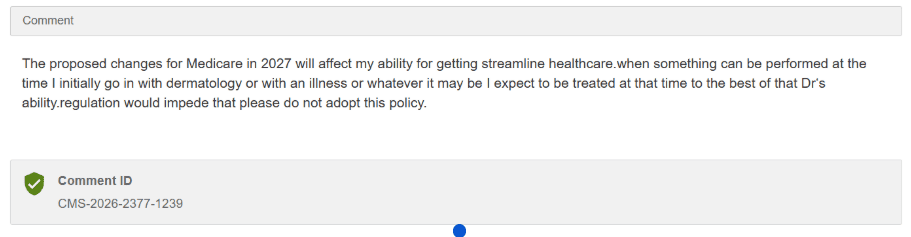
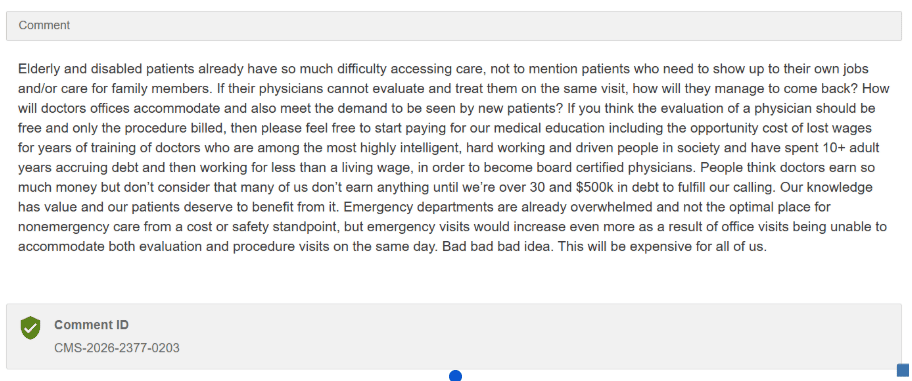
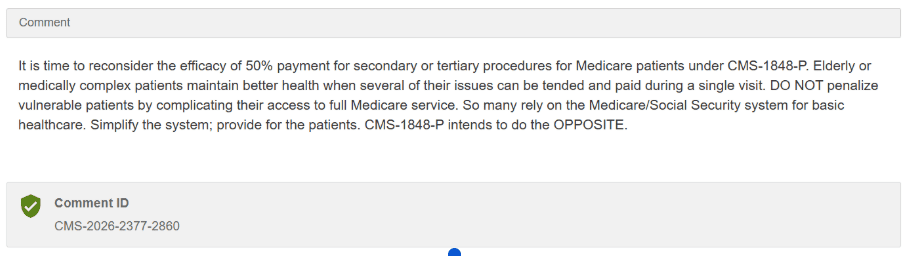
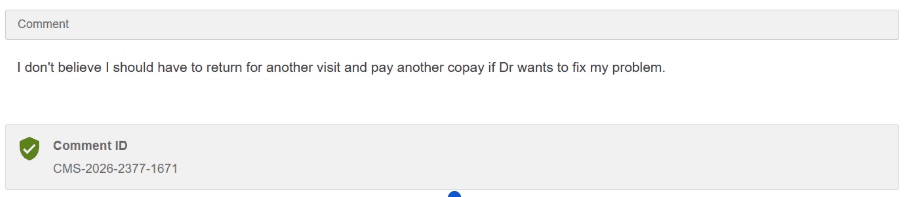
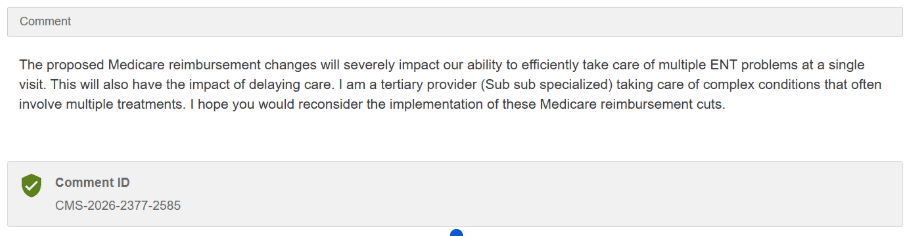
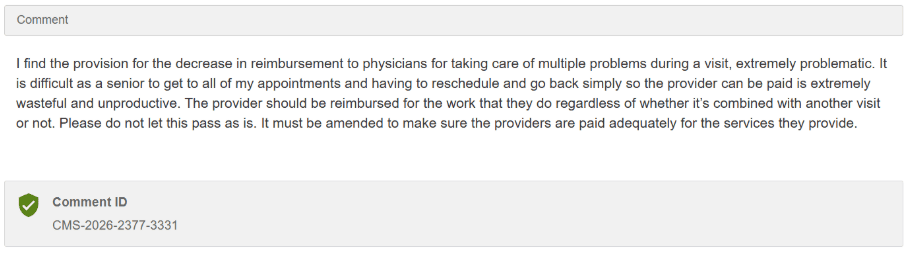
Here are just a few of the 24238 comments that have been posted:
 |
 |
 |
 |
 |
 |
 |
Another part of the same proposal wants to trim the conversion factor itself. Every year Medicare decides how much a dollar is worth for physician pay. That number is called the conversion factor.
Every service you bill has a point value attached to it called an RVU and Medicare multiplies that point value by the conversion factor to calculate your payment. If the conversion factor rises, every single service you bill pays more, and vice versa.
For 2027, CMS wants to lower that number. Physicians in an alternative payment model (APM), meaning practices that get paid partly on cost and quality outcomes rather than a straight fee for each visit, would see their conversion factor drop by about 1.2%.
Everyone else, the majority of physicians still billing the traditional way, would see a drop of about 1.7%
Your paycheck stands to receive a flat percentage trimmed off the top and then a second cut layered on top of that for any day you see a patient for two things at once.
In case you missed it: Medicare Physician Payment Cuts 2025: 2.8% Reduction Impact and What Doctors Need to Know
Why CMS Says the Cut Is Necessary
CMS argues that the current payment method counts physician work twice since E/M resources are already built into the global surgical package’s valuation.

The agency believes part of what a same-day visit pays for is already baked into the procedure’s own reimbursement so paying both in full amounts to paying twice for overlapping effort.
The American Medical Association disagrees — loudly. The AMA points out that Medicare already has a process for resolving genuine payment overlap.
Physicians and specialty societies work through the AMA/Specialty Society Relative Value Scale Update Committee, alongside CMS, specifically to review whether procedures already account for related E/M work.
That process already exists and the AMA wants CMS to use it code by code, rather than apply a 50% cut across the board.
CMS floated a version of this same idea in the 2019 fee schedule, limited to a smaller set of procedures.
After physician groups pushed back during the comment period, CMS dropped it. The 2027 version is back, covering more procedures than the 2019 attempt did and that too without a clear public explanation for what changed CMS’s thinking between then and now.
What This Means for Healthcare Access
The AMA’s chief worry is what a cut this size will do to practices. Independent, office-based practices carry the cost of clinical staff, supplies, and equipment tied to patient care, and CMS’s own example shows the proposed reduction could push payment for some services below the direct cost of providing them, before even accounting for the physician’s own time. A practice that loses money on a service eventually stops offering it, starts referring patients elsewhere or outright closes.
The AMA is urging CMS to reject the 50% cut warning it threatens the viability of independent practices nationwide and could reduce patient access to care, particularly in rural and underserved communities that heavily depend on said practices.
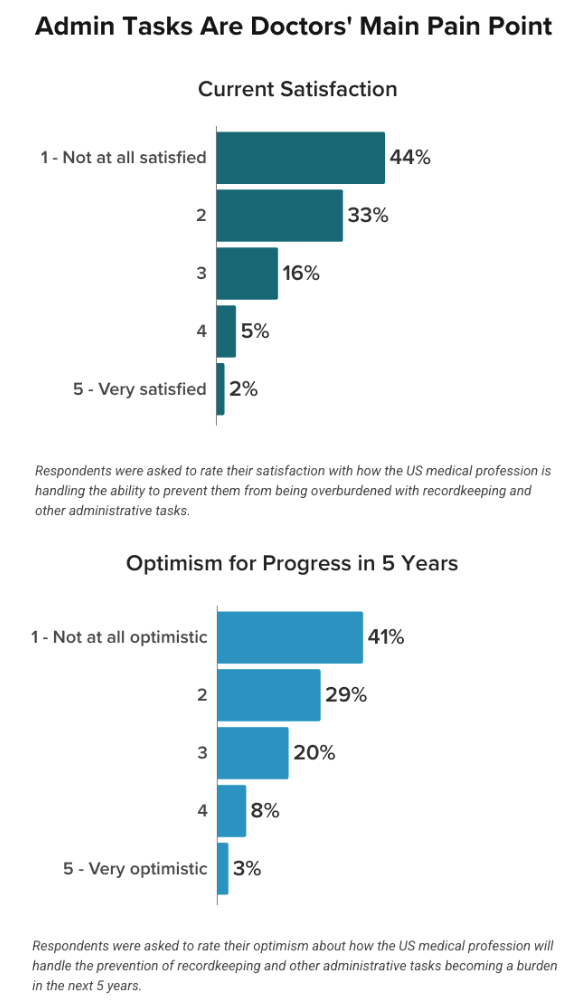
The AAMC projects a national physician shortage of up to 86,000 by 2036 with rural areas seeing the worst of it. Physicians report their lowest satisfaction with recordkeeping and administrative tasks.
The AMA estimates that documentation and admin work takes up about 35% of a doctor’s working week. Add in a payment structure that penalizes efficient, same-day care, and the incentive tilts toward scheduling a second visit for a second problem instead of handling both at once.
Source: Medscape
If you go through even a couple of the public comments submitted to the CMS docket, like I have, you’ll see who stands to lose the most if this rule goes into effect. It’s elderly patients and those managing chronic disease.
A senior with failing strength or a mobility issue doesn’t have the easiest time arranging a second trip. A second visit also means a second co-pay for care that used to fit into one. Patients wait longer. Practices see fewer people per day. Nobody comes out ahead.
What This Means for Your Practice
If you own a practice or work in one that bills using modifier 25 this proposal directly affects your bottom line.
CMS pays the highest-valued service at 100% and knocks everything else down to half, so the size of the hit depends entirely on how often you legitimately bill both a same-day E/M visit and a procedure for the same patient.

Some specialties do this constantly. Others rarely touch it. Here’s who takes the biggest hit:
- Dermatology: Frequent pairing of a full-skin evaluation with a same-day biopsy or excision means a large share of daily billing runs straight through this cut.
- Otolaryngology: Office-based procedures paired with same-day E/M visits for ear, nose, and throat complaints are a routine part of the specialty’s workflow.
- Podiatry: High-volume same-day procedures, from nail care to wound debridement, layered onto evaluation visits, put podiatry squarely in the crosshairs.
- Ophthalmology: Same-day minor procedures alongside comprehensive eye exams follow a similar billing pattern.
- Orthopedics and hand surgery: Joint injections, splinting, and minor procedures performed during the same visit as a new evaluation carry global periods that trigger the cut.
- OB/GYN, family medicine, and urgent care: High patient volume and frequent same-day procedures (IUD placement, wound repair, joint injections) mean broad exposure even without a single dominant procedure type.
A 50% reduction on one service might look minor form an individual claim’s point of view but when multiplied across a full patient panel over a year, it can result in a material dent in take-home revenue. And that’s on top of a declining conversion factor, mind you.
Learn more: Physician Side Gigs That Actually Pay in 2026
What This Proposed Cut Means For Your FIRE Timeline
The fact this proposal comes at a time when reimbursement is already declining is a reminder of what I’ve been saying all along. Physician compensation isn’t always predictable and betting your entire financial plan on stable government reimbursement is a bet you don’t control.
CMS walked back on a similar proposal in 2019 but still brought it back in 2026 with confidence. That’s not a one-time event. Reimbursement policy will always shift with budget pressure, administrative priorities and political turnover.
Physicians rarely get much warning before a rule takes effect. If you’re building a financial plan that assumes your income holds steady at today’s payment rates for the next 15 or 20 years, think again.
Odds of a recession climbed as high as 49% earlier in the year by some estimates before easing back down. Do I want you to panic? Not at all. All I’m asking is that your FIRE number should account for policy risk as well as market risk.
Would your savings rate survive a reimbursement cut without derailing your timeline? Are your expenses flexible enough to absorb a bad year in Medicare payment policy?
Don’t bank on certainty from CMS in order to build your road to FI (Financial Independence). Take control of your finances before it’s too late.
Also read: Gen Z is Giving Up On The American Dream and Your FIRE Goals Just Got More Urgent
Frequently Asked Questions
What is CMS proposing for same-day E/M visits?
CMS proposes paying the highest-valued service in full and reducing other eligible services billed the same day to 50%.
What is modifier 25 in medical billing?
Modifier 25 identifies a significant, separately identifiable E/M service performed on the same day as a procedure.
When would the proposed Medicare payment cut take effect?
If CMS adopts the proposal, the changes would take effect January 1, 2027.
Which medical specialties would the CMS cut affect most?
Dermatology, otolaryngology, podiatry, ophthalmology, orthopedics, and several primary care specialties could face significant exposure.
How would the CMS cut affect physician income?
The impact would depend on how often a physician bills eligible same-day E/M services and procedures, alongside the proposed conversion factor reduction.
Would the CMS cut affect independent medical practices?
Yes. Practices that rely heavily on same-day E/M billing could see lower revenue and face pressure to change how they schedule or provide care.
Why does the AMA oppose the proposed CMS payment cut?
The AMA argues that CMS should review potential payment overlap code by code rather than apply a broad 50% reduction.
How could the CMS cut affect patient access to care?
Lower reimbursement could make some services less viable for independent practices, potentially leading to fewer appointments, more referrals, or practice closures.
How could the CMS cut affect a physician’s FIRE plan?
A sustained reduction in reimbursement could lower savings and investment contributions, making it harder to reach financial independence on the original timeline.
Where can physicians submit comments on the CMS proposal?
Physicians can submit public comments through the Federal Register before the September 14, 2026 deadline.