Originally published on Of Dollars & Data

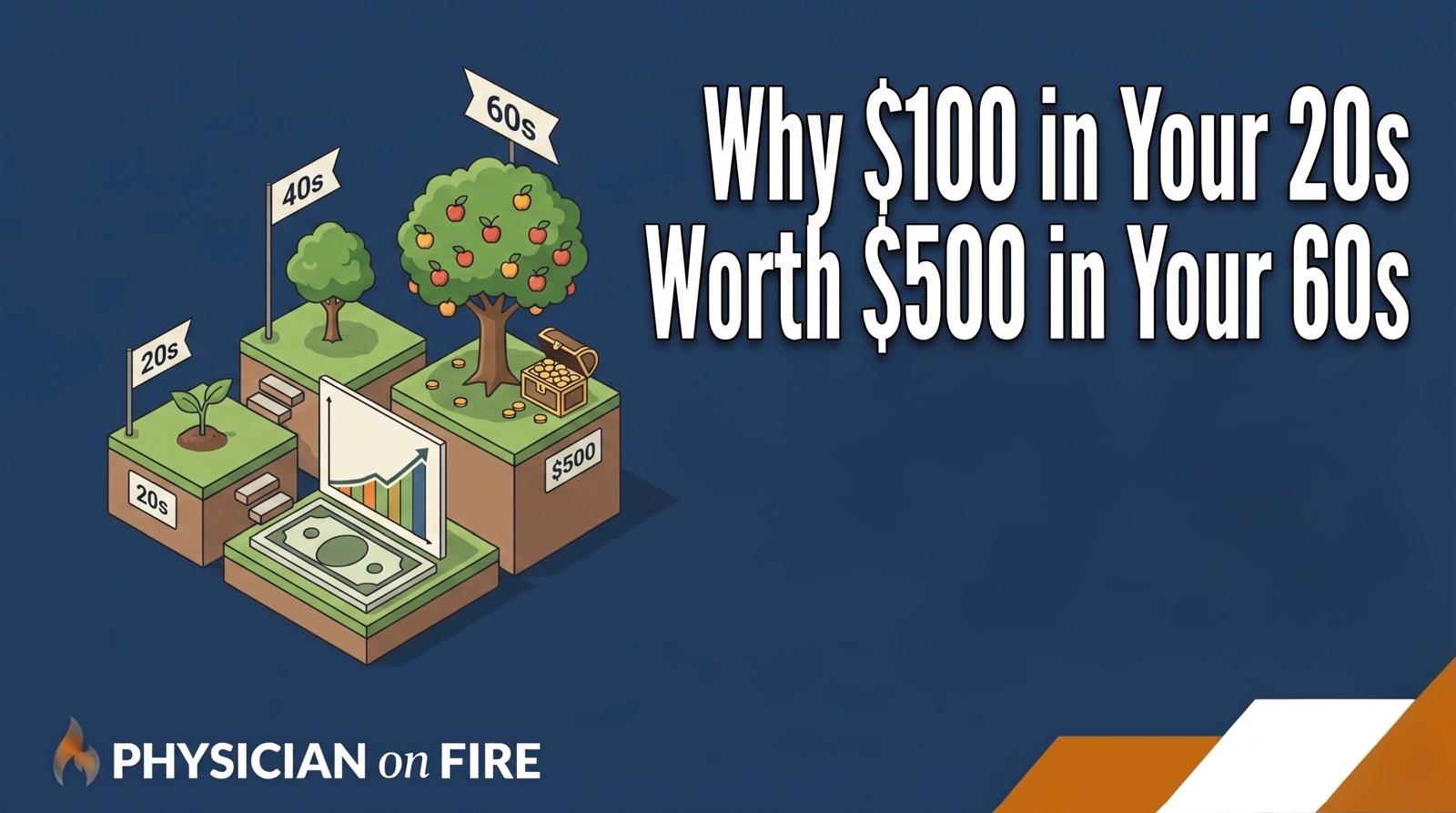
What if I told you that $100 at 25 is worth $500 at 65, even after we adjust for inflation?
Well…it is.
There’s an unspoken belief in personal finance that a dollar is always worth a dollar (putting inflation aside). We assume that spending $100 today would bring the same amount of joy as spending $100 (inflation-adjusted) in the future. But it won’t.
Why?
Because of how we experience time as we age. And it took a French philosopher from the 1800s to help me understand why.
Why Spending Becomes Less Valuable with Age
In 1877 the French philosopher Paul Janet put forth a new idea about why time seems to speed up as we age. He proposed that “the rate of passage of subjective time is proportional to the age of the person making the judgement.”

In other words, younger people experience time more slowly because they have lived less total life than older people. When you’re 10 years old, one year is 10% of your life. By the time you’re 50, one year is only 2% of your life. This difference, Janet proposed, is why our perception of time seems to increase as we get older. Each additional year reduces the novelty of lived experience, making time seem like it is going faster.
George Mack shared this visual of “Janet’s Law” for someone born in 1990:
 As you can see, the first five years of your life take up roughly as much perceived time as early adulthood (6-21) and the rest of your life (22-80).
Janet’s Law is directionally accurate, but needs to be adjusted for one thing—memory. Most of us have little to no memories of our early childhood, so our perception of these early years as adults is basically non-existent. Research on memory agrees with this. Older adults consistently seem to have a reminiscence bump (or enhanced memory) of ages 10-30.
If we adjust Janet’s Law to start at age 10 to take into account this reminiscence bump, then when you’re 20, one year represents 1/10th (or 10%) of your “memorable” life. This also means that, when you’re 60, one year represents 1/50th (or 2%) of your memorable life.
Adjusting for the reminiscence bump, your perception of time would look like this:

Now, most of your perceived life comes in childhood, followed by young adulthood, and so forth. It also means that your 20s occupy 5x more of your perceived life than your 60s.
You can see this in the chart below which shows the percentage of your overall memorable life that each year represents (through age 80):

As you can see, age 20 represents 2% of your memorable life while age 60 is 0.4%, or about 1/5 as much.
This simple observation has profound implications for how you spend your money throughout your lifetime.
After all, if a year in your 20s occupies 5x more of your perceived life than a year in your 60s, then any money you spend in your 20s should be worth 5x more to you in terms of experiential value.
Yes, perceived time is not the same as experiential value, but the two are closely linked. Years that occupy more of our perceived life are years that shape our identity more and that we remember more vividly. So, if experiences are valuable partly because we relive them through memory, then years with more perceived time should also pay the highest experiential dividend.
This matches my experience going to restaurants in my 20s and early 30s. In my 20s going out was fantastic. Everything was new and fresh. But by my mid-30s, fancy restaurants started to lose their appeal. As I wrote previously, “my 60th dry-aged ribeye didn’t taste as good as my first.” The habituation to novel experiences makes spending money earlier in life more valuable than later in life.
But this creates a problem—if money buys us better experiences while younger, why should we save for old age?
Should We Spend More Money in Our 20s?
So far we’ve determined that spending money earlier in our lives gives us a bigger experience payoff than that same money spent later in life. Does this imply that we should spend all of our money earlier in time to maximize our experiences?
No.

The issue with this approach is that it doesn’t take into account the compounding we give up along the way for every dollar we spend now. So while $100 in our 20s may be worth 5x more (perception-wise) than $100 in our 60s, due to compounding that $100 in our 20s can become much more than $100 in our 60s.
How much more? Well, it depends on your rate of return. If we assume that you can get a 4% inflation-adjusted return for 40 years, then every dollar invested today will become about $5 in real terms in 40 years. Note that this basically matches the 5x perception premium of spending money in your 20s versus your 60s!
Therefore, with a 4% real rate of return, spending $100 at 25 is roughly equivalent (experience-wise) to investing that $100 for 40 years and spending $500 (inflation-adjusted) at 65.
Of course, this is with a 4% real annual return. If you believe that you could earn more than 4% real per year, then investing your money will provide more experiential value in your 60s than spending it in your 20s. The opposite is also true. If you would earn less than 4% real per year, then you’d get more experiential value by spending your money in your 20s than investing it for your 60s.
This demonstrates how your view of the future can influence your spending habits today. For example, if you don’t understand (or don’t believe) in investing, then your money is worth more today than it ever will be in the future.
But there’s a cruel irony to this worldview—the years where your money has the highest experiential return (your 20s) are also the years where you have the least to spend.
On the flip side, if you can earn high returns via investing, then you should save as much as possible to consume more in old age. There’s an irony to this approach as well—the data suggests that those who are great savers (and investors) end up not spending the money they worked so hard to acquire in retirement. Blowing all your money while young isn’t a smart move, but hoarding money now that you won’t spend later is worse.
This doesn’t mean that you should stop investing if you’re young or that you should strive to die with zero if you’re old. But you shouldn’t feel guilty about spending money on experiences, especially while younger. As Jack Raines wrote in Young Money (his new book out today):
Money can buy a lot of things, but it can’t buy back the opportunities and experiences of one’s youth.
This is even more true when we take into account our inevitable physical decline. Many life-changing experiences (e.g., traveling the world, running a marathon, playing with your kids/grandkids, etc.) require good health. Without the ability to physically enjoy such experiences, they are worth much less. Beyond the perception argument, our declining health provides further evidence that we should spend more while younger.
So enjoy the big trip or the front row concert tickets while you still can. I promise the experience will be worth it.
Thank you for reading.