Public Service Loan Forgiveness is still exactly what it was in 2007. Anyone who works for a qualifying employer and makes 120 qualifying payments can get whatever debt’s left forgiven tax free.

The One Big Beautiful Bill Act didn’t tamper with that core structure (though, not for lack of trying).
However, some things have changed: which repayment plans count, what a qualifying employer looks like on paper, how much a missed month costs you, and what it actually costs to buy back time you lost along the way.
Here’s everything a physician looking at PSLF in 2026 needs to know.
More useful information:
- Beyond PSLF: Additional Student Loan Forgiveness Programs
- The 7 Advantages of a Solo 401(k) Over a SEP IRA
- Fast FIRE: Achieving Financial Independence in 5 Years
- We Can’t All Be Boomers: The New Economics of the American Dream
For The Uninitiated
PSLF forgives your remaining federal loan balance after 120 qualifying monthly payments, or 10 years, made while working full time for a qualifying employer.
Qualifying employers are government agencies at any level and 501(c)(3) nonprofits. Most academic medical centers, public hospitals, and nonprofit hospital systems qualify.
For profit hospital systems, including many large regional networks that operate like nonprofits but are structured as LLCs or corporations, do not, regardless of the actual work you’re doing there.
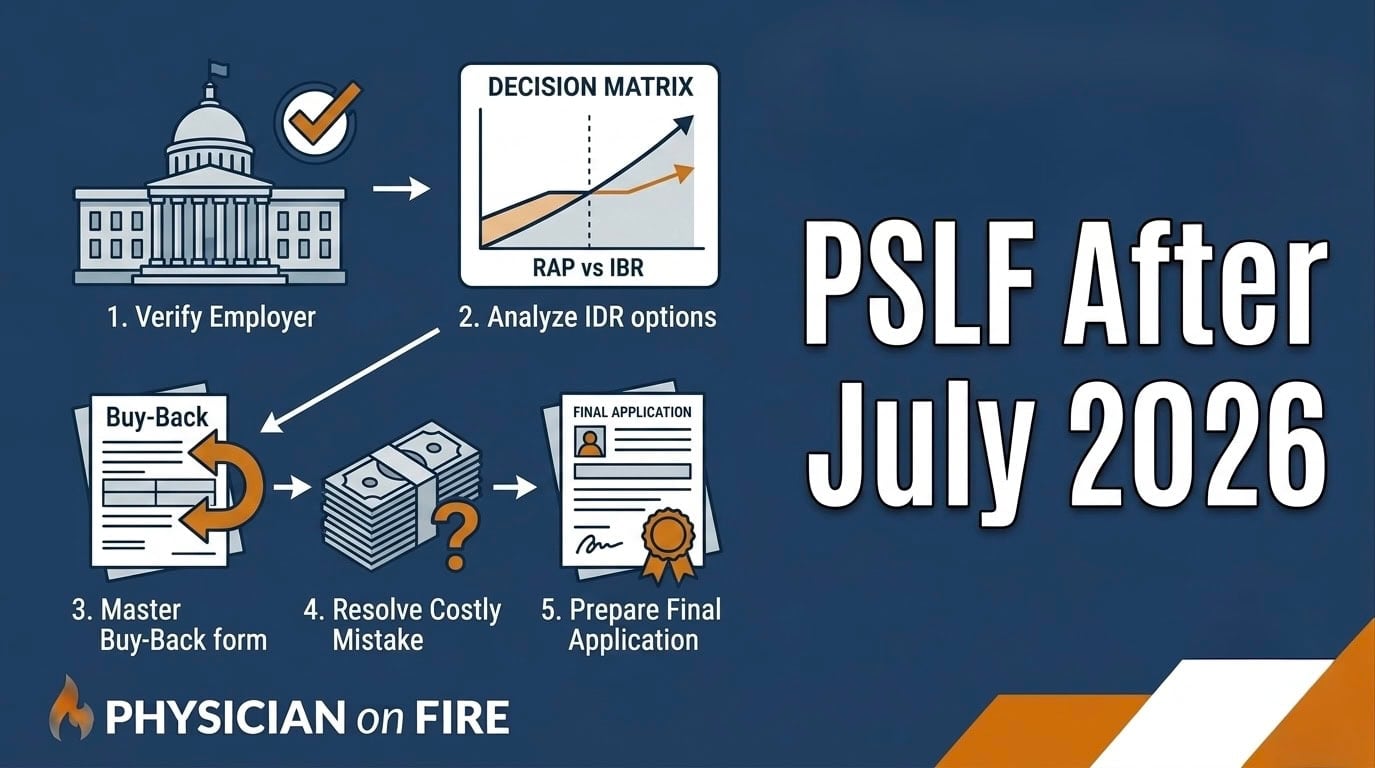
Checking your employer’s status before you build a decade of planning around it is the single most important thing a physician can do at the start of this process, and it’s free to do through the PSLF Help Tool at studentaid.gov.

Forgiveness under PSLF is not taxable at the federal level. That makes it worth more than IBR or RAP’s own forgiveness tracks, both of which produce a taxable event on whatever balance remains after 20 to 30 years.
Changes to PSLF on July 1, 2026
Four changes took effect simultaneously.
- RAP launched and consequently became the only income driven plan available to anyone taking out a new federal loan.
- The new Tiered Standard Plan launched as well, but time spent on it doesn’t count toward PSLF at all.
- A rule letting the Education Secretary disqualify certain nonprofit employers took effect on paper, then got blocked by two federal courts before it could actually bite. More on that later.
- And finally, Parent PLUS borrowers who hadn’t consolidated by June 30 lost their path into PSLF permanently.
Going forward, these changes affect what PSLF entails for anyone still finishing training or about to pick a repayment plan for the first time.
The Employer Eligibility Rule is Blocked — For Now
The rule would have let the Department disqualify an employer found to have a “substantial illegal purpose.” It was finalized in October 2025 and scheduled to take effect on July 1, 2026. Two federal judges struck it down in June, just before it went into effect.
The Department has said the employer certification language tied to the rule won’t be enforced while it updates PSLF forms to comply with the court order. Whether the government appeals is still open, and no one can promise it won’t.
For most physicians this is a non-issue. Standard hospitals, clinics, academic medical centers, and government facilities were never the intended target of this rule.
If your employer’s mission touches something the current administration might view as legally contested, say, immigration services, reproductive health work, certain advocacy arms attached to a hospital system, submit an employment certification form now regardless of when you last did one.
If the rule ever does take effect, months worked before any disqualification determination stay protected. Only months worked after a determination would be at risk.
Which Loan Repayment Plans Still Count
Whether or not your payments count moving forward depends entirely on when your loans were disbursed.
If every loan you hold was disbursed before July 1, 2026, you keep access to IBR and can opt into RAP. Both count fully toward PSLF. PAYE and ICR are technically still open for those already enrolled, but both plans are set to disappear entirely by July 1, 2028.
If you’re on either one now, that’s a fine place to stay temporarily, but not for long.
If any of your loans were disbursed on or after July 1, 2026, RAP is your only income driven option, and it does count toward PSLF. The Tiered Standard Plan does not. The Tiered Standard Plan also happens to be the default plan a new borrower lands on if they don’t actively choose something else.
Former Education Department official Rich Williams flagged this as a risk. Borrowers who assume their repayment plan is automatically handling PSLF for them are often wrong, and the mistake is invisible until years of payments turn out not to have counted.
IBR vs RAP, Specifically For PSLF
Both plans reach forgiveness at 10 years under PSLF, regardless of each plan’s own separate forgiveness track. What differs along the way is your monthly bill, which for physicians specifically can mean a difference of thousands of dollars a year.
Travis Hornsby, CFA, CFP, gives us an example of a urologist earning $500,000 with $300,000 in loans. On RAP, their payment lands around $4,000 a month, roughly 10% of income with no ceiling.
On IBR, the payment caps around $3,000 a month, close to what the standard 10-year repayment amount would be on that balance. That cap, which Hornsby approximates as roughly 1% of your loan balance per month, is the entire reason IBR usually beats RAP for high earners whose debt isn’t wildly out of proportion to their income.
The reverse can also be true. A physician carrying an unusually large balance relative to income, a second degree, a long training pipeline, an expensive private school, may find the cap doesn’t help much because the standard 10-year payment on that balance is already way too high.
In that case RAP’s flat percentage of income can come in lower.
Learn more
There’s really no example that can substitute for running your own balance and income through both formulas before choosing.
Also note that RAP comes with an interest waiver that cancels any unpaid interest that a borrower’s payment doesn’t cover each month, so the balance doesn’t grow beyond what’s already owed. IBR doesn’t offer that protection.
Once you’re locked into a 10-year forgiveness timeline through PSLF, that difference matters less than it would for someone paying the loan off on their own, since whatever interest accrues gets forgiven along with the principal at the end of 120 payments.
The difference in monthly cash flow is what actually matters for a PSLF borrower, not the long run cost of the loan.
The One Way Street From IBR To RAP
Payment history earned on IBR carries over if you move to RAP later, but the reverse is not true. Months spent on RAP don’t count toward IBR’s own forgiveness timeline if you decide to switch back.
For PSLF purposes this specific asymmetry doesn’t matter, since PSLF counts a qualifying payment as qualifying no matter which eligible plan produced it.
But if PSLF falls through for some reason and you end up needing IBR’s own 20 or 25 year forgiveness as a fallback, switching from IBR to RAP can be catastrophic and should be treated as a one way door.
There’s also a hard enrollment deadline attached to IBR itself, separate from anything about new borrowing. Existing borrowers who want to keep IBR available have to actually enroll in it by July 1, 2028.
Sitting on PAYE or ICR past that date without ever formally switching into IBR closes the door permanently, and RAP becomes the only option left.
New Borrowers After July 2026
Medical students starting this fall are capped at $50,000 a year in federal loans and $200,000 total, with Grad PLUS gone entirely, per the AAMC.
Living costs beyond that cap typically get filled with private loans, which don’t carry PSLF eligibility under any circumstances.
Hornsby estimates most graduating medical students under the new limits will owe around $230,000 by graduation once interest during school is factored in.
For these borrowers, RAP is the only federal plan that keeps PSLF alive, but before you count on it, know that RAP payments are calculated off your prior year’s tax return, so a new attending’s bill doesn’t jump to a full attending-level payment the moment residency ends.
It phases in gradually over roughly the first few years out of training, since the income on file still reflects a lower resident or fellow salary for some time after the actual raise happens.
That provides an advantage in the early attending years and is worth consideration during your early career when other goals require your attention as well.
The PSLF Buyback Program
If time in SAVE’s administrative forbearance, or any other period of deferment or forbearance, would otherwise count against your PSLF progress, the Buyback program lets you retroactively purchase credit for those months with a lump sum payment.
It’s a different mechanism from a qualifying payment made in real time, but the credit counts the same way once approved.
The cost of buying back a month changed materially this year. Through March 2026, buyback amounts for SAVE forbearance months were calculated using the SAVE formula, which produced the lowest payments of any plan available.
On March 31, the Department switched to calculating those amounts using IBR, PAYE, or ICR instead, according to Forbes.
One example in that reporting showed a borrower’s monthly figure jumping from SAVE levels to roughly $640 a month under IBR, pushing the cost of a 20-month buyback to around $12,800.
Earlier periods of forbearance, generally before July 2024, still get calculated under whatever rules applied when those months actually occurred.
Roughly 88,000 buyback applications were still pending as of the Department’s own court filings, though officials have disclosed that a meaningful share of that number are duplicate submissions from borrowers who filed more than once.
Processing typically takes several months to a year. If forbearance months matter to your PSLF timeline, file the request regardless of the queue length. Waiting doesn’t lower the price, and every month you delay is a month you’re not credited.
Keep making payments on your current qualifying plan while you wait. If you cross 120 qualifying payments on your own before the buyback processes, the buyback request closes out as unnecessary, and you get forgiveness the ordinary way.
A related program called Temporary Expanded PSLF still technically exists for specific borrowers: those who made 120 payments on the wrong plan, Graduated, Extended, or certain Consolidation plans, and were denied for that reason alone.
There’s no separate application. Submitting the standard PSLF form automatically considers a borrower for both PSLF and TEPSLF if the payment history fits.
Certifying Employment and Denied Applications
Submitting the form through the PSLF Help Tool does two things at once. It certifies that a specific employer qualifies, and it locks in credit for every qualifying month worked through the date of filing, regardless of what happens to that employer’s eligibility later.
Make it a habit to file once or twice a year, even when nothing about your job has changed. This creates a paper trail that survives servicer errors, which are common, and it means that any dispute over your count only ever concerns the most recent 6–12 months rather than a decade of history.
Keep your own copies of every submitted form, along with pay stubs and any payment confirmations from your servicer.
Servicers do lose or miscount payments, and the burden of proof in a dispute tends to fall on the borrower. Don’t just assume that the system will get it right.
The most common reasons PSLF applications have historically been denied are a shortfall in qualifying payments, an incomplete application, or loans that were never eligible to begin with, most often FFEL or Perkins loans that were never consolidated into a Direct Loan.
FFEL and Perkins loans do not qualify for PSLF on their own under any circumstance. Consolidating them into a Direct Consolidation Loan fixes that.
If a denial happens for a reason that looks like an error, say an employer wrongly marked as ineligible, a miscounted payment, a processing mistake, you can go through PSLF Reconsideration to correct it without starting the 120-payment count over.
Is PSLF Actually Worth It For a Physician
Here’s where actual calculations matter more than assumptions and vibes.
Hornsby ran a scenario for a physician starting medical school in 2026, finishing a four-year residency, and earning $300,000 as an attending. Under the new RAP-only path for post-2026 borrowers, total payments over 10 years came to roughly $195,000 against an estimated $230,000 starting balance.
Refinancing that same balance privately and paying it off over five years at a 4% rate was estimated to cost around $254,000 including interest.
The value of pursuing PSLF in that scenario works out to roughly $59,000, which he deems as something like $10,000 a year in after tax value over six years as an attending, or $15,000 to $20,000 in pre-tax salary equivalent.
That’s real money, but it’s a fraction of what PSLF was worth to physicians under the old rules, when unlimited borrowing through Grad PLUS combined with SAVE’s low payments could make forgiveness worth well over $100,000 for some specialists.
Practically speaking, PSLF hasn’t stopped being worthwhile, but its pursuit now genuinely competes with private practice compensation in a way it didn’t a few years ago. It’s very very important to run your own numbers, rather than assuming that forgiveness is the best option there is.
If you plan to moonlight, take locums shifts, or pick up 1099 work during residency or as an attending while pursuing PSLF, both RAP and IBR calculate payments off adjusted gross income drawn from your tax return, so additional 1099 income raises your monthly PSLF-qualifying payment the same way a W-2 raise would.
Factor the higher required payment into whatever the extra shift is actually worth to you.
PSLF is here to stay— for now. However, these changes signify that it’s not as bulletproof as it once was. Policy shifts can upend the whole thing at a moment’s notice. The payoff is great, yes, but so is the risk.
Frequently Asked Questions
Is PSLF going away?
No. Congress didn’t touch the underlying program. What changed is which repayment plans and which employer types count toward it.
Does the Tiered Standard Plan count for PSLF?
No. Only RAP and, for borrowers with loans disbursed before July 1, 2026, IBR count toward PSLF now.
Can I still use IBR for PSLF?
Yes, if every loan you hold was disbursed before July 1, 2026. You also need to enroll in IBR by July 1, 2028 to keep it available going forward.
Did the employer eligibility rule take effect?
It was scheduled to on July 1, 2026, but two federal courts blocked it in June before that date. It isn’t currently enforced.
Do RAP payments count toward PSLF?
Yes. RAP is a qualifying plan. PSLF forgives after 120 payments regardless of RAP’s own 30 year forgiveness track.
What happens if I switch from IBR to RAP?
Your payment history carries over. It doesn’t work in reverse. Time spent on RAP doesn’t count toward IBR’s own forgiveness timeline if you switch back later.
Are Parent PLUS loans still eligible for PSLF?
Only if they were consolidated into a Direct Consolidation Loan by June 30, 2026. That window is closed.
Does moonlighting or 1099 income affect my PSLF payment?
Yes. Both RAP and IBR calculate payments off adjusted gross income. Extra income raises your required monthly payment the same way a salary increase would.
What if my employer isn’t a 501(c)(3) or government entity?
It doesn’t qualify for PSLF, regardless of the work performed there. This includes many hospital systems structured as for profit entities. Check your specific employer through the PSLF Help Tool before building a plan around it.