
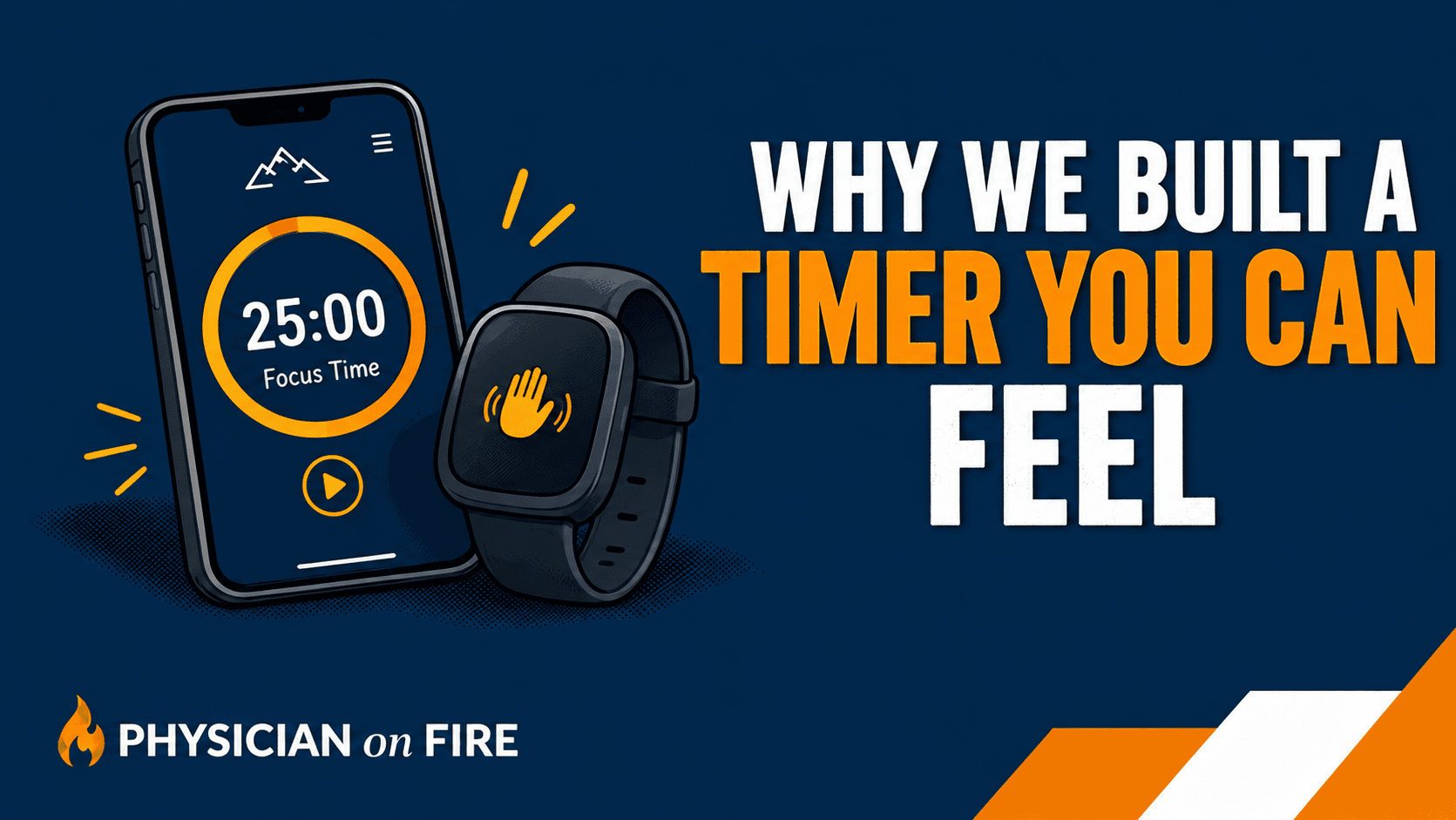
I originally built Haptica Timer for my wife, who is a physician.

Like many clinicians, she spends much of her day moving from one patient visit to the next. She is constantly balancing two responsibilities that can sometimes feel at odds: being fully present with the patient in front of her while also staying aware of a demanding clinic schedule.
She did not want to keep looking at the wall clock. She did not want to glance at her phone or repeatedly raise her wrist during a conversation. Even when those actions are completely innocent, they can make a patient feel rushed or leave them wondering whether the physician is still listening.
What she needed was simple: a quiet way to understand how much time had passed without visibly checking the time.
That was the starting point for Haptica Timer.
The original idea was to create subtle vibration cues that could be felt on the wrist without interrupting a conversation. Just as importantly, the timer needed to repeat automatically.
A clinician should not have to remember to start another timer before every appointment or continually manage an app throughout the day.
Instead, the timing pattern could follow the natural rhythm of the clinic schedule, repeating from one visit to the next.
The goal was never to force every patient encounter into a rigid block of time. Some appointments need more time, and physicians must always be free to respond to what the patient needs.
The goal was simply to give clinicians a private sense of where they were in the visit, reduce the need to manually track time, and help the day move more smoothly without taking attention away from the patient.
The rest of this article is written by Jorge Sanchez, one of my former co-founders at Alertive Healthcare.
A Familiar Moment in Clinic
A patient is explaining something important.
The appointment may have started as a routine follow-up, but another concern has surfaced. It deserves attention. At the same time, the clinician knows the visit is beginning to run long and that another patient is waiting.
This is a normal part of medicine. Patient visits do not always follow a predictable path.
The challenge goes beyond simply keeping appointments short. It is remaining engaged with the person in front of you while still respecting the time of every patient who comes afterward.
Most clinicians develop their own ways of managing this. They glance at the clock, check the computer, look down at a watch, or try to estimate how much time has passed.
None of these approaches is necessarily wrong, but they’re all rather visible.
Patients may notice when attention shifts, particularly during emotional, personal, or complicated conversations. Even a quick glance can change the feeling in the room.
At the same time, losing awareness of time can affect the rest of the clinic day. A few additional minutes across several appointments can create longer waits, less time for documentation, hurried transitions, and increasing pressure on both clinicians and staff.
The problem is not the clock itself. The problem is needing to continually look for it.
The Problem With Traditional Timers
A traditional timer is designed to capture your attention.
It makes a sound, displays a notification, lights up a screen, or requires you to look at it. Those features are useful in many settings, but they are not always appropriate during a medical visit.
An audible alarm would interrupt the conversation. A phone notification could feel out of place. A visible countdown could become another thing competing for the clinician’s attention.

The better solution was a less noticeable timer.
A subtle vibration could provide awareness without changing the conversation. The clinician could feel that a certain amount of time had passed and decide what, if anything, to do with that information.
That cue might prompt the clinician to summarize the discussion, confirm the care plan, address the patient’s final concern, or decide that the conversation needs to continue.
A Timer That Follows the Clinic Day
One of the most practical parts of Haptica is its ability to run repeating timers.
Clinic schedules often follow a regular cadence. Appointments may be scheduled in 15, 20, 30, or 40-minute blocks, sometimes with a short period between visits for documentation or transition.
Once the timing pattern is configured, the timer can repeat automatically.
This means the clinician does not need to start a new timer before every patient. There is no need to repeatedly open the app or remember to reset it as the day progresses.
For example, a physician might choose to receive one gentle cue when most of the visit has passed and another near the scheduled end. The timer can then pause briefly and begin the next cycle automatically for the following appointment.
This repeating pattern is important because it allows the timer to support the workflow without becoming another workflow to manage.
The experience is less like operating a stopwatch and more like maintaining a quiet awareness of the clinic’s rhythm.
Supporting a More Efficient Clinical Workflow
A typical appointment may include reviewing concerns, gathering relevant history, performing an examination, discussing options, answering questions, agreeing on a plan, documenting the encounter, and preparing for the next patient.
When time awareness is lost early in the visit, the final portions can become compressed. The clinician may have less time to explain the plan, complete documentation, or transition thoughtfully to the next appointment.
A discreet timing cue can help the clinician recognize where they are in that process.
It may provide an opportunity to move from information gathering into decision-making, begin summarizing the plan, or identify a concern that deserves a separate follow-up rather than trying to address everything at once.
The repeating timer also reduces the small amount of mental and operational effort involved in managing separate timers throughout the day. Once configured, it can continue through the clinic schedule with minimal interaction.
A Routine Follow-Up
During a routine follow-up, a subtle vibration lets the physician know that most of the scheduled time has passed.
Nothing interrupts the conversation. The patient does not hear or see anything.
The physician may begin bringing the visit together by reviewing the plan, confirming the next steps, and asking whether there is one final concern that needs to be addressed.
The cue does not end the visit. It helps the physician recognize that it may be time to transition naturally toward a conclusion.
A Difficult Conversation
During another visit, the vibration occurs while a patient is discussing something emotional or unexpected.
The physician feels the cue but chooses not to act on it.
The conversation continues because the patient needs more time.
This is an important part of how Haptica is intended to work. It provides awareness, and leaves the clinician to decide what the moment requires.
A Full Clinic Schedule
On a busy day, small delays can build quickly.
A few extra minutes across several morning appointments may become a significant delay by the afternoon. Patients wait longer, staff members work to catch up, documentation may accumulate, and the clinician may begin to feel increasingly rushed.
A repeating timer does not solve every scheduling or workflow challenge.
It can, however, provide a consistent sense of time throughout the day without requiring the clinician to repeatedly manage it.
That awareness may help identify when a visit is drifting, when it is time to begin summarizing, or when a concern may be better addressed through a separate follow-up.
Even when the physician decides to continue the visit, that decision is made with a clearer understanding of where the day stands.

Presence and Time Awareness Can Coexist
Being present does not require completely losing awareness of time. In some cases, greater time awareness may make it easier to remain present.
When clinicians know where they are in a visit, they may feel less pressure to mentally track the clock. They can focus more fully on the patient and make a deliberate decision about whether to continue, transition, or arrange additional time.
The timer stays in the background. Clinical judgment remains at the center.
That is the principle behind Haptica.
Why We Kept It Simple
We did not want to create another complicated productivity system.
Clinicians already work with numerous systems, alerts, documentation requirements, and administrative tasks. Haptica was designed to address one specific problem without adding another layer of complexity.
Set the timer.
Choose the vibration cues.
Enable the repeat cycle.
Then let it run in the background.
It does not need to dominate the visit or become another screen to manage. The less attention it requires, the better it supports the reason it was created.
The purpose is to give clinicians one small, private signal that helps them use their time and judgment more intentionally.
That is why Haptica Timer was built.