You read that right, we’re bringing the holiday spirit earlier this year with a discussion on how early is early enough to start planning for the holiday frenzy.

Now, Mariah Carey still has a couple months left before she’s summoned back to take over the radio, but you already know how this goes. Fall starts, and before you’ve finished raking a single leaf, Halloween candy is on clearance and you’re staring down two straight months of travel, shopping, gifts and family logistics.
Most people categorize this as an emotional gauntlet. It’s a time for family and mayhem, making new memories and reliving old ones.
For physicians, or any high earner really, it’s also a financial trial. Having high income doesn’t magically make holiday spending a breeze. If anything, your wealth-building habits are put to their hardest test in November and December. It’s hard to be a spectator when everyone around you is spending like they’ve never heard of a budget.
Planning now, while the season still feels far off, is one of the ways you can get ahead of the season and its temptations.
Waiting Too Long Can Cost You
The average American planned to spend around $890 per person last year on gifts, food, decorations and other seasonal costs, according to the National Retail Federation’s annual survey. That figure is the second highest in the survey’s 23-year history.
Last year, a Gallup survey found that consumers expected to spend $1,007 on gifts alone but that figure dropped to $778 by the time November actually arrived. That’s usually when the early enthusiasm comes face to face with the actual bank balance.

Upcoming Webinar
Earned Wealth
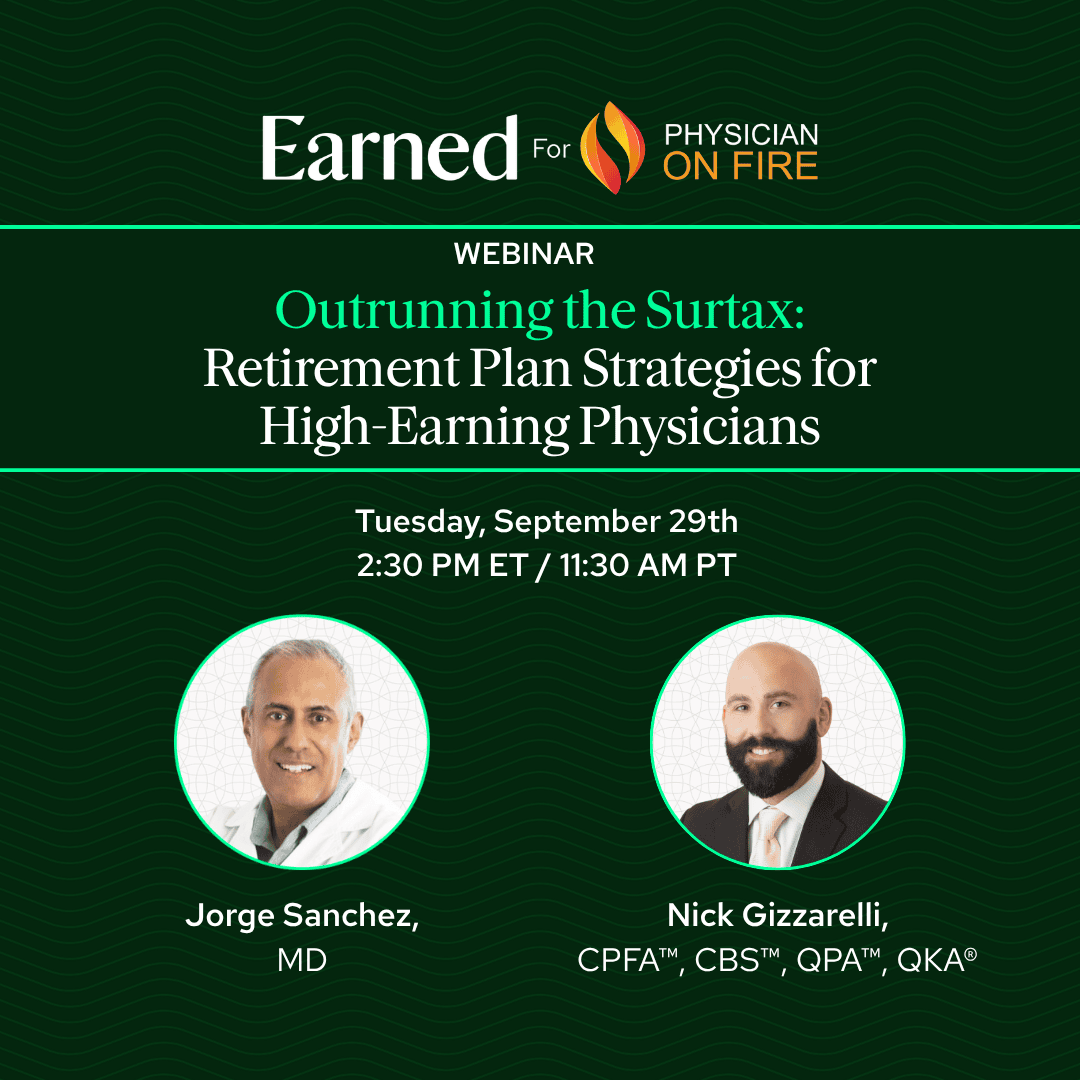
Outrunning the Surtax: Retirement Plan Strategies for High-Earning Physicians
Learn how cash balance plans, 401(k) profit sharing, and smart plan design can cut taxable income — keeping high earners under surtax thresholds and helping every physician save more pre-tax.
Register now →A family of four routinely spends $3,500 to $4,000 across the full season with travel and entertaining accounted for.
Those are reasonable numbers, some might even call them conservative. Which is fine as long as they align with the budget. But what happens when the spending exceeds what you had planned for?
In 2024, 36% of Americans took on new debt to cover holiday costs, averaging $1,181. Less than half (44%) of them expected to end up there. Average credit card balances aren’t slowing down either. According to Forbes, consumers, on average, owe more than $6,500.
Physicians aren’t immune to this. Heck, they might even be more vulnerable. High earners overspend for the same reason everyone else does. Decisions made in December, under time pressure, during the busiest clinical stretch of the year, have a way of getting out of hand.
Last year, Deloitte’s Holiday Retail Survey found that 57% of consumers expected the economy to weaken over the following six months, the most negative outlook Deloitte had recorded since it started tracking sentiment back in 1997.
Three-fourths of shoppers said they expected higher prices on holiday goods that year, largely tied to tariff uncertainty. In 2026, things aren’t much different. We’ve got active international conflicts and shaky global markets. The case for building a cushion months ahead has never been stronger.
The Case For Starting Now
Travel gets cheaper and easier.
Travel analyst Katy Nastro told Vox that domestic flights are typically best booked 3 to 7 months out, and international flights 4 to 10 months out. Booking your December trips in late September can be a gamechanger.

Rental cars follow the same logic. You don’t need to pay upfront, so reserving one now costs nothing and protects you from the price climb once inventory shrinks closer to the holidays.
Automated saving beats last-minute scrambling.
Forbright Bank’s internal data on recurring deposits found that customers who automate savings consistently saw about 5 times the growth of those who don’t.
Set up a weekly transfer into a dedicated account today so by the time you need to head out for gift shopping, you’ve already got a good chunk of change and won’t have to rely on a credit card.
People started shopping early last year.
A 2025 survey found that 38% of Americans had already started holiday shopping by the first week of September last year. 66% said that they planned to shop earlier than usual.
The National Retail Federation’s survey found that 54% of early shoppers said that spreading out their budget was their leading reason for starting early, and 41% said they did it specifically to avoid the stress of a last-minute rush.
Early planning protects your time, not just your money.
Marriage and family therapist Jamila Holcomb told Vox that holiday coordination tends to fall disproportionately on one person in a family, usually a woman, who ends up managing flights, meals, gifts and everyone else’s schedule on top of her own.
For a physician working full clinical hours, that invisible labor is a direct hit to the recovery time you need between shifts.
There’s also a well-documented cognitive cost to decision-making under pressure. Research on decision fatigue has repeatedly found that the quality of a person’s choices declines the more decisions they’ve already made that day.
Spreading holiday decisions across three months instead of cramming them into three weeks in December means less mental fatigue for the person who has to manage it all.
Addressing The ‘Buts’
“I’m already swamped. I don’t have time to think about the holidays in September.”
This is the most understandable objection, and also the one early planning actually solves.
I’m not suggesting you build a full itinerary this weekend. Take one task at a time like booking a flight or automating that recurring transfer. It can also be something as simple as asking family members what gifts they want this year.
These tasks are small enough that they should only take a couple of minutes but each one removes a decision you’d otherwise be making in December, when your schedule will be much worse.
“My family will think I’m nuts.”
Bankrate’s 2025 survey found that nearly half (49%) of holiday shoppers had already begun shopping before the end of October, which is consistent with prior years. You wouldn’t be the outlier you think you are. And getting the conversation going in the family group chat will help you mentally sort out a lot of the logistics before Halloween, even.

“Holiday shopping makes sense when the sales are on.”
Many of us still believe that Black Friday is the best day to buy. That reputation doesn’t hold up well under scrutiny.
Accroding to Bankrate’s Ted Rossman, the deep discounts people associate with Black Friday now typically show up in early October instead.
WalletHub’s research has repeatedly found that 36% of items marketed as Black Friday deals offer no real savings compared to pricing in the weeks before.
Many of the products marketed heavily during the holiday season (toys and electronics in particular), actually get steeper discounts in December and January once retailers work through leftover inventory.
Waiting for a specific sale date isn’t the savings strategy many of us think it is.
The Real Limits to Early Planning
To be fair to the skeptics, planning early isn’t free of trade-offs.
Locking in a flight or a purchase in September means giving up the chance that the price drops later. Booking early is a bet on certainty over optimization, which is reasonable for a flight with limited seats. Not so much for buying a gadget you could just as easily get on sale in January.
Ironically, the same early planning that is supposed to mitigate stress can sometimes morph into its own source of stress. You might start feeling more anxious the more you think about all the holiday stuff you still have to get done.
Don’t overdo it.
The planning process should be unintrusive enough that it doesn’t disrupt your current routine. Think of it like soup on the stove set to a slow simmer. Tasted and seasoned occasionally with some stirring here and there.
We tend to make the holidays all about the last two weeks of December. Which is honestly a small pay-off for months of planning but what if you could make the planning part of the fun?
Physicians already spend all year making decisions under pressure. The holidays don’t have to be one more thing squeezed in at the last minute. Start now, while it still feels early, and you’ll spend less money, lose less sleep and get to enjoy the season instead of just surviving it.
For 2026 in particular, “getting ahead of it” includes the economic uncertainty we’re living through. Whether you watch the news or avoid it like the plague — you know what I’m talking about. The holiday season will not be exempt from the domestic repercussions of overseas conflicts and economic uncertainty.
So, plan ahead and save yourself the last-minute drama.
Frequently Asked Questions
When should you start planning for the holidays?
Early fall works best. Late September to October gives you enough runway to book flights, start saving, and shop before prices climb and inventory tightens in November and December.
Is it cheaper to book holiday travel early?
Usually. Domestic flights tend to be cheapest 3 to 7 months out, and international flights 4 to 10 months out, according to travel analyst Katy Nastro. Booking a December trip in September falls inside that window.
Are Black Friday deals actually the best deals of the year?
Not always. WalletHub’s research found that roughly a third of items marketed as Black Friday deals offer no real savings compared to pricing in the weeks before. Toys and electronics often see steeper discounts in December and January instead.
When do the best holiday discounts actually start?
Earlier than most people think. Bankrate’s Ted Rossman has said the deep discounts associated with Black Friday now typically show up in early October.
How can physicians avoid overspending during the holidays?
Automate savings early. Forbright Bank found that customers who automate recurring deposits see about 5 times the savings growth of those who don’t, which removes the temptation to rely on a credit card in December.
Does economic uncertainty affect holiday spending?
It can. Deloitte’s 2025 Holiday Retail Survey found 57% of consumers expected the economy to weaken over the following six months, the most negative outlook the survey had recorded since 1997. That kind of uncertainty is part of why building a financial cushion months ahead makes sense.
Upcoming Webinar
Earned Wealth
Outrunning the Surtax: Retirement Plan Strategies for High-Earning Physicians
Learn how cash balance plans, 401(k) profit sharing, and smart plan design can cut taxable income — keeping high earners under surtax thresholds and helping every physician save more pre-tax.
Register now →Is it too early to start holiday shopping in September?
No. A 2025 survey found 38% of Americans had already started holiday shopping by the first week of September, and 66% planned to shop earlier than usual that year.

Don’t Miss Out
Your investment income may have a tax problem you haven’t noticed yet.
Once your modified adjusted gross income crosses $200,000 single or $250,000 married filing jointly, the IRS tacks a 3.8% surtax onto your net investment income. Those thresholds date to 2013 and have never been indexed for inflation, so plenty of attendings who blew past them years ago still haven’t run the math on what it costs.
Plan design is where you push back. The right retirement plan pulls dollars out of your taxable income before the IRS gets a look, and for some high earners that’s enough to slide back under the line. If you’re nowhere near the threshold, the same planning still lets you shelter far more pre-tax than the plain-vanilla 401(k) HR handed you at onboarding.
This afternoon I’m sitting down with Nick Gizzarelli, CPFA, QPA, QKA, a retirement plan specialist who builds these structures for a living. We’ll cover which designs suit W-2 docs, which suit practice owners and 1099 folks, and where the real contribution ceilings sit.
We go live today at 2:30 PM ET / 11:30 AM PT. Bring your questions (and your last tax return, if you’re brave).