IBR and RAP are both federal student loan repayment plans. The quick answer is that for most physicians with a typical debt-to-income ratio, Income Based Repayment (IBR) wins. Its 10-year standard-payment cap protects high earners from open-ended bills.

Repayment Assistance Plan (RAP) wins only when your debt total is far higher than your income, say $500,000+ in loans against a $300,000 salary. You should run your own numbers on the Federal Student Aid loan simulator before committing to either plan.
Read more:
- How Much Student Debt Does the Average Doctor Owe? The Ultimate Solution Guide
- Will My Employer Know If I Take a 401k Loan? A Closer Look
- How $500k in Student Loan Debt Prepared Us for FIRE
Why Choosing Between IBR and RAP Matters Now
The One Big Beautiful Bill Act rewrote federal repayment starting the summer of 2025. It replaced the old income-driven plans with RAP and a new Tiered Standard plan, per the Department of Education’s fact sheet. RAP opened for enrollment July 1, 2026.
If you borrowed before that date don’t assume you’re automatically stuck with RAP. You can still choose IBR. But PAYE and ICR sunset in summer 2028, and SAVE is already gone after a lawsuit forced borrowers out of forbearance.
IBR and RAP are the two survivors. If you’re finishing training in the next year or two, this is the plan you’ll live with through your early attending years.
What’s Changed Since RAP Launched
As I mentioned, SAVE is officially over. If you were still enrolled, the Department will notify you between July 1 and August 15, 2026, and you get 90 days from that notice to pick IBR or RAP.

That window is crucial. If you don’t choose, you’ll be defaulted into whichever plan the servicer assigns, and it may not be the cheaper one according to your situation.
The Auto Pay Rate Cut
Separate from the RAP-vs-IBR decision: the interest rate reduction for enrolling in Auto Pay is jumping from 0.25% to 1%, effective July 1, 2026. It’s temporary, running through June 30, 2028, and you need to enroll by 11:59 p.m. ET on September 30, 2026 to lock it in.
This applies on top of whatever repayment plan you’re on and shaves a full point off your rate for essentially no effort beyond setting up autodraft. There’s no version of this decision where skipping it makes sense.
Don’t forget to take a look at Physician on FIRE’s student loan refinancing recommendations.
How IBR Works
There are two versions of this, distinguished by borrow date.
Old IBR (first loan before July 1, 2014) offers the borrower forgiveness at 25 years while paying 15% of discretionary income.
New IBR (first loan on or after July 1, 2014) offers forgiveness at 20 years while paying 10% of discretionary income.
Discretionary income is your AGI minus 150% of the federal poverty guideline for your household size, a threshold set annually by the Department of Health and Human Services. For a single borrower in 2026, that offset is $23,940 a year. The IBR percentage (10% for old IBR or 15% for new) applies only to what’s left after that subtraction, not your full salary.
For high earners, the good news is that payment is capped at your standard 10-year repayment amount, calculated off your loan balance when you enter repayment. A resident is able to lock in a small payment before their salary quadruples as an attending.
How RAP Works
Instead of the discretionary-income formula, RAP runs a straight percentage of AGI, with no poverty-line offset, scaling up to 10% once you cross $100,000. So basically, every attending ever.
Dependents get a flat $50/month reduction each, not a family-size adjustment to the formula itself.
The good news is that unpaid interest is waived rather than added to your balance, and the government matches your principal payment up to $50/month if yours falls short.
The bad news is that RAP doesn’t have a cap. Your payment is 10% of AGI for as long as you’re on the plan, no matter your loan size. Forgiveness for any remaining balance arrives at 30 years, a decade later than the new IBR.
How To Make The Choice Between RAP and IBR
Your debt-to-income ratio is the deciding factor.

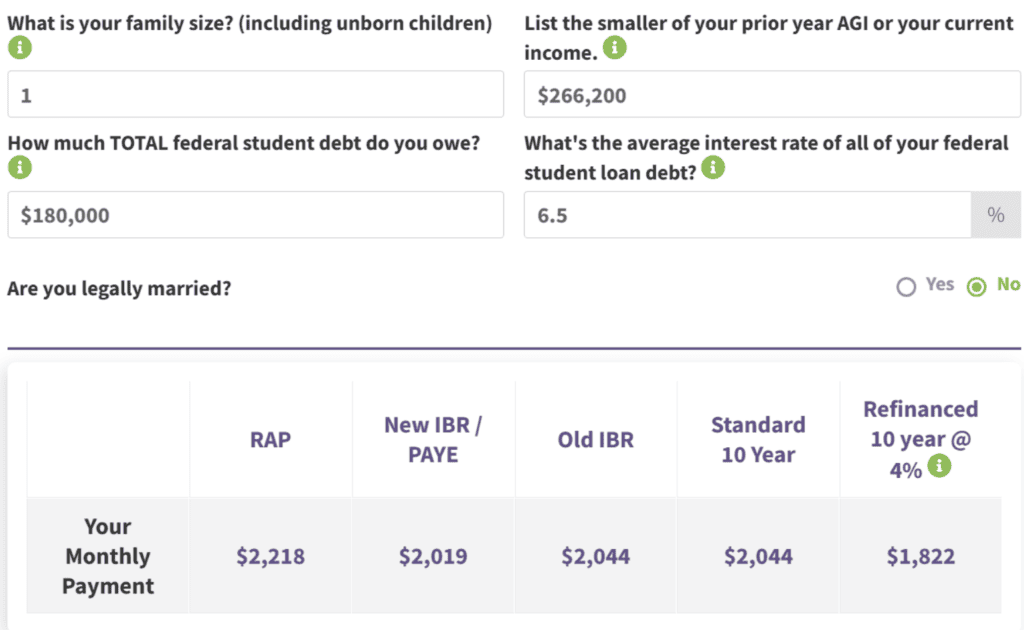
An attending earning $300,000 (estimated AGI of $266,200) with $180,000 in debt at 6.5% will have a standard 10-year payment of $2,044/month, and IBR’s cap locks that in. New IBR payments are even lower at $2,019 per month.
RAP payments come out to be $2,218. IBR wins by roughly $174/month (about $2,088/year) purely because of the cap.
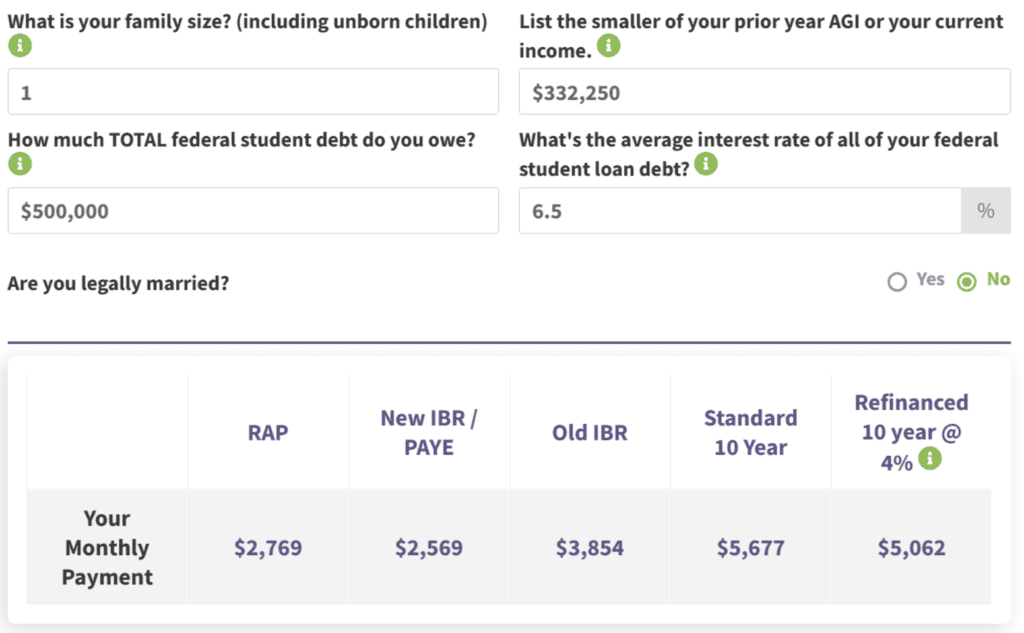
On the flipside, for someone earning $350,000 (estimatedAGI of $332,250) with $500,000 in debt, the standard 10-year payment would be roughly $5,680/month— a very high ceiling and thus a useless cap in this scenario.
Old IBR comes out to $3,854, much higher than RAP, which would be $2,769. New IBR wins here at its 10% rate. In many cases, Old IBR’s 15% rate for the same balance and income can be substantially higher than RAP because 15% of discretionary income at attending pay can exceed 10% of full AGI once the cap isn’t low enough to save you.
If You’re Pursuing PSLF
Important: While federal direct consolidation no longer zeroes out your PSLF payment history, (since September 2024), it applies a weighted average of the qualifying payments from the loans you combine, based on their balances.
If your loans have very uneven counts (one near 120, another freshly disbursed), consolidating can still pull your average down meaningfully. And the immediate post-consolidation display often shows zero before the real weighted average is posted.
Both RAP and IBR payments count toward PSLF’s 120 qualifying payments, provided you’re employed full-time by a qualifying nonprofit or government entity.
The only difference is your exposure during the years your income jumps from trainee to attending pay while the PSLF clock is still running.
Residents pay small IBR or RAP payments during training, then hit “real” payments as attendings with years still left before forgiveness. IBR’s cap limits how high that number can climb. RAP has no such backstop. If income keeps rising and you’re five years from your 120th payment, your bill keeps rising with it.
Retirement contributions can really come in clutch here. Both plans calculate using your AGI (or a figure derived from it), and pre-tax contributions to a 403(b), 401(a), 457, or HSA reduce that number directly. Maxing tax-deferred accounts during the years you’re accumulating PSLF credit lowers your payment under either plan.
Important: The Department finalized a rule on October 30, 2025, letting the Secretary disqualify employers found to have a “substantial illegal purpose,” effective July 1, 2026. A federal court vacated that rule hours before it took effect, ruling that it exceeded the Department’s statutory authority and violated the First Amendment. That ruling is likely to be appealed, so treat this as unsettled rather than resolved.
For now, payment counts, employer eligibility, and discharges are unaffected, but it’s important to keep a weather eye open.
If You’re Not Pursuing PSLF
Without PSLF, what’s left of your balance at 20-25 years (IBR) or 30 years (RAP) is forgiven— but will be taxable as ordinary income in the year it happens.
On a large physician loan balance, that tax bill can be substantial. Most physicians who aren’t pursuing PSLF come out ahead refinancing to a private loan once they can get a materially lower rate, and paying it off directly rather than riding either federal plan to its forgiveness date.
IBR vs RAP for Married Couples
Both plans let you exclude a spouse’s income via Married Filing Separately (MFS), which matters if you’re both high earners. MFS typically costs more in taxes than filing jointly, so before committing either spouse to it for years, weigh the actual tax cost against what it saves on the loan payment.
When both spouses have loans of their own, it’s important to ask whether MFS helps or hurts the household’s combined payment position:
- Similar incomes, similar balances: MFS rarely helps. Payments under an income-driven plan come out close to what they’d be under MFJ anyway, since the household income is the same either way, but you give up the tax benefits of filing jointly. Stay joint.
- One spouse carries a much larger balance relative to income: MFS can still help that spouse, even where it costs the other. Work out each borrower’s payment separately rather than assuming one filing status suits both.
- Both spouses are on a PSLF track: MFJ tends to win. Splitting the same combined income across two separate payment calculations, one per borrower, usually costs the household less overall than two MFS filings would.
At-a-Glance Comparison
| Plan | Payment Formula | Payment cap | Forgiveness | Availability |
| New IBR (loans after July 2014) | 10% of discretionary income ÷ 12 | Capped at standard 10-year payment | 20 years | Available now; long-term |
| Old IBR (loans before July 2014) | 15% of discretionary income ÷ 12 | Capped at standard 10-year payment | 25 years | Available now; long-term |
| RAP | (AGI × 1–10%) ÷ 12 − ($50 × dependents) | No cap | 30 years | Available now; new default |
Federal student loan repayment has become a moving target rather than a one-time decision.
The plan that makes the most sense during residency may not be the one that saves the most money five years into practice. Income changes, family changes, tax law changes, and Congress all affect how much you pay.
The physicians who come out ahead are the ones who revisit their numbers whenever their circumstances change.
So, has RAP changed your repayment strategy, or are you sticking with IBR? Let’s discuss in the comments.
Frequently Asked Questions
Is IBR or RAP better for physicians?
For most physicians, IBR is the better choice because its 10-year payment cap limits costs as attending income rises. RAP usually benefits borrowers with an unusually high debt-to-income ratio.
Who should choose RAP instead of IBR?
RAP generally makes more sense for physicians whose federal student loan balance is significantly larger than their annual income.
What is the biggest difference between RAP and IBR?
IBR bases payments on discretionary income and includes a payment cap. RAP uses a percentage of AGI and has no payment cap.
Does RAP have a payment cap?
No. RAP payments continue to increase as income rises until the loan is repaid or forgiven.
Does IBR have a payment cap?
Yes. IBR payments cannot exceed the standard 10-year repayment amount calculated when you entered repayment.
Should physicians switch from RAP to IBR?
It depends on income, loan balance, and career goals. Physicians with a typical debt-to-income ratio often pay less under IBR.
Which repayment plan is better for medical residents?
Many residents benefit from IBR because they can make lower payments during training while locking in the future payment cap.
Is RAP better for high-income physicians?
Not usually. Many attending physicians pay less under IBR because of its payment cap.
Does RAP count toward PSLF?
Yes. Qualifying RAP payments count toward Public Service Loan Forgiveness.
Does IBR count toward PSLF?
Yes. Qualifying IBR payments count toward the 120 payments required for PSLF.
Can attending physicians lower student loan payments?
Yes. Pre-tax contributions to retirement accounts and an HSA can reduce AGI and lower payments under income-driven repayment plans.
Is refinancing better than IBR or RAP?
It can be for physicians who are not pursuing PSLF and qualify for a significantly lower private interest rate.
Are forgiven student loans taxable?
Outside of PSLF, forgiven federal student loan balances may be treated as taxable income under current law.
What happens if I do nothing after SAVE ends?
Your loan servicer may place you into another eligible repayment plan if you do not choose one during the enrollment window.
What debt-to-income ratio favors RAP?
RAP generally becomes more attractive when your student loan balance is substantially higher than your annual income.
Is RAP replacing all income-driven repayment plans?
No. RAP is a new repayment option, while IBR remains available for eligible borrowers.