Healthcare has been the one part of the U.S. economy that didn’t flinch. While manufacturing and tech cycled through layoffs, and federal employment dropped by 277,000 after hitting its peak in January 2025, hospitals, nursing homes, and home health agencies kept hiring.

Healthcare employment averaged 34,000 new jobs per month in 2025, a slowdown from the prior year, but still the most reliable job growth engine in the entire economy, according to the Bureau of Labor Statistics.
Total nonfarm payroll employment was estimated to rise by just 584,000 in 2025, which, after annual revisions came out closer to 181,000. Without healthcare and social assistance, most of the country was already shrinking.
In 2026, that backstop is under pressure. Twin forces of Medicaid cuts and an immigration crackdown are converging on the healthcare labor market at once. The Medicaid cuts will drain billions from provider revenue over the next several years, and the immigration crackdown is hitting the workforce that actually delivers much of that care.
The layoffs are already happening, hospital closures are already being announced, and the physicians whose income is tied to Medicaid-dependent employers or practices? Let’s talk about them too.
How Medicaid Cuts are Hurting Healthcare
The One Big Beautiful Bill Act, signed into law on July 4, 2025, authorized roughly $1 trillion in Medicaid cuts over 10 years. This was the largest reduction in the program’s history. The cuts involve three overlapping levers that compound each other.

Administrative complexity
The bill blocked simplified enrollment and renewal processes that states had adopted under the Biden administration and requires expansion enrollees to re-verify eligibility every six months instead of annually.
The CBO estimates the six-month redetermination requirement alone reduces federal Medicaid spending by $63 billion through 2034.
Those federal savings materialize simply due to paperwork pressure. People stand to lose coverage because they can’t clear the re-verification process on a compressed timeline.
Work requirements
Starting January 2027, adults ages 19–64 in the Medicaid expansion group must document 80 hours of work or qualifying community engagement per month.
Research from the Urban Institute estimates between 4.9 and 10.1 million people stand to lose Medicaid coverage in 2028 from the six-month redeterminations and work requirements combined.
Between 19% and 37% of people who are already working are still projected to lose coverage because they can’t document compliance. People who are self-employed, work irregular hours, are over 50, or are providing care for disabled family members are particularly exposed.
Provider tax restrictions
States have long used provider taxes to unlock their federal Medicaid matching dollars. OBBBA disallows new or expanded provider taxes and caps state-directed payments at 100–110% of Medicare rates.
The CMS estimates this alone cuts $510 billion in federal Medicaid spending through 2034, forcing states to either find alternative revenue sources or cut provider payment rates and services to absorb the difference.
The Argument in Favor of the Medicaid Cuts
Supporters of the legislation point out that Medicaid spending was on a trajectory that wasn’t sustainable, and state provider tax arrangements had evolved well beyond what the program’s original design contemplated.
In some cases, effectively gaming the federal match to draw in more dollars than the underlying patient population warranted.
Work requirements, in theory, direct limited program resources toward the most vulnerable enrollees and encourage labor-force participation among people capable of it.
The $50 billion Rural Health Transformation Program included in OBBBA was specifically designed to cushion hospital losses in underserved areas.
The counterargument also acknowledges that not every state faces the same exposure. Non-expansion states like Wyoming face lesser losses because work requirements don’t apply to them, and could actually see net budget gains.
However, the $50 billion rural relief fund will provide $10 billion per year for five years (FY 2026 through 2030), after which, poof, it’s gone entirely. Most of the Medicaid cuts it’s meant to offset, however, are permanent and backloaded.
KFF analysis of CBO estimates found the fund covers just 37% of the estimated $137 billion in cuts to federal Medicaid spending in rural areas over ten years, and about 5% of total estimated Medicaid cuts nationwide.

Nearly two-thirds of the ten-year reductions in federal Medicaid spending occur after fiscal year 2030, when the fund runs dry.
Meanwhile, half the fund’s dollars are distributed equally among all states with approved applications, regardless of rural population size, number of rural hospitals, or the financial condition of those hospitals.
For instance, Connecticut, with 3 rural hospitals by one definition, could receive the same amount as Kansas, which has 90. The 44% of rural hospitals already operating at negative margins get a mention in the law, but no guarantee of priority in the distribution formula.
The historical evidence on work requirements isn’t encouraging either. In 2018, Arkansas’s first year of Medicaid paperwork requirements produced significant coverage losses among eligible people with no measurable change in employment rates.
Georgia’s Pathways program spent more than $86.9 million to enroll 6,500 participants in 18 months, which is 75% fewer than the state had projected for year one.
What Medicare Cuts Mean For Physician Revenue
Urban Institute’s modeling projects physician practices would see $6.4 billion in reduced revenue and absorb an additional $2.2 billion in uncompensated care burden if Medicaid expansion coverage rolls back at scale.
Hospitals take a larger direct hit of $31.9 billion in lost revenue plus $6.3 billion in additional uncompensated care. Health systems are major employers of physicians, and a hospital under financial stress becomes an employer under financial stress.
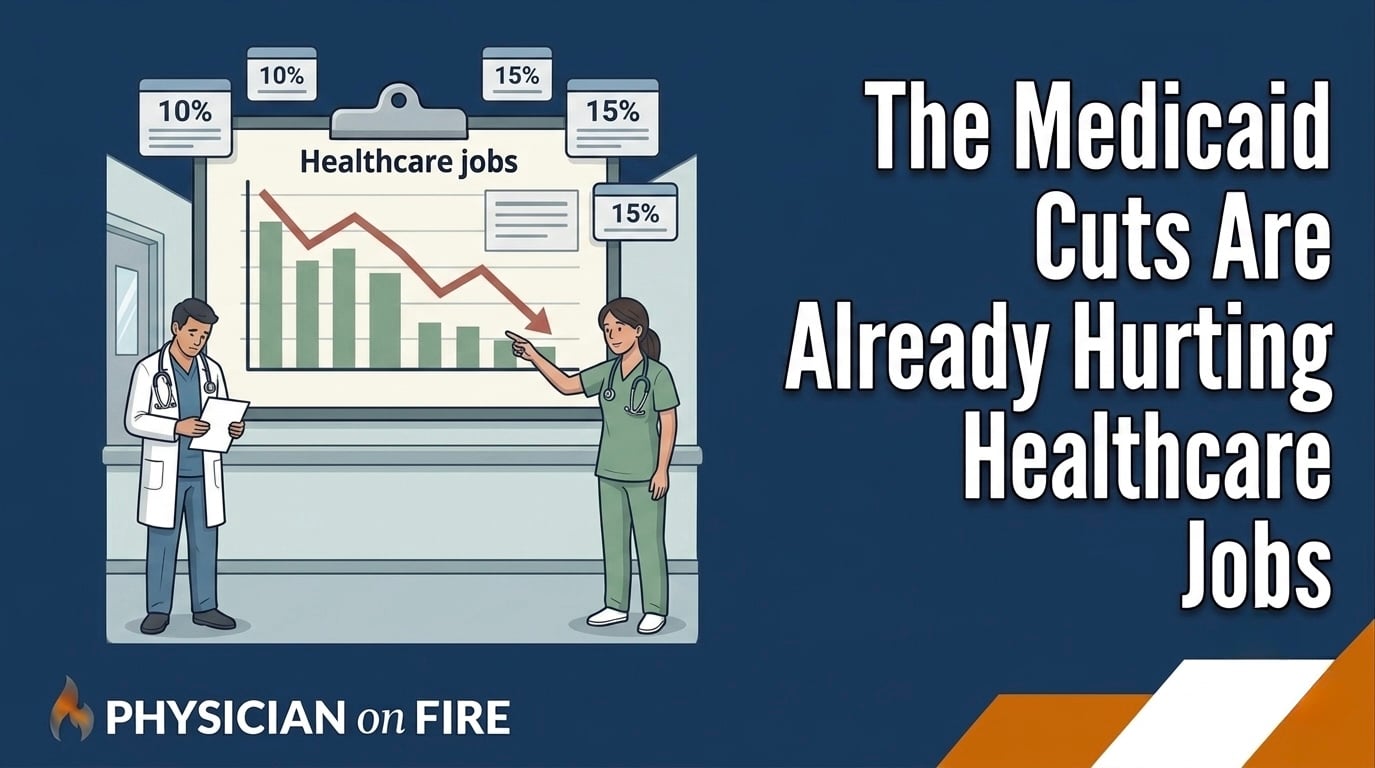
The layoffs are already coming. Alameda Health System confirmed plans to eliminate 247 positions across its five public hospitals, projecting losses exceeding $100 million annually by 2030, tied to federal Medicaid cuts.
Hennepin Healthcare in Minneapolis announced roughly 100 layoffs, citing a $50 million budget shortfall tied to Medicaid revenue losses and removing 100 inpatient beds to stabilize operations.
Trinity Health said it expects to lose $1.5 billion due to “recent and future government policy changes” and cut 10.5% of its billing staff. One of its Georgia hospitals closed its maternity unit last October.
Baptist Health in Arkansas laid off 150 employees at its Fort Smith campus, 10 of whom were physicians, while shutting down nephrology, pulmonary, oncology, and infectious disease services.
Public Citizen’s analysis of financial data from roughly 95% of U.S. hospitals found 446 at high risk of closing or cutting services. These are systems where 20% or more of revenue comes from Medicaid and other low-income government programs, and which have been losing money.
Independent and rural practices operate on thinner margins, with less access to capital and higher Medicaid dependency than their hospital-affiliated counterparts.
When reimbursement shrinks, the choices shrink just as quickly. They can choose between hiring fewer people, seeing more patients per hour, or closing.
What Physicians Can Do
This is one of those instances where policy becomes a personal finance problem.
If you’re in an employed position at a health system with significant Medicaid exposure, your income isn’t as stable as your contract suggests.
Health systems under financial duress restructure service lines, close unprofitable departments, and renegotiate physician compensation, especially productivity-based models where drops in volume compress collections directly.
If you haven’t looked at your employer’s Medicaid revenue share or operating margin recently, it’s worth a gander. Public hospital systems, safety-net hospitals, and rural critical access hospitals face the most concentrated risk.
This is precisely why, here at Physician on FIRE, we consistently urge physicians to take a magnifying glass to their employment contracts. The guarantees in your agreement are only as good as the financial health of the entity backing them.
Moving on to insurance: a physician at a safety-net hospital with compressed Medicaid reimbursement and a thinning operating margin has less financial cushion to absorb a disability event than one at a well-capitalized system with a diversified payer mix.
The income pressure from Medicaid cuts and the income loss from a disability are separate events, but they’re not mutually exclusive, and the combination is uglier when you’ve already taken a revenue hit.
If your coverage comes primarily through an employer group plan rather than an individual policy, there’s something you should know. If your employer pays the premiums and deducts them as a business expense, any benefit you collect is taxable income.
It’s best to confirm with your accountant before you assume the stated benefit is what you would actually receive.

An own-occupation individual policy, one that pays if you can’t perform the specific duties of your specialty, even if you’re still working in some capacity, is the coverage structure most physicians in procedural or high-skill specialties should hold regardless of what’s happening with Medicaid. The uncertain climate just makes the case for having it stronger.
Let’s not forget liquidity. A practice running lean on cash reserves and depending heavily on Medicaid collections for operating cash flow is a practice that can’t absorb a 15–20% drop in that patient population without either cutting staff or taking on debt.
Three to six months of operating expenses in accessible reserves (separate from retirement accounts) is a margin of safety in normal times. In this environment, it’s a baseline requirement.
For physicians still in a contract negotiation or considering a move, Medicaid exposure at the practice or system level requires due diligence.
It changes the risk profile in ways that should inform your compensation expectations and your read on long-term employment stability. An employed position at a rural critical access hospital carries meaningfully different income risk than a position at an academic center with a diversified payer mix.
Roth conversions and taxable account contributions also look different in an environment where physician income is under structural downward pressure. If your income takes a step down for whatever reason, that’s a potential conversion window.
Lower income means a lower marginal rate and more room to fill up the 22% or 24% brackets. A silver lining amidst the gray clouds. The physicians employed in Medicaid-heavy positions are most likely to benefit from modeling this at a time when their income trajectory is genuinely uncertain over the next two to three years.
2027 is Only 6 Months Away
When work requirements go live in January 2027, that’s when provider revenue starts falling off the enrollment cliff.
States with substantial use of SDPs and provider taxes, like Arizona, Iowa, and Nevada, will see reductions of more than 15% of their Medicaid funds.
Enrollment reductions are projected to exceed 20% in West Virginia, Oregon, New Mexico and Washington, D.C., where a high percentage of Medicaid beneficiaries are subject to the work requirement.
The CBO projects these Medicaid provisions will increase the number of uninsured Americans by 7.8 million in 2034. Those patients will undoubtedly still need care. They will still show up at emergency rooms, generating uncompensated care costs that’ll flow back to the providers treating them.
Healthcare’s role as the U.S. labor market’s last reliable growth engine was a demographic consequence, driven by an aging population with no alternative but to consume more medical services.
That demographic tailwind is still in effect, but the funding mechanism that allowed providers to staff for that demand is getting cut out from under it. The jobs will follow the money, and right now, a whole lot of money is leaving the system.
So, have you seen the writing on the wall where you’re at? Are the layoffs and service line cuts already hitting close to home, or does it still feel like calm before the storm?
Frequently Asked Questions
How will the Medicaid cuts affect physician salaries?
Physicians employed at safety-net hospitals, rural critical access hospitals, and Medicaid-heavy health systems face the most direct risk. When Medicaid revenue drops, health systems restructure compensation, cut service lines, and reduce staff. Productivity-based pay models are especially vulnerable since lower patient volume means lower collections.
Will Medicaid cuts cause hospital closures?
They already are. Public Citizen identified 446 hospitals at high risk of closing or cutting services. Rural hospitals are most exposed, with 44% already running at negative margins before the cuts fully kick in.
When do the OBBBA Medicaid work requirements start?
January 2027. That is when adults ages 19 to 64 in Medicaid expansion states must begin documenting 80 hours of work or community engagement per month to keep their coverage.
Should physicians review their disability insurance because of Medicaid cuts?
Yes. Physicians at financially stressed health systems have less of an income cushion to absorb a disability event. An own-occupation individual policy offers stronger protection than a group plan, particularly for procedural and high-skill specialties.
Which states will be hit hardest by Medicaid cuts?
Expansion states with high Medicaid dependency and limited budget flexibility face the steepest losses. West Virginia, Oregon, New Mexico, and Washington D.C. are projected to see enrollment reductions exceeding 20% once work requirements take effect.