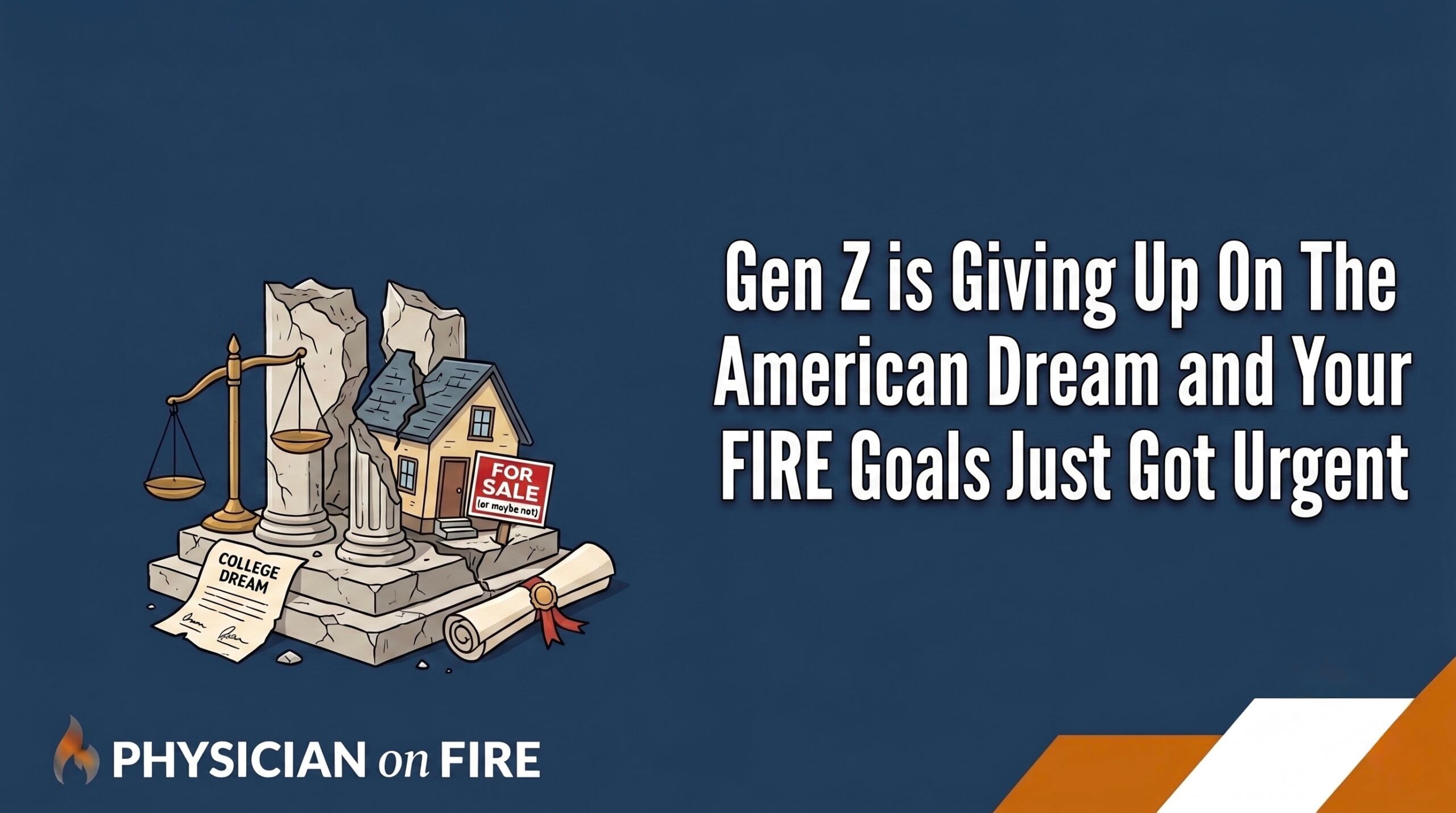
We’ve all been feeling something in the air, recently. But unlike Millennials and Gen X who try to maintain the status quo, Gen Z is saying “nope.”
The American Dream isn’t working for them and they’re walking away.
According to the Harvard Joint Center for Housing Studies, price-to-income ratios used to be at an average of 3.2 in 1990. Today it’s closer to 5.0.
The New York Fed reports that the median wage for a recent bachelor’s degree holder, adjusted for inflation, has crept from $54,386 in 1990 to just $60,000 in 2024. So instead of saving, Gen Z is taking risks. 42% of Gen Z investors hold crypto, which is nearly four times the 11% who hold a retirement account.
Economists are calling it financial nihilism. Gen Z is making it the new normal.
The Housing Market And Broader Economy Are Already Bending
According to Redfin data, In Los Angeles, only 1.1% of homes are considered affordable to a family earning the local median income. Yikes. In New York it’s 8.2% and in Boston it’s 10.5%.
Only 38.3% of 28-year-old Americans own a home today, compared with 42.5% of Gen Xers and 44.4% of boomers at the same age. Out of those Gen Z and millennial homebuyers, a little over half (56.5%) said they funded their own down payment. The rest leaned on cash gifts, inheritance, or crypto windfalls.
Income, or lack thereof, is no longer the biggest hurdle to ownership. It’s the down payment itself, which is increasingly coming from a parent’s bank account rather than a paycheck. This has effectively split the buyer market into two groups. One gets a cash injection and can wait out a bad market. The other has no cushion and has to gamble its way toward the same outcome.
The so-called great wealth transfer, often cited as the fix for all this, doesn’t hold up either. Baby boomers hold $78.6 trillion, or 51.8% of all U.S. wealth, and an estimated $68 to $84 trillion is projected to move to spouses and younger generations over the next two decades. While that sounds reassuring— it isn’t, at least not for the majority.
The wealthiest 10% of households are set to receive 56% of all intergenerational transfers. The bottom half gets 8%. Cut the top 10% out of the equation entirely and the median inheritance for the remaining 90% of Americans is close to zero.
The macro consequence is bigger than any one generation’s headache. According to the Bank of America, Gen Z’s aggregate income was $9 trillion in 2023 and is projected to reach $74 trillion by 2040.

They are soon to be the largest cohort on the planet, at roughly 30% of the global population within a decade.
Standard monetary policy assumes a household with a mortgage that responds to rate hikes, savings in conventional markets, and enough skin in the traditional system to change behavior when the Fed moves.
A growing share of Gen Z holds none of that. No mortgage to refinance, savings routed into crypto and prediction markets instead of equities or bonds.
Every rate decision the Fed makes reaches a shrinking share of the population it was designed to influence, and policymakers are only beginning to reckon with what that does to the transmission mechanism they’ve relied on for 40 years.
Prediction market volume has quadrupled in the past few years, and nearly a third of Gen Z investors are trading them or considering it. One industry estimate puts the broader crypto derivatives market Gen Z is driving at $100 trillion in volume.
Consumer sentiment has followed the same track. The University of Michigan’s index shows adults under 35 posting the steepest sentiment decline of any age group over the last decade, even with the stock market near record highs. Afterall, a rally in equities does nothing for a generation that doesn’t hold equities.
Some of this is already reshaping policy. Renters’ rights and public housing are moving from fringe issues to the mainstream in high-cost cities. Seattle’s city government bought a 150-unit downtown apartment building outright, with plans to acquire and develop 1,800 more units through its social housing arm.
New York’s last mayoral race turned partly on tenant protections. None of that will fix the affordability gap on its own, but it signals that an entire generation is done waiting for the old path to reopen and is starting to amp up political pressure for a different one.
By now you must be thinking…okay, but what does that have to do with me? I know, I know, doctors aren’t Gen Z renters priced out of a studio apartment, and physician income still surpasses the median by a wide margin.
But the underlying mechanics do affect us all.
Why The Status Quo Stopped Working
Nihilism, in the philosophical sense, is the belief that life is meaningless. Economic nihilism narrows that down to the pursuit of economic success being meaningless when the milestones that used to mark progress become unreachable no matter how hard you work.
Researchers at the University of Chicago and Northwestern found that a lack of affordable housing produces exactly this kind of giving up, and it shows up as three things: higher consumption, less effort, more risk-taking.
Joseph Andrew, a Gen Z accounting student at the University of Miami, thinks his own generation misses how good they have it. He pointed to how a niche business can go viral and make someone rich overnight, and how homeownership has become the one thing they hyperfocus on precisely because it’s the one thing still out of reach.
Philosopher Michael Burns observes that the anxiety underneath it all harkens back to Kierkegaard, who once distinguished between the anxiety of limited options and something worse, the anxiety of the infinite. Knowing that everything is theoretically possible and yet none of it is promised, is torture in its own way.
The Former Department of Labor chief economist Janelle Jones sums it up pretty well, saying that young people “have low expectations for how they’re doing now, they have low expectations of how things are going to look in the future,” and the job market is only part of the why.
Does A Medical Degree Still Pay Off The Way It Used To?
Ask an aspiring doctor right now, and they may not be able to answer confidently.
According to AAMC, an education in medicine costs $297,745 at public schools and $408,150 at private ones on average, and federal aid covers less of that than it used to. More than 70% of graduates carry education debt north of $212,000 before factoring in undergrad loans.
On top of that, the financing rug got pulled from under these aspiring physicians. The One Big Beautiful Bill Act passed last year caps federal loans for professional programs at $50,000 a year, $200,000 total, and terminated Grad PLUS entirely (which was the program that let med students borrow the full cost of attendance regardless of credit).
Almost half of M.D. students relied on it, borrowing more than $1 billion a year between them.
According to AAMC’s Kristen Earle the bill “fundamentally changes the medical school financing landscape for aspiring physicians.”
In its place came a 30-year Repayment Assistance Plan (RAP) that leaves most borrowers with higher monthly payments than what they’re replacing.
Residents chasing Public Service Loan Forgiveness now have to enroll in it too, and many will pay more before forgiveness than they would have under the old rules.
Education Secretary Linda McMahon has argued that loan caps will force schools to compete on price, telling Congress that once enrollment drops, universities will “realize part of the reason is because the cost is too high” and adjust.
Louisiana Senator Bill Cassidy, a physician himself, was more straight-forward about it: “the increasing availability of federal loans has resulted in skyrocketing tuition prices, trapping students in a cycle of overwhelming debt that they can’t pay back.” Cap the loans, the argument goes, and tuition growth slows with it.
A 2023 paper cited in the same Senate hearing found that Grad PLUS did coincide with higher graduate program prices. But Leslie Turner, one of the paper’s authors and an economist at the University of Chicago, told CNN that’s not the whole picture.
Capping loans might slow the rate of tuition growth, but there’s little precedent to expect tuition to actually come down.
Public medical schools, more dependent on tuition revenue as state funding shrinks, have raised prices faster than private ones since 2001. In other words…less money to borrow doesn’t mean less to pay. It just means schools will find the difference somewhere else.

Enter: private lending. A gap between a $200,000 federal cap and a $400,000 tuition bill gets filled with loans that carry higher rates, skip income-driven repayment, and often require a co-signer most 22-year-olds don’t have.
Private loan availability has shrunk for two decades and never fully recovered after the Great Recession, and lenders lean hard on credit history to decide who gets approved.
Students without family credit to lean on will get the short end of the stick, which is another way of making a career in medicine less accessible to those who don’t have enough to begin with.
One Yale premed, the daughter of immigrant parents with no family safety net, told CNN she has shelved her plan to become a doctor entirely. The reason being that she no longer believes it would let her support her family the way medicine once promised to.
A Brown student who committed to a combined med program before the cap took effect now estimates she’ll need $200,000 in private loans just to cover what Grad PLUS used to. Feeling betrayed, she says that “if I’d known this would happen, I may not have committed to med school at this point.”
Panacea Financial asked physicians if they’d still choose medicine knowing what the new loan cap policy looks like. Only 47% said yes. 27% said no outright. The rest weren’t sure.
So half a workforce (53%) is internally reconsidering the trade it already made. It’s no wonder, the students coming up behind them are working that out before they even start.
HRSA projected a shortfall of 87,150 primary care physicians by 2037. A financing structure that pushes students toward the specialties with the biggest paychecks and away from the ones with the biggest need is only going to increase that number.
Primary care is in dire straits. Family medicine went 16.4% unfilled in the 2026 Match, with pediatrics and internal medicine close behind.
Residents are running the same calculations Gen Z is running everywhere else. The result is residents routing away from the specialties with the worst pay-to-debt ratio, and towards the ones that still “pay off”.
The Reimbursement Problem
AMA President Bruce Scott said that the 2026 fee schedule represented “the fifth consecutive year of cuts, and they came on the heels of woefully inadequate payment updates that have fallen 33% below the rate of inflation since 2001.”
The schedule technically includes a 2.5% bump from the One Big Beautiful Bill Act. CMS then layered in a new “efficiency adjustment” that claws most of it back for high-volume specialties. Learn more on that here.
MGMA’s Anders Gilberg said that “These policies reflect systemic inadequacies in the payment structure. Congress must intervene and pass legislation to provide an annual inflationary update to physician payments.”
Medicare Advantage insurers, meanwhile, are facing a 4.33% hike for 2026 (above inflation) while the physicians treating those same patients eat the cut.
Add the OBBBA’s Medicaid provisions on top (tighter eligibility, new work requirements, coverage losses concentrated in the safety-net hospitals already running thin margins), and the reimbursement environment younger physicians are stepping into is structurally worse than the one their attendings trained under.
What Older Physicians Can Learn From The Nihilists
Physicians have spent their careers optimizing for a version of the American Dream which has fundamentally changed. Gen Z’s answer is to detach effort from the old signifiers of success and build new ones.
The physician version of that is to take financial independence seriously years earlier than the previous generation did.
The writing on the wall couldn’t be clearer: waiting for the old system to reward patience the way it used to is no longer a safe assumption. FIRE, or at the very least FI, is no longer optional.
That means planning for a shorter accumulation window. It means aiming for a number and a timeline that doesn’t count on policy reforms.
Truth be told, every generation thinks it inherited a worse deal than the one before it. Sometimes that’s just nostalgia talking. This time the facts and figures back it up.
The old assumptions that a stable career always pays off are no longer guaranteed. So my advice to you is to get your bag while the getting’s still good and go get FIREd up.
So, what do you make of all this? Is Gen Z just doing what every younger generation does — rebelling against the status quo? Or are they onto something the rest of us just can’t see yet?
Frequently Asked Questions
What is Gen Z financial nihilism?
It’s the idea that the traditional path to financial security no longer pays off, so why bother following the old rules. It shows up as more risk-taking, more spending and less saving among young adults.
Is Gen Z giving up on the American Dream?
Not exactly giving up. They’re redefining it. Homeownership on the old terms feels out of reach for a lot of them, so they’re building wealth through other channels instead, like crypto, side income and prediction markets.
How does Gen Z’s financial nihilism affect the economy?
It weakens how monetary policy works. The Fed’s rate moves are built around households with mortgages and traditional savings, and a growing share of Gen Z has neither, so those levers reach fewer people than they used to.
Is medical school still worth it in 2026?
For most specialties, yes, but the margin is tighter than it used to be. New loan caps and the end of Grad PLUS mean more of the cost falls on private loans, which makes the payoff timeline longer and riskier.
Why are Medicare physician reimbursements going down?
Budget rules force CMS to offset any payment increase with cuts elsewhere. Combined with new efficiency adjustments in the 2026 fee schedule, most specialties are seeing real cuts even in years with a technical raise.
Should doctors pursue FIRE?
Given where reimbursement and training costs are headed, front-loading savings and building financial independence earlier makes more sense than waiting for the old system to reward patience the way it used to.