


Your newborn has a Social Security number and a pediatrician. Now, not ones to be left behind, they also have a stock portfolio.

Trump Accounts went live on July 4, 2026. Also known as the “Baby Bonus”, these are new tax-deferred savings accounts for kids under 18, created by the One Big Beautiful Bill Act. They work like a traditional IRA, but a parent or guardian opens one on a child’s behalf, and the money has to stay invested in a low-cost U.S. stock index fund until the child turns 18.
Eligible newborns get a one-time $1,000 deposit from the federal government, and family, friends and employers can add up to $5,000 a year on top of that.
High-earning parents have three major questions to consider: Should you open one? Does the $1,000 seed deposit matter? And is this actually better than the 529 you’re already funding? The Congressional Research Service published an updated overview of the program in June which goes into more details than the earlier press releases. Here’s what physician families need to know.
Also read: What It Really Costs to Raise a Child in the Age of AI
What Exactly Is a Trump Account?
While a Trump Account has been labeled as a traditional IRA, it comes with slightly different rules. CRS calls the time until your child turns 18 the “growth period,” and it comes with three restrictions standard IRAs don’t have.
Money can’t leave the account during the growth period except in the case of a rollover into an ABLE account for a disabled beneficiary.
Contributions aren’t tied to the child’s earned income, which of course, makes sense since toddlers with a W-2 are hard to come by.
And the funds have to sit in a specific kind of index fund instead of whatever brokerage account you’d otherwise pick.
Once the growth period ends, on January 1 of the year your child turns 18, the account converts into an ordinary traditional IRA and plays by the same rules as yours.
Who Qualifies for the Trump Account’s $1,000 Seed Deposit?
The federal government will hand out $1,000 to any U.S. citizen born between January 1, 2025, and December 31, 2028, with a valid, work-authorized Social Security number. The President announced that the government has already deposited that money into more than 500,000 accounts by early July.

In order to receive the deposit, you must first claim the child as a dependent for tax purposes. The usual dependency rules apply here: more than half a year of residency, financial support and so on.
The work-authorized Social Security number requirement can prove to be a hiccup for physician families with visa-holding spouses or children born abroad before a green card comes through. If a child doesn’t have a Social Security number that qualifies for work, they don’t qualify for the account.
Kids born before 2025 don’t get the $1,000, but roughly 25 million of them can collect $250 instead, funded by a $6.25 billion pledge from Michael and Susan Dell. That money goes to children under 10 living in ZIP codes where the median household income comes in under $150,000.
Learn more: 11 Ways to Invest in Your Child’s Future
A Forbes contributor checked her own ZIP code against Census Reporter data and found that most ZIP codes across the country clear that threshold, since it covers roughly 80% of children age 10 and under.
How Much Can You Contribute to a Trump Account Each Year?
Family and friends can add up to $5,000 a year, combined, per child. That’s below the standard IRA cap of $7,500 which means $2,500 of lost savings for teenagers who earn money from summer jobs or research assistantships. If your 16-year-old earns $9,000 a year, they can save more in a custodial Roth IRA than a Trump Account.
Employers can contribute up to $2,500 of that $5,000 cap, tax-free, and a growing list of companies (Goldman Sachs, BlackRock, Nasdaq) have pledged to match the federal deposit for employees’ kids. Ask your hospital system or physician group whether they’ve adopted anything similar.
Contributions above $5,000 in a year trigger a 6% penalty on the excess, charged annually until you pull the overage out.
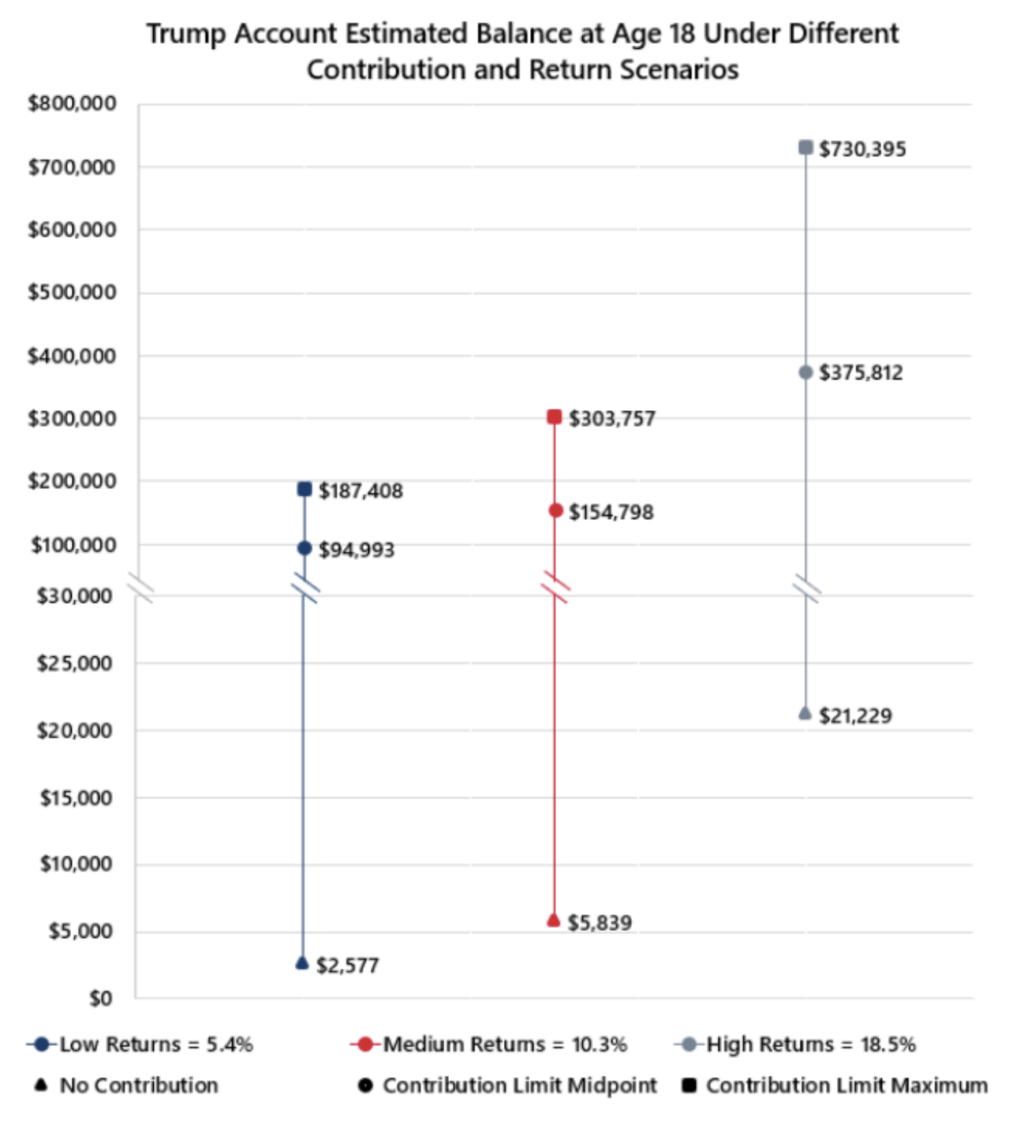
According to The Council of Economic Advisers a child born in 2026 whose family puts in the full $5,000 annual amount every single year till 2043 could end up with more than $300,000 by age 18. Assuming typical long-term stock market growth.
Not contributing beyond the $1,000 seed would still give you close to $6,000 by CEA’s estimate.
Source: whitehouse.gov
Where Is the Money In a Trump Account Invested?
During the growth period, every dollar must sit in a broad U.S. stock index, skip leverage, and charge no more than 0.1% in annual fees. The Treasury named the SPDR Portfolio S&P 500 ETF as the default fund. No bonds, no individual stocks and no sector funds.
If you’re the type of parent who doesn’t want to think about asset allocation for a 3-year-old, that’s all well and good. For those who already run a more sophisticated portfolio, it can feel like a limitation.
What Happens to the Trump Account When Your Child Turns 18?
The account becomes a regular traditional IRA. Standard withdrawal rules apply, including the 10% early withdrawal penalty before age 59½, with the usual exceptions for higher education, a first home purchase (up to $10,000), birth or adoption costs, certain medical expenses, and a few others.

Contributions you made with after-tax money come out tax-free, but any growth on that money gets taxed as ordinary income when withdrawn rather than at the lower long-term capital gains rate a taxable brokerage account would offer. The government seed money and any employer or nonprofit contributions get taxed too, since they never got taxed going in.
Trump Account vs. 529 vs. Custodial Roth IRA vs. Brokerage Account
Physician families already juggle several accounts for their kids. Here’s how a Trump Account stacks up.
529 plan
If college is the goal, a 529 usually wins. Qualified withdrawals come out completely tax-free, and you can roll up to $35,000 into a Roth IRA under SECURE 2.0. A Trump Account taxes the growth on withdrawal no matter what you use the money for.
Custodial Roth IRA
Only available to kids with earned income, but far more generous for those who qualify. Contributions go in after-tax and come out tax-free forever, with the annual limit set at $7,500 as opposed to a Trump Account’s $5,000. If your teenager works as a lifeguard or tutor, a custodial Roth typically surpasses a Trump Account in terms of savings.
Taxable brokerage account
No contribution limit, no age restriction, no withdrawal penalty. You lose the tax deferral, but long-term capital gains rates run lower than the ordinary income rates a Trump Account charges on withdrawal.
Learn more: Backdoor Roth vs Taxable Investing for High Earners
Trump Account
For kids with no earned income and families who won’t otherwise open a 529 or brokerage account for them, this one wins. The $1,000 (or $250) in free government money, plus tax-deferred growth from birth, gives young kids a head start that doesn’t require a paycheck to unlock.
This doesn’t have to be an either-or decision. Opening the Trump Account costs you nothing and hands your kid free money before they can even hold a pencil. Nothing’s stopping you from claiming the deposit and you can always layer a 529 or custodial Roth IRA on top later.
What Physician Families Should Should Know About Trump Accounts
According to the CRS the tax break on deferred growth benefits higher earners more than lower earners, because it shields income from whatever marginal rate you’d otherwise pay.
Employer matching compounds that advantage since access to a workplace retirement benefit correlates strongly with income. Bureau of Labor Statistics data shows that 83% of the highest-earning 10% of workers have access to an employer retirement plan, compared with 36% of the lowest-earning 10%.
The CRS also states that the statute doesn’t yet clarify how Trump Account balances interact with means-tested programs like Medicaid, SNAP, or federal student aid, and federal agencies haven’t finished writing that guidance.
If a resident or fellow’s household relies on any income-based benefit, that warrants a call to a tax professional.
How to Apply for a Trump Account
Brokerages like Fidelity, Vanguard, and the rest of the usual custodial-account players don’t yet offer their own version, so every account opens through Treasury’s designated financial agent for now.
The White House says parents will eventually get to transfer balances to a preferred brokerage through a simple trustee-to-trustee rollover, but that option doesn’t exist yet.
To open an account, fill out IRS Form 4547, either on paper or online at trumpaccounts.gov. The IRS estimates the online process takes 5 to 10 minutes. Forbes estimates upwards of an hour. From trumpaccounts.gov, you are redirected to the IRS Trump Accounts page confirming a valid Social Security number for the child.
Next you have to verify your identity through ID.me if you don’t already have an account with the IRS. Upload a driver’s license or passport and complete a facial scan.
The system also asks permission to pull credit-reporting data under the Fair Credit Reporting Act, purely to confirm your identity, not to check your credit.
Once verified, you fill out the actual application, which lets you enter multiple kids in one session. Watch for a pre-filled address pulled from an old tax return. Double-check that it matches your current ZIP code before you submit, since ZIP code mismatches have caused processing errors for early applicants.
After submission, some parents hit roadblocks tied to high demand, with error messages saying an election couldn’t be processed. Waiting an hour and resubmitting has resolved it for most people.
Are Trump Accounts Worth It for Physician Families?
For physician households a Trump Account is supplemental at best.
The $1,000 is free money with no real downside beyond the paperwork. Beyond the seed deposit, treat the account as a part of your kid’s savings portfolio rather than the whole. If education is the priority, keep funding the 529.
If your teenager earns income, a custodial Roth IRA will usually serve them better. If you want investment flexibility or lower long-term tax rates on growth, a taxable account is your best bet.
Frequently Asked Questions
Are Trump Accounts a good idea?
For most families, yes, mainly for the free seed money. Treat it as a bonus account, not your child’s main savings plan.
How much will a Trump Account be worth when my child turns 18?
With the $1,000 seed deposit alone, roughly $6,000 by CEA estimates. With the full $5,000 annual contribution every year, potentially over $300,000, assuming typical stock market returns.
What’s the difference between a Trump Account and a 529 plan?
A 529 offers tax-free withdrawals for education. A Trump Account taxes growth on withdrawal no matter what the money funds, but it isn’t limited to education expenses.
Who manages a Trump Account?
The Treasury’s designated financial agent manages every account for now. A future rollover option to a private brokerage is planned but not yet available.
Can I lose money in a Trump Account?
Yes. The funds track the stock market, so account values fluctuate with the S&P 500, the same as any other index fund investment.
Are Trump Account contributions tax deductible?
No. Individual contributions use after-tax dollars, and no deduction applies, for the contributor or the child.
Do Trump Accounts count as assets for FAFSA or financial aid?
Unclear as of now. Federal agencies haven’t finished writing guidance on how account balances interact with financial aid or other means-tested programs.
What happens to a Trump Account if my child dies before 18?
The account allows an early distribution in that circumstance, one of the few exceptions to the growth-period withdrawal lock.
Can my child have more than one Trump Account?
No. Each child qualifies for exactly one funded Trump Account.
Do I need a Social Security number for my child to open an account?
Yes. Your child needs a valid, work-authorized Social Security number and U.S. citizenship to open an account or qualify for the seed deposit.







1 thought on “Are Trump Accounts Worth It? Everything You Need to Know and Act on”
Hey Jorge nice article and summary, man. When the child turns 18 I think the most powerful thing with the Trump Accounts is that you could do Roth conversions. The kid should be in the lowest tax brackets and possibly just take the standard deduction if they’re not working or even if they are working they’re not really high-income and at lowest tax brackets for the conversion, right? Isn’t this the most powerful play for a child to use a Trump Account? Also do you know if it’s when they turn 18 or when they are finally not a dependent, like out of college and not a student?