


Almost half of full-time physicians in the US feel burned out at some point in their career, and almost a quarter experience depression, with more than 8 in 10 doctors attributing that burnout to the job itself.

14% say their burnout is severe enough that they’re considering leaving medicine altogether. Bureaucratic burden and long hours remain the top two drivers.
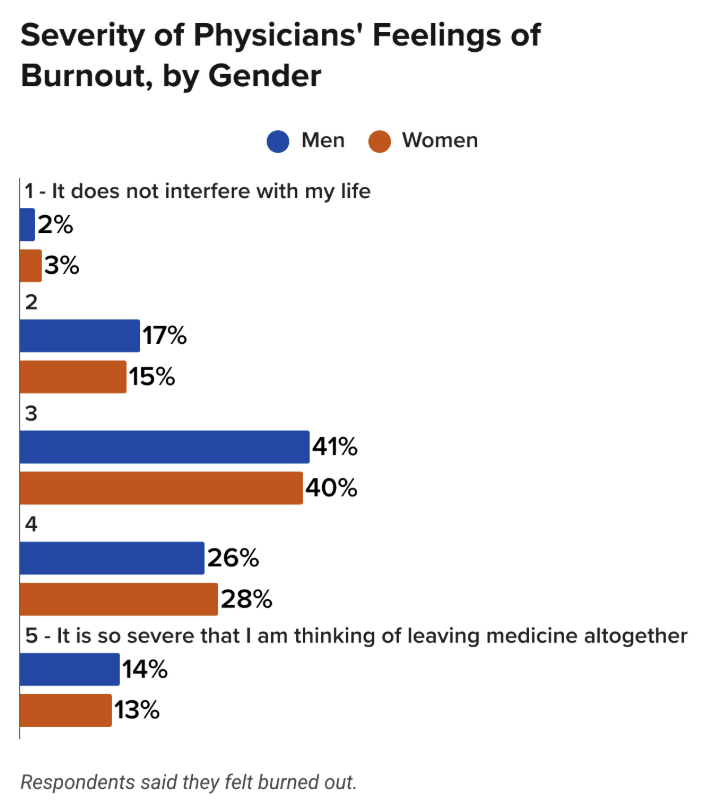
Source: Medscape
Retirement used to be a goodbye. You worked until you reached a certain age or your body gave up. The department threw you a party, and au revoir, off you ride into the sunset. Now, retirement is an “exit ramp”.
Physicians are no longer waiting to get old before they get out. Once they’ve decided the job no longer fits the life they want, they start optimizing the way out. That’s what FIRE is all about, making the transition intentional instead of it looking like you’re fleeing a burning building.
In medicine, it’s worse because the schedule is not up to you, at least not always. Shifts, call rotations, an EHR that tells you what to do next before you’ve finished the last task. Once that structure is gone, a lot of physicians who expected peaceful Tuesdays actually come face to face with a reckoning. Here are some thoughts on how to contend with it.
In case you missed it: Retire To Something: Why Physicians Need Hobbies Long Before They Need Them
Your Job Gives You Structure
In our eagerness to stop working, we often forget that our job gives us more than just a paycheck.

Financial life planner Derek Hagen points out that a job gives you a schedule that organizes your day, a direction to move toward, a sense that what you did mattered, an answer to “what do you do,” and a built-in social circle that showed up every day whether you liked them or not.
Whether you loved the job or just tolerated it, it was covering all five of those needs at once. Once you retire, you lose all that along with the paycheck. No more structure, no direction, no sense of belonging. Most people take it all for granted until it’s gone.
Hagen uses golf to illustrate his point. The prospect of retiring is exciting in the beginning because you’ve spent 30 years waiting for retirement to play everyday. When retirement finally arrives — you do get to play every day. But you can’t play all day. You take care of other things that were pending — projects and trips — but eventually you run out of stuff to fill the day the way your job did.
Studies consistently show that a good chunk of retirees eventually go back to work because the job was the one thing supplying structure, direction, purpose, identity, and connection all at once.
Most retirement planning revolves entirely on the logistical questions like, do you have enough saved, when can you afford to stop, what’s a safe withdrawal rate? A financial plan will get you to the finish line but it won’t help you figure out what to do once you’re there.
Also read: Wicked Is The Yellow Brick Road to Retirement
Losing Your Identity Overnight
For many physicians, their job title is their identity. Not something I condone, but it’s just what it is. Many of us feel like we have much more to prove, to achieve, to give.
Physician retirement brings with it the loss of this professional identity first, which turns into a loss of purpose, which in turn cascades into a loss of meaning. One can read all the articles and studies in order to be best prepared for this exact scenario but it may still catch you off-guard.
A researcher at the Harvard Business School developed a screening question to assess whether retirement might push someone toward existential crisis: would you say work is what you do or who you are?
People who answer that medicine is who they are, not just what they do, are most likely to feel lost in retirement. That’s most physicians. Because our training began long before med school, most of us developed habits that set us apart from our peers even back in junior high. It’s no wonder then that our profession can feel more than just a job.
One way to fix this is by retiring from medicine into something else that still provides meaning and a sense of contribution, rather than retiring cold turkey with nothing lined up. And I don’t mean bucket lists and a packed schedule.
Take some time to identify your core values, personal and professional. Write them out if you wish and use those to figure out what you want the rest of your life to look like. Think of it as rediscovering the person you used to be — the version of yourself that existed before you became a doctor. You might just be surprised by what you find.
Retiring Toward Something, Not Away From It
The phrase “retire to something” is often thrown around like it’s the ultimate retirement plan. It tells people they’ll magically develop new habits, energy and motivation the day they stop working.

But retirement doesn’t always transform you, it just gives you more time to be whoever you already were. Which is why “retire to something” is incomplete advice. People need to build the life they eventually want to live before retirement instead of waiting to invent it after.
Apart from that, “retiring to something” rather than from something is the difference between having something waiting for you versus getting out and then finding ways to occupy yourself. If the plan was just to escape, to be free from a job you’d grown to resent — you never give much thought to what comes after and thus end up rudderless.
A plan on paper isn’t enough either. “I’ll join a non-profit when I retire.” Okay, but what if you don’t like it? What if it doesn’t fulfil you like you had thought? Better to start participating in the things you wish to pursue after retirement before you retire.
If you want to mentor students after retirement, begin while you’re still working. If you want to run a Saturday clinic for uninsured patients, start by volunteering at one that’s already operating 1 or 2 years before you retire.
Choose what you want to do and actually start while you’re still a couple years out from retiring. You’re more likely to land on your feet that way as opposed to planning something the week before.
Yes, practicing medicine is exhausting and unforgiving and often thankless. But each and every one of us got into it because we wanted to help. If you find yourself grinding through a specialty or a practice setting you dislike purely to fund an eventual exit— maybe it’s time to reevaluate.
You don’t have to be stuck in a job that you hate. More and more physicians are choosing to prioritize their wellbeing by either cutting clinical hours, moving into medical writing or consulting, or restructuring their practice altogether.
Stop treating the job as something you have to survive and start treating it as something worth shaping into a life you wouldn’t want to escape from in the first place.

In case you missed it: Micro-retirements aren’t a shortcut to FIRE
Retirement Is Not Supposed To Be Optimized
This may be an unpopular opinion, but I really don’t think you need a hundred different activities and a packed calendar to make you feel “fulfilled” in retirement. Coming to terms with this only requires you to understand the importance of the silent moment.
Life doesn’t have to be chock-full of plans, hobbies, projects and endeavors. Who set up this standard anyway? Retirement marketing wants you to believe that having some free time to languish is the equivalent of being lazy or worse — being boring.
But remember when feeling bored used to be a normal part of being alive? Now it’s treated like a symptom. Every idle minute must be filled with a podcast, a “quick” email, a notification or scrolling.
Retirement, for a lot of people, becomes just another version of work then. They replace call schedules and shifts with pickleball leagues and travel bookings, commitments, and schedules — obligations with the glamour of choice. But obligations nonetheless.
I wonder how many of us actually want that.
I can cite burnout data and talk about retiring to or from all day, but the truth is none of us actually knows how retirement goes until we’re standing in it.
That’s why I want to hear from you. If you’ve already retired, was it everything you had hoped it’d be? If you’re still practicing, have you started building your “second life” yet or are you planning to figure it out the week before you hang up the ol’ white coat?
Learn more: How Do You Retire at 55?








1 thought on “The Idea of “Retiring to” Something”
Agree. It’s generally good advice to retire something and make plans, but lots of people online seem to be trying to create anxiety about it and sell something. I’m not going to stress out about what to do in retirement. That misses the whole point!