


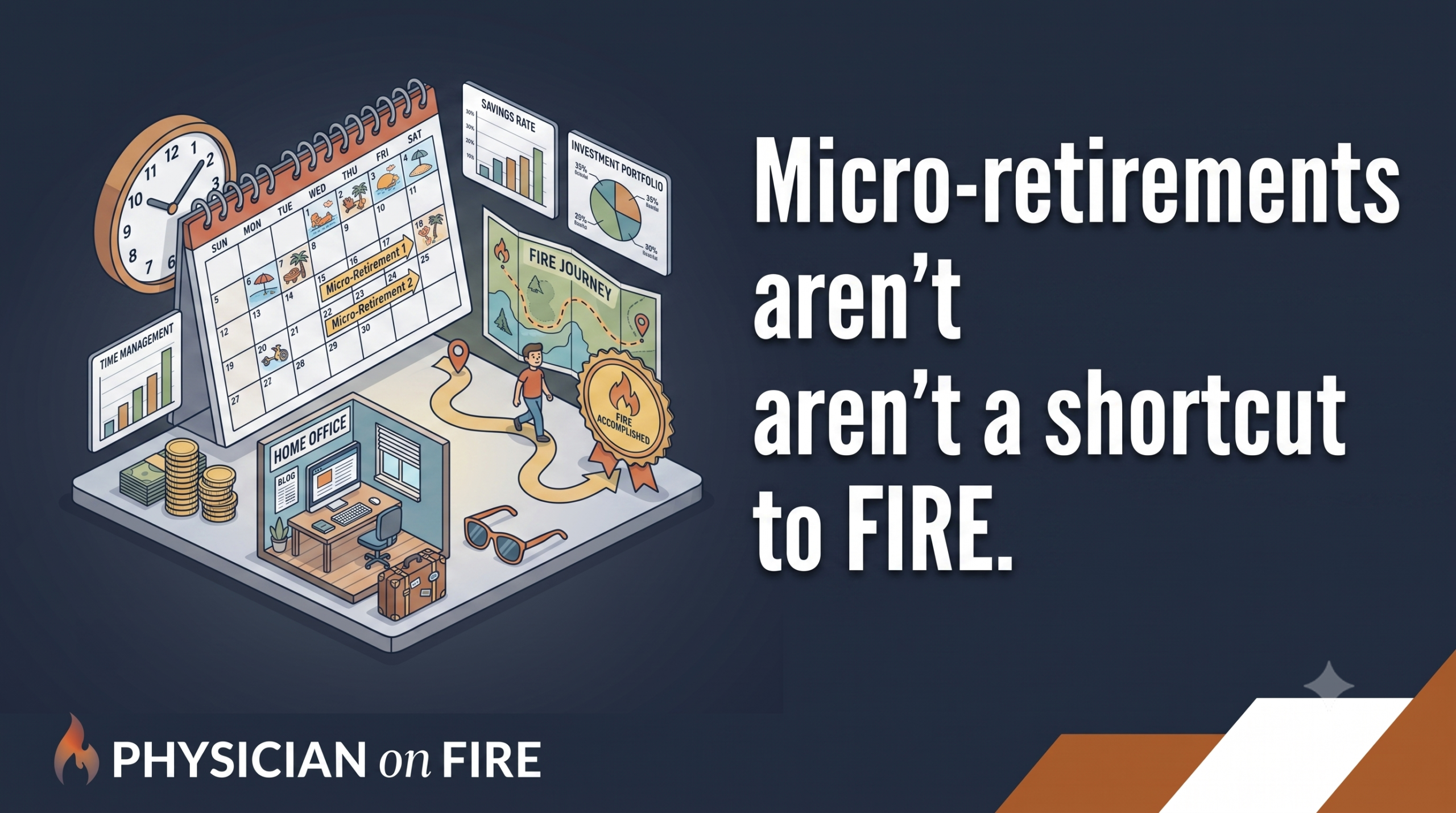
“Micro-retirement? I thought that was a vacation?”

Well, yes…and no.
A micro-retirement is an extended, unpaid career break taken years before traditional retirement age, usually to travel, rest, or reset, with the explicit plan to return to work afterward.
There’s no employer check that comes with it, and no guaranteed desk waiting for you when you’re done. It’s TikTok’s rebrand of the sabbatical, and it’s having a moment.
FIRE, on the other hand, aims to free you from the workforce permanently through aggressive saving.
So are there any merits to it? Or is it just another fad?
Let’s take a closer look at the trend than the Instagram Reels selling it are giving it.
Also read:
- Gen Z is Giving Up On The American Dream and Your FIRE Goals Just Got More Urgent
- From the Floor to the Blog: What a Decade of FIRE Taught a Hospitalist
- What HCPs across the country are saying about policy and research and why your voice matters
- The Medicaid Cuts Are Already Hurting Healthcare Jobs
Micro-Retirement Data
HSBC’s 2025 Quality of Life survey of roughly 10,000 affluent respondents across 12 markets found that 37% of Americans, led by Gen X and Millennials, are planning what HSBC calls a “work-retire-work” model built around multiple planned breaks over a career.
U.S. respondents who’d already taken one reported the experience improved their quality of life at a striking rate.
Gen Z respondents expect to take an average of 2.9 mini-retirements over a lifetime, and 77% of them feel well prepared to plan and manage the break, the highest confidence of any generation surveyed.
Separate polling from a workplace platform studying 1,000 Gen Zers found nearly one in ten Gen Zers and 13% of millennials planned to take a micro-retirement in 2025, with 59% of all employees saying they’d consider one if their employer supported it.
The motivations behind it vary by generation. Gen Z wants to use the time off to chase passion projects, millennials want to spend more time with family and Gen X wants to travel without restrictions. Unsurprisingly, every generation also mentioned burnout as a main reason.
The experts agree. Brief, intentional pauses let workers reset and return more focused and engaged.
Does Micro-retirement Actually Help With Burnout?
When it comes to medicine, burnout has become part of the job description. Physicians report chronic exhaustion at rates that outpace most other professions. The need to ‘reset’ before it spirals into full disengagement deserves merit.

Read: Why are Doctors Burning Out? Three Ways FIRE Can Save Us
Sabine Sonnentag’s stressor-detachment study found that psychological detachment from work, in the true sense, is the active ingredient in recovery. The time off itself does nothing for you. Standard vacations rarely achieve proper psychological detachment from work.
You’re still likely juggling emails or calls while trying to enjoy a pina colada by the beach. Additionally, wellbeing gained from a two-week trip tends to evaporate within a few weeks of returning.
Longer breaks give the physiology related to stress time to actually reset, which is why research on sabbaticals consistently documents reduced burnout and improved wellbeing, strongest where the detachment was absolute instead of partial.
According to experts, people generally aren’t stepping away from jobs that are going great. There’s typically a trigger like burnout or a toxic environment, and the break is a response to something rather than a whim.
The aim of a micro-retirement is to provide much-needed relief without the fear of falling behind financially, which is not the same as simply quitting and hoping for the best.
Retention also plays a part, especially for anyone running a practice or a group.
Replacing an employee typically costs half to twice their annual salary once recruiting, training, and lost productivity are counted, and a structured break that brings a physician back re-energized is cheaper than losing them permanently to burnout.
Women and Micro-retirement
Women are taking the micro-retirement trend and reshaping it to match their stakes.
Forbes profiled several women who used a micro-retirement deliberately as a financial strategy layered on an existing FIRE foundation.
One had already built a portfolio aggressive enough to fund a six-month pause without derailing her long-term number. Another used a lower-income year during her break to convert a traditional IRA to a Roth, turning what could have been a pure cost into a tax play.
One woman, now living her Barista FIRE dreams in Spain, frames micro-retirement as a recalibration rather than a retreat, provided the woman taking the break had already done the work needed.
But something the trend’s cheerleaders fail to admit is that retirement security already skews worse for women before a single micro-retirement enters the picture.
A report by Transamerica Center for Retirement Studies found that nearly half of women workers expect to retire after 65 or not at all, with 13% saying they never plan to retire, largely for financial reasons tied to lower lifetime earnings, career interruptions for caregiving, and longer life expectancy stretching the same savings further.
A voluntary pause added on top of an existing gap isn’t the universal fix-all it’s made out to be. Someone starting from a fully funded position can have her cake and eat it too. But that’s not every woman’s story.
The women interviewed all had one thing in common: preparation.

Everything from monthly expenses to health insurance, a purpose for the time off, and an exit and re-entry were all planned to a tee from the get go.
That version of a micro-retirement protects FIRE progress. A version without that level of planning can cost a woman years she just can’t afford to lose.
Why Micro-retirement Works Against FIRE
At its core a micro-retirement asks you to believe that stepping away from an accumulation phase, using up a portion of the savings you’ve already built, and returning to the workforce afterward to rebuild those same savings, counts as a form of progress toward independence.
In a clear A to B to C way, it just doesn’t. A micro-retirement is a detour from FIRE at best, if not a derailment with good PR.
Call me a diehard FIRE purist if you must, but even the experts acknowledge the risks.
The loss incurred through missed compounding is bigger than the missing paychecks.
Experts describe dollars invested in your 20s and 30s as your drive off the tee, with the most fairway ahead of them to travel.
The difference between a six-month break and a full year away, taken during peak earning years, can translate to hundreds of thousands of dollars by retirement, from the lost salary itself and the growth that money never got the chance to make.
To top it all off, financial anxiety takes away from the recovery you paid for.
An undersized fund can turn the break into months of money stress. No amount of gaslighting yourself can transform that stress into rest. It’s just unemployment with better branding. Planning for a micro-retirement requires 6 to 12 months of costs plus a separate 3 to 6 month re-entry buffer.
Plenty of departures inspired by Instagram fail to clear that bar.
Another thing to consider is that if nothing about the job actually changes, the benefits from the break are short-lived.
Benefits gained from taking a sabbatical tend to decay within months of returning to unchanged conditions. A break can treat depletion but not the misfit job itself. Workers who return to the same job that burned them out the first time frequently cycle back to the same state, having spent away a year of compounding to buy a temporary reprieve.
Also read: The Medicaid Cuts Are Already Hurting Healthcare Jobs
“Don’t stress about it” is not a plan
Some experts reassure micro-retirees in their 20s and 30s not to worry much about a missed year of saving, since it’s not hard to catch up at that age. That may be true in isolation but it’s also the kind of advice that harms FIRE timelines one reassuring exception at a time. Interruption is not a small hiccup when it has the risk of repeating.
The fantasy comes at a cost
Perhaps the sharpest critique of this trend is that if the fantasy driving the break is to never come back, a pause just won’t cut it. Treating a permanent problem with a temporary fix, funded by savings, no less, is not FIRE-adjacent. It’s FIRE-deterrent.
Physicians especially should be wary. A doctor who steps away for a year mid-career isn’t losing the equivalent of a barista’s wage. They’re choosing to forgo, on average, $386,000 in income at a time when people are grumbling about an impending recession.
Taking months off in the current labor market is either the worst idea imaginable or the best timing available, depending entirely on which way the economy breaks over the next few years, and nobody currently knows which.
That uncertainty emboldens the argument for staying the course. A physician chasing true financial independence isn’t giving up the beach for burnout.
They’re choosing between a defined, ever-shortening path to F- You Money, and a longer, reset runway that feels better in the moment, yes, but costs extra years to reach that same goal.
Does that mean you should ignore the burnout or continue to grind toward FI at the expense of your health? Not at all. But honesty is important. A micro-retirement is a wellness intervention with a not-so-micro financial bill attached. Don’t mistake it for a shortcut to the same place FIRE was taking you.
Call it what it is, take it if you must but only if you can fund it properly. Most importantly, be very aware of exactly how many years it adds to your true retirement’s horizon before you take the leap.
Learn more: The FIRE Guide to America’s Healthcare System (2026)
What do you think? Are micro-retirements worth the trouble? Or are they just the equivalent of taking the long way to FIRE? If you’ve taken one, tell me whether it delivered what you hoped or just delayed the thing you actually wanted.
Frequently Asked Questions
What is a micro-retirement?
A planned, unpaid career break lasting a few months to a year, taken mid-career with the intent to return to work. It’s not the same as a sabbatical, which is usually employer sanctioned with a guaranteed return.
Is a micro-retirement the same thing as FIRE?
No. FIRE means leaving work permanently through aggressive saving. A micro-retirement spends down savings temporarily, then returns to earning and rebuilding them.
Does a micro-retirement hurt your retirement savings?
Yes, more than most people expect. The bigger loss isn’t the paused paycheck. It’s the growth that money never got the chance to make during peak compounding years.
How much money do you need for a micro-retirement?
Most planners recommend 6 to 12 months of expenses saved, plus a separate 3 to 6 month buffer for the time it takes to find work again.
Is taking a micro-retirement riskier for women?
It can be. Women already face a bigger retirement savings gap tied to career interruptions and lower lifetime earnings, so an underplanned pause costs more than it does for someone starting from a fully funded position.
Should physicians consider a micro-retirement?
Only with a real plan. The income given up during a year away is significant, and the payoff depends heavily on whether the underlying burnout gets addressed or just postponed.







2 thoughts on “Micro-retirements aren’t a shortcut to FIRE”
I’ve never been a fan of the FIRE (Financial Independence, Retire Early) movement. While I understand its appeal, I don’t think it reflects why many doctors chose this profession. For many of us, medicine isn’t just a career—it’s part of who we are.
I grew up poor. We relied on food stamps and free school lunches. I didn’t realize how little we had until I became successful and looked back. That upbringing fueled an intense drive to achieve.
I built a single orthodontic practice into nine locations with three associate doctors and more than thirty-five employees. Professionally, it was everything I had hoped for. Personally, it came at a cost. My marriage ended, and my relationships with my older children suffered. You only have so much time and energy, and building a business often means something else receives less of both.
Eventually, I sold my practice to private equity for more than $20 million. I thought financial independence would be the reward. Instead, I found retirement surprisingly unfulfilling. I traveled the world, saw incredible places, and eventually realized I missed the work itself.
Today, I’m remarried, have two young children, and practice orthodontics three days a week in a small private office. I take regular time off, but I can’t imagine not practicing. My work gives me purpose, not just income.
That’s why FIRE has never resonated with me. If your job is simply a paycheck, retiring early may be the goal. But if your profession is part of your identity, leaving it behind may not bring the fulfillment you expect.
Ironically, I now own the things I once dreamed about as a kid—vacation homes, boats, and cabins. They’re wonderful, but they don’t compare to meaningful relationships. Today, my greatest investment is rebuilding the relationships I should have prioritized years ago.
Financial success provides freedom. It does not replace purpose, and it cannot make up for neglected relationships. If I’ve learned anything, it’s that wealth is valuable—but the people you share your life with matter far more.
CW, this is the most useful comment I’ve received on the site in a long time, and it deserves a real answer rather than a thank-you.
We came up the same way, roughly. Colombian household, both my parents on factory floors in New Jersey, shifts arranged so somebody was always home and somebody was always exhausted. I didn’t understand we were poor either. Kids don’t benchmark. You just notice which months your mother goes quiet about money. That upbringing hands you a motor that doesn’t have an off switch, which is useful right up until it isn’t.
Read your own story back. You reached financial independence, tested full retirement against your actual temperament, found it hollow, and then built a working life that fits: three days a week, small office, real time off, two young children who get a version of you that your older kids didn’t. That’s the point of the whole exercise. The acronym is terrible branding for it.
The RE half was always optional. Most financially independent physicians I know are still working, and I’m one of them. I still pick up telemedicine shifts. The money didn’t buy me an exit. It bought the ability to build a week around my family and to decline things without running the numbers first.
What should worry a 38-year-old reading your comment isn’t the retirement chapter. It’s location number nine. You paid for that expansion with a marriage and with years you don’t get back, and that bill has nothing to do with financial independence. It’s the tax on accumulation with no defined finish line. Those of us raised watching our parents work doubles are especially bad at naming a number and stopping, because the motor is the thing that got us out, and turning it down feels like betrayal. So the practice keeps growing, because growth is the skill. Then a private equity term sheet arrives and the house is quiet.
Which is why the version of FIRE that gets marketed hardest is the one I’d steer you away from recommending to anyone. There are others:
Slow FI which is a direct refusal to trade your thirties and forties for a number. You buy time back as you go, dropping the fifth clinical day at 43 instead of waiting for a liquidity event at 55. Your comment is close to the best argument for this I’ve read, and you arrived at it in reverse.
Coast FIRE which should be front-load savings during peak earning years, stop contributing, let compounding finish the job while you work lighter. Roughly where you are, funded by a sale rather than by gradual arrival.
Fat FIRE usually means having no interest in shrinking your life to fit a spreadsheet, so build a bigger number instead. Vacation homes, boats, cabins. You’re the case study.
Barista FIRE for part-time work covers insurance and some spending, portfolio handles the rest. Closest label to your three days a week.
Fast FIRE usually is high income, business equity, a sale event, compressed into a decade or so. You ran this one wide open. It works, and the cost lands on ledgers nobody audits.
One piece of pushback. Your current life is bought and paid for by that $20 million. An orthodontist without it who wanted to be present for two small kids would be working five or six days and missing the same milestones a second time. The room you have to rebuild those relationships on a three-day schedule is financial independence doing precisely what it’s meant to do. Money can’t restore what got neglected, and you’re right about that. It’s the reason you have the calendar space to try.
If you’d ever write this up at length, I’d publish it. The doctors who need it most are the ones signing a lease on location four this month, telling themselves the marriage will hold and the kids will understand. -Jorge Sanchez, MD