
Dr. Addams sold a rental property in 2021 and moved $150,000 into a value-add apartment deal. The sponsor’s deck projected a 17% IRR, the photos looked good, and the person on the Zoom call was likable. She wired the money.

What she never asked was how the debt was structured. Floating rate, three-year term, an interest rate cap set to expire in month 26. When rates moved, the loan repriced, the property stopped covering debt service, and eighteen months later she got an email asking for another $40,000 to avoid a lender workout.
Her capital didn’t get hurt because the building was bad. The building was fine. The financing was the problem, and the maturity date was printed in the offering documents she skimmed on a Tuesday between cases.
That’s the shape of most physician losses in private real estate. We’ll spend twenty minutes grilling a drug rep about study design, then commit six figures based on a slide deck. The gap isn’t intelligence. It’s that nobody has ever taught us how to tell a well-built investment vehicle from a poorly built one.
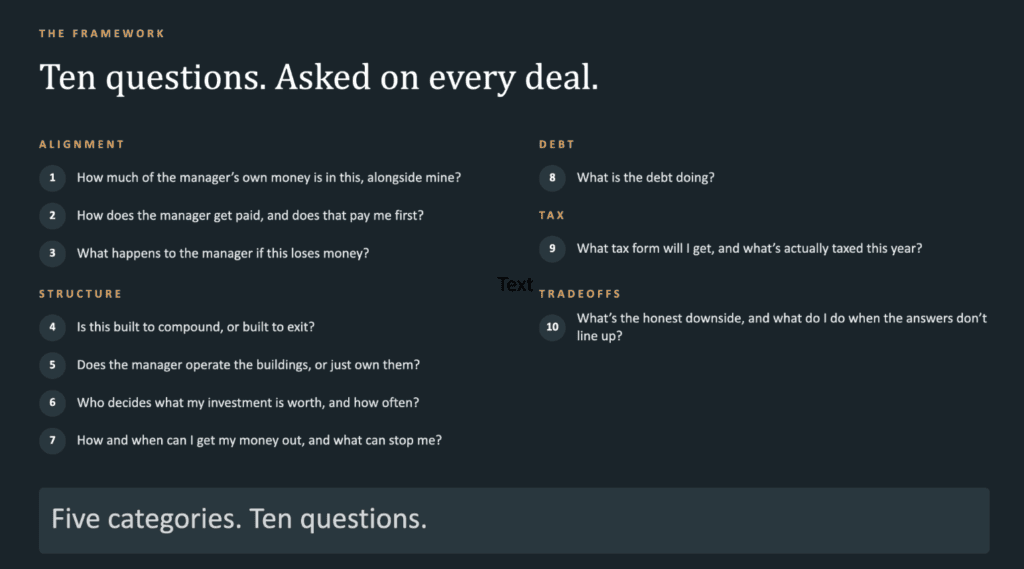
Here are the questions worth carrying into every conversation with every sponsor, forever. Ten questions, grouped into five areas.
Important information:
- A Step-by-Step Due Diligence Checklist for Physicians Evaluating Private Real Estate Debt
- The Most Expensive Western States for Prospective Homeowners
- Home Upgrades That Are (and Aren’t) Worth the Money
Alignment: start with who, not what
It’s basic instinct is to ask about returns first. That’s the wrong order. Before the vehicle, before the projected IRR, before the market, find out who is actually deploying your dollars and what happens to them if the deal disappoints.
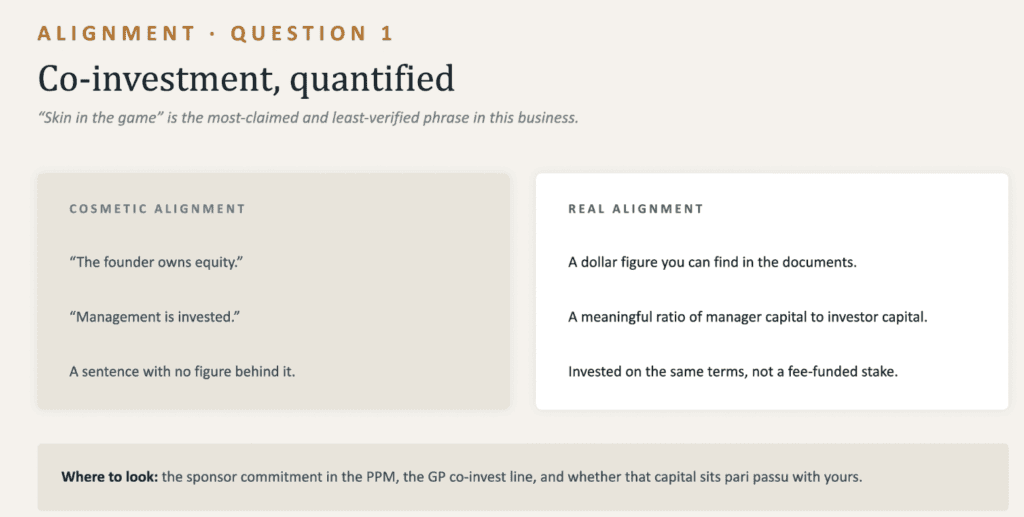
1. How much of the manager’s own money is in this, alongside mine?
Skin in the game may be the most-claimed and least-verified phrase in this business. “The founder owns equity” and “management is invested” are sentences, not numbers. What you want is a dollar figure in the private placement memorandum, divided by the total raise, so you know the ratio.

A sponsor raising $50 million with a $500,000 general partner commitment has put in one percent, which is a rounding error dressed up as alignment.
Then check two things about that dollar figure. Is it contributed cash, or is it a waived acquisition fee converted into equity? Those show up identically on the page and mean opposite things.
And does the manager’s capital sit in the same class as yours, subject to the same losses, or in a preferred position ahead of you?
2. How does the manager get paid, and does that pay me first?
Misaligned fees are the real enemy here. Each type rewards a different behavior.
Acquisition fees reward buying, whether or not the purchase works out. Asset management fees reward gathering and holding capital, and if that fee is calculated on gross asset value rather than net, the manager earns more the more leverage they pile onto your equity.
Promote or carried interest rewards performance, but only above a genuine hurdle that doesn’t quietly reset after a refinance.
3. What happens to the manager if this loses money?
Ask it as arithmetic rather than philosophy. On a $50 million raise that returns exactly the capital contributed and nothing more, what does the sponsor collect across acquisition, asset management, and disposition?
What does the investor walk away with? Run that comparison, and you learn whether your manager needs the deal to work or merely needs it to exist.

Structure: the vehicle shapes the outcome
There are three ways to own private real estate, and they compete on different axes.
Direct ownership gives you total control and depreciation you can sometimes use against active income, paid for with your evenings.
A syndication or fund buys you access to a specific deal, along with partners and a K-1. A pooled vehicle like a non-traded REIT hands the decisions to a manager and gives you diversification and simpler reporting.
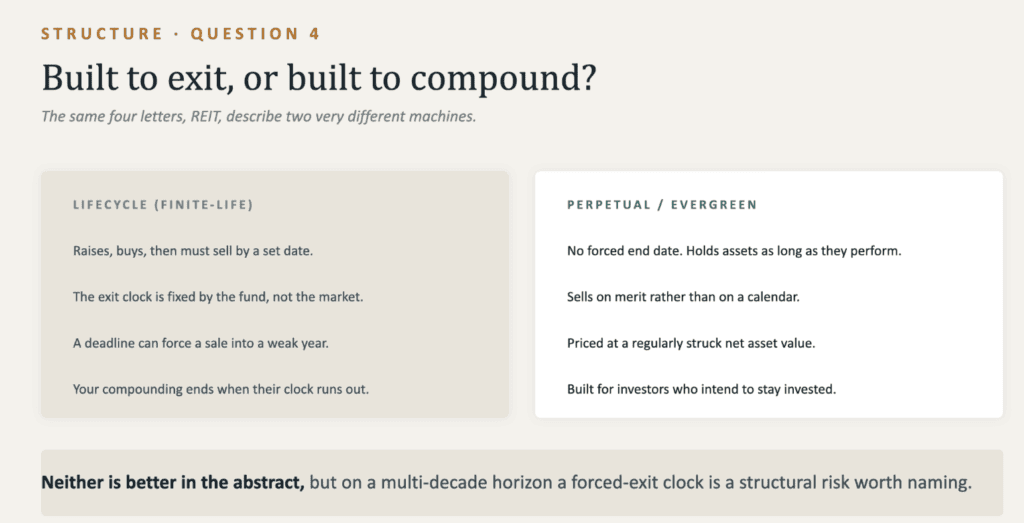
4. Is this built to compound, or built to exit?
A finite-life fund raises, buys, and must sell by a set date. That clock belongs to the fund, not the market, which means a deadline can force a sale into a weak year.
An open-ended or evergreen vehicle has no forced end date and can hold assets as long as they perform. Neither is superior in the abstract.
For a physician with a twenty-year horizon, a five-year forced exit is a structural risk worth naming out loud.
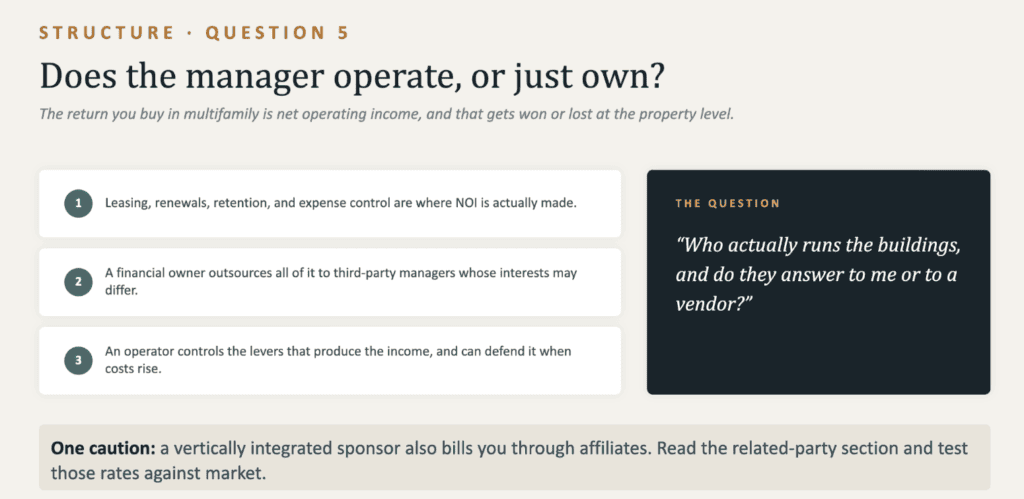
5. Does the manager operate the buildings, or just own them?
In multifamily, the return you’re buying is net operating income, and that gets made or lost at the property level every single day through leasing decisions, renewal pricing, turn times, and expense control. A financial owner outsources all of it.
An operator controls those levers and can defend the income when insurance premiums jump 14%.
One caution: vertically integrated sponsors also collect property management and construction management fees through affiliates, which no one bids against. Read the related-party transactions section and ask whether those rates look like what an unaffiliated vendor would have quoted.
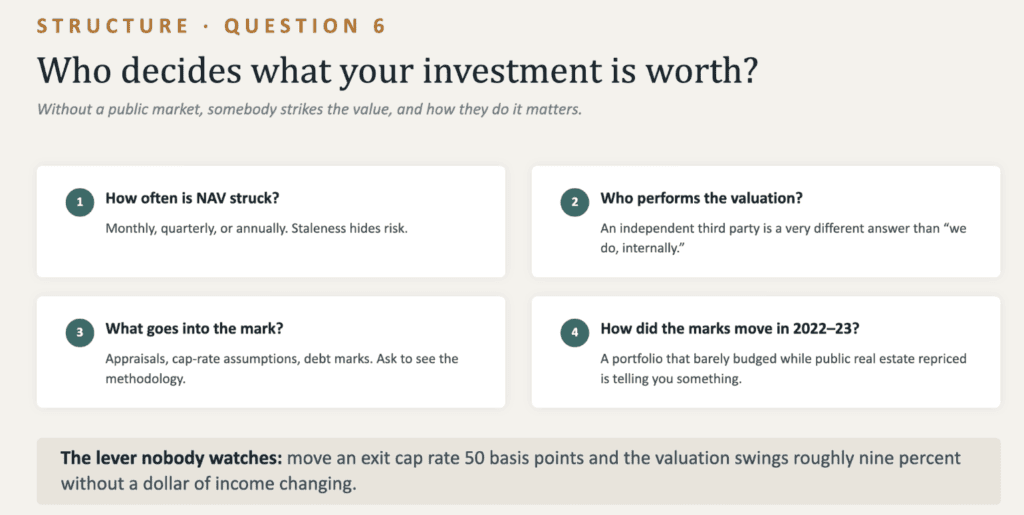
6. Who decides what my investment is worth, and how often?
In any vehicle without a public market, somebody strikes the value. That process deserves scrutiny, because the same number often drives the manager’s fee.
Ask who performs the valuation, whether an independent firm signs it or merely reviews assumptions the sponsor selected, and how often it gets updated.
Cap rate selection is the largest lever in the whole calculation. Move an exit cap by 50 basis points on a stabilized asset, and the value swings by roughly 9% without a dollar of income changing.
A portfolio whose marks barely moved through 2022 and 2023, while public real estate repriced hard, is telling you something about the marking process.
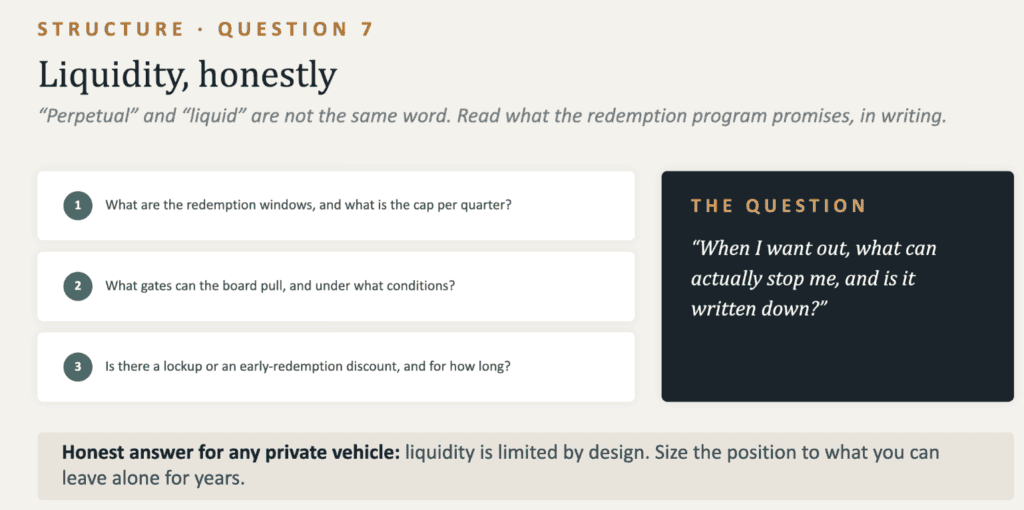
7. How and when can I get my money out, and what can stop me?
Perpetual and liquid are not synonyms. Read the redemption program in writing: the windows, the quarterly cap as a percentage of net asset value, any annual limit, the lockup period, and the early-redemption discount.
Then read the gate provision, which lets the board suspend redemptions entirely under conditions they define.
A 5% quarterly cap sounds generous until the queue is oversubscribed in a stressed market, your request gets partially filled, and you go back in line for another 90 days.
Debt: four numbers, one afternoon
More good buildings hit distress in 2022 and 2023 than bad ones. Debt will determine whether your capital survives a rate move.
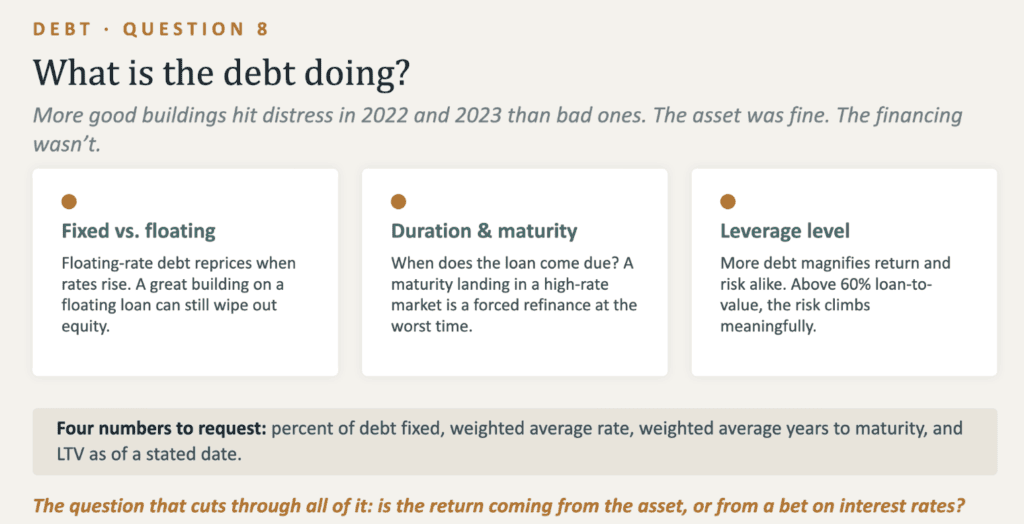
8. What is the debt doing?
Ask for the debt schedule before you ask for the track record, and get four figures: the percentage of debt that’s fixed versus floating, the weighted average interest rate, the weighted average years to maturity, and the loan-to-value against a stated valuation date.
Above 60% LTV, risk climbs meaningfully.
Any sponsor who can’t produce those four numbers within a day either doesn’t track them or doesn’t want you looking.
Tax: the form is part of the return
Two investments quoting the same headline yield can deliver very different money to a physician in the top marginal bracket. After-tax return is the only return that matters, and it’s the number almost nobody puts on a slide.
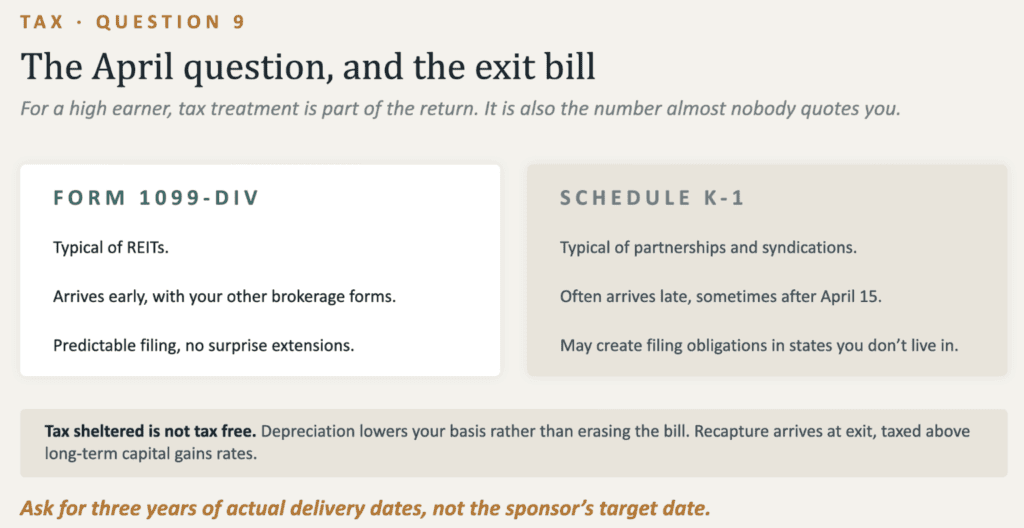
9. What tax form will I get, and what’s taxed this year?
A 1099-DIV arrives with your other brokerage forms and hands your CPA something simple. A K-1 often arrives late, sometimes after April 15, and can force an extension every year you hold the position.
Worse, a partnership holding property in six states can create nonresident filing obligations in each one, which is a real CPA bill for a doc who has never set foot in Ohio. Ask for the sponsor’s actual delivery dates over the past three years, not their target date.
Then, understand what “tax-sheltered” means, because it gets heard as tax-free. When depreciation flows through and reduces the taxable portion of a distribution, that payment becomes a return of capital and lowers your cost basis.

The tax isn’t erased. It’s deferred until you exit, where Section 1250 recapture on the depreciation piece is taxed at 25%, the appreciation piece at long-term capital gains rates, and the net investment income tax may apply on top.
Deferral is still worth real money at peak earnings. Illustratively, a 5.3% distribution that’s fully sheltered beats a 6.5% fully taxable yield for someone in the top bracket, and it isn’t close. Just know the exit bill exists before you’re standing at the closing table.
Tradeoffs: permission to walk away
Any question set that can’t produce a “no” isn’t doing anything for you. The last question is the one that turns nine diagnostics into a decision.
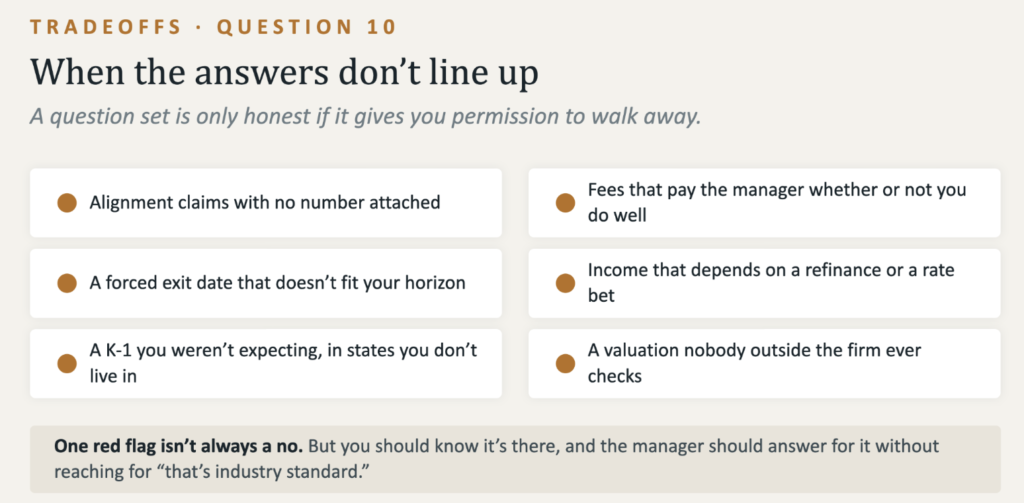
10. What’s the downside, and what do I do when the answers don’t line up?
Red flags worth naming: alignment claims with no number attached, a forced exit date that doesn’t match your horizon, fees that pay the manager regardless of outcome, income that depends on a refinance or a rate bet, a K-1 in states you don’t live in, and a valuation nobody outside the firm ever checks. One flag isn’t automatically disqualifying. But you should know it’s there, and the manager should be able to answer for it.
Watch how they answer. “Our fees are standard for the industry” is technically true and completely useless. A real answer names the number, explains what behavior the structure rewards, and puts the investor’s position first without being asked.
What ten good answers can and can’t tell you
Here’s the part a checklist won’t do for you. Ten good answers tell you the structure is fair and the incentives point roughly the same direction as yours.
That is a different claim from the deal being good. Plenty of honest, well-aligned managers have lost investor capital by making a reasonable bet on rent growth in a submarket that didn’t cooperate.
Fairness you can verify in an afternoon with the offering documents. Whether occupancy holds in 2031 is unknown to everyone on the call, including the people selling.
So size the position accordingly, and send the questions by email before your first conversation. What comes back, and what doesn’t, is the answer.