
Every physician who retired at 47 and every physician still grinding at 64 made roughly the same professional decisions. They chose comparable specialties. They invested in the same index funds. They read the same blogs, opened the same backdoor Roths, agonized over the same loan repayment strategies.

The gap between them, almost without exception, traces back to one variable. Who they went home to.
There’s a reason the FIRE community talks endlessly about withdrawal rates and sequence-of-returns risk and rarely about this. It’s uncomfortable. It implicates the person you love. It suggests that romance and spreadsheets share a bed, which feels deeply unromantic — right up until the moment you’re 58, exhausted, and calculating how many more years you have left to go.
According to a 2024 study, 26.1% of married physicians are in dual-physician households. That means the remaining 74% are navigating everything from yawning income disparities to competing geographic ambitions, often without a shared financial plan.
Meanwhile, Fidelity’s 2024 Couples & Money Study found that 53% of couples disagree on how much to save for retirement. Nearly one in four say money is their greatest relationship challenge. More than a third don’t even know what their partner earns.

Your partner’s relationship with money will do more to determine when you retire than every other financial decision you make combined. Most physicians have mapped every variable in their FIRE equation except the most important one.
This guide fixes that.
Learn more: Till Debt Do Us Part — Money Mistakes Couples in Medicine Make
Different Partnerships, Different Logistics
Is it fate? Is it luck? Nope. Your household income is a starting point. The structure of your partnership shapes every dollar that flows through it.
1: Dual-Physician Power Couple
Combined income potential: $500K–$800K+
Medscape’s 2025 Physician Compensation Report puts specialist average earnings at $404,000 and primary care at $287,000. Two physicians could theoretically pocket $600K–$800K combined. Except — that often doesn’t happen.

Source: Medscape
Research also reveals that physicians in dual-doctor marriages actually earn less individually than those married to non-physicians. Why? ‘Cause geography.
Two hospitalists each earning $320K means $640K of household income. At a 40% savings rate, that’s $256K saved annually. Need $4M for FIRE? You’re looking at 12–14 years assuming 7% real returns. Sweet.
But where the rosy projections bury the lede is that a $320K hospitalist job might have been $380K in an unconstrained market. Over 12 years, the geographic discount costs $1.44M in foregone combined gross income — roughly $860K after tax. That’s the equivalent of a beach house.
On the upside, 86.8% of dual-physician couples report marital satisfaction which is slightly higher than 85% of physicians married to non-physicians.

Although minor, this 1.6% leg up is largely due to shared understanding of the demands medicine places on a life. When your partner understands why you’re still at the hospital at midnight, that’s worth something money can’t fully quantify.
This dynamic works well when both partners value flexibility over peak earnings, both are in specialties with geographic mobility (hospital medicine, emergency medicine, psychiatry), or both are willing to do locums and travel assignments to chase income.
Learn more: Financial Planning for Dual-Physician Households: Optimizing Your Wealth for Success
2: Physician + High-Earning Non-Medical Partner
Attorney/software engineer/finance professional. Combined income: $450K–$750K
The money looks spectacular on paper. However, the logistics can be brutal.
When two high-achievers are both grinding, neither can afford to blink. Full-time childcare in major metros now costs more than rent, going as high as $1,996 per month.
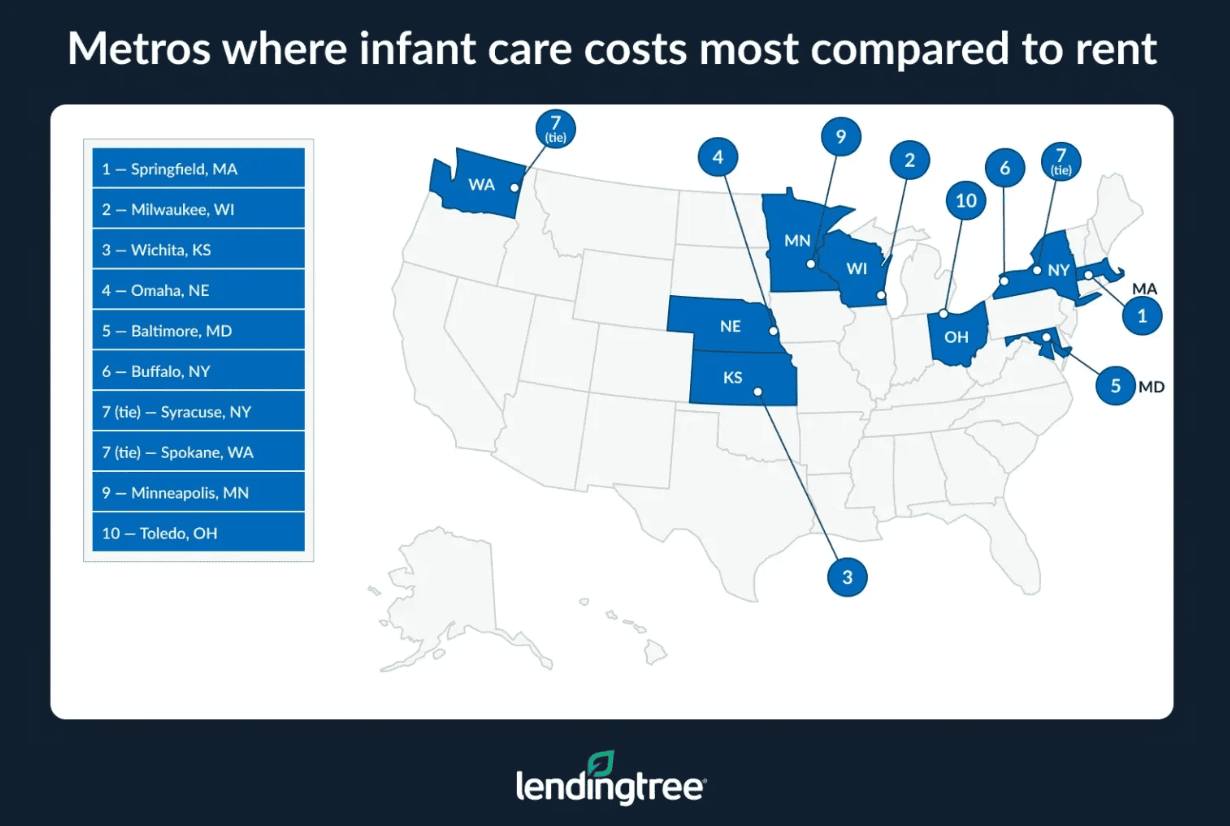 Source
Learn more: What It Really Costs to Raise a Child in the Age of AI
Add in household help, the convenience premium of DoorDash at 11pm and dry cleaning you never get the time to pick up, and you’re burning cash at a clip that’s shocking physicians who assumed their income would feel limitless.
Here’s a projected budget (all figures are approximations for illustration using 2026 tax law; actual liability varies significantly by state, deductions, and retirement contributions):
- Physician $350K + attorney $200K = $550K gross
- Federal income tax (22% effective rate, joint filers, $32,200 standard deduction): –$121K
- State income tax (varies widely: 0% in TX/FL/SD to 9–10% in CA/NY — illustrated here at 5%): –$27K
- Employee FICA (Social Security 6.2% on first $184,500 of each earner’s wages + Medicare 1.45% on all wages + 0.9% Additional Medicare Tax on combined wages above $250K): –$22K
- Childcare (2 kids): –$50K
- Household help: –$15K
- Convenience premium: –$8K
- Actual usable income: ~$243K (moderate-tax state) to ~$190K (California)
Save 50% of that ($121K annually) and you’ll hit $3M in roughly 18 years at 7% real returns. But that requires both partners staying in high-stress careers for nearly two decades.
The Fidelity study found that more than 1 in 4 partners admit being frequently frustrated by their partner’s money habits but let it go to keep the peace. In dual-high-earner households, that frustration can solidify into resentment before you’ve hit your FIRE number.
You’re in for success if both partners genuinely love their careers (not just their salaries), are comfortable with aggressive outsourcing, or one partner has meaningfully more flexibility.
Also read: 11 Ways to Invest in Your Child’s Future
3: Physician + Moderate Earner
A physician earning $300K married to a teacher who brings home $60K puts their household income at $360K. At a 35% savings rate ($126K annually), you hit $3.15M in roughly 16 years.
What you need to watch out for in this scenario is the invisible imbalance that develops when income is radically asymmetrical.

The lower-earning partner can feel like a minor shareholder with no voting rights. The physician starts feeling like they’re hauling water for two without acknowledgment. Nobody talks about it openly because it feels too loaded to touch. They watch their FIRE number creep upward while their relationship suffers.
Research has found that income disparity alone does not predict marital discord but differing financial values can cause problems. The number on the paycheck matters far less than whether both partners are rowing in the same direction.
Couples can make this scenario work if you establish from day one that it’s “our money” regardless of who earned it. Both partners get equal input on major financial decisions. You’re aligned on FIRE goals versus lifestyle spending. The lower earner’s contributions, financial and otherwise, are named and appreciated.
In case you missed it: To Have Kids, or to DINK: Why Having Kids Can Push Out Retirement Timelines 15+ Years
4: Physician + Stay-at-Home Partner
Only 11% of female physician households have a stay-at-home spouse, compared to 35% of male physician households.
Counterintuitively, a financially-engaged stay-at-home partner can accelerate your FIRE timeline compared to being single.
When you’re a single physician earning $400K, you’re unknowingly also paying a “single tax” in the form of:
- Meal prep services / eating out: $12K–$18K/year
- House cleaning (biweekly): $6K/year
- Lawn care and home maintenance: $4K/year
- Convenience premium: $3K/year
- Total: $25K+ annually
A financially-savvy stay-at-home partner who runs household management like a tight ship generates measurable economic value by:
- Meal planning and cooking, which saves around $12K/year
- Handling cleaning and home maintenance, saving around $10K/year
- Managing bills, HSA optimization, tax prep. This saves time and catches money leaks
- Strategic credit card rewards which adds $2K–$4K/year
- Eliminating convenience tax, saving roughly $3K/year
- Total: $27K–$30K annually
Here’s a 15-year comparison at 7% real returns (tax figures are approximations for illustration):
| Single Filer Physician, 2 Kids (Head of Household) | Physician + Stay-at-Home Partner, 2 Kids (MFJ) | |
| Gross income | $400K | $400K |
| Federal taxes | –$120K (23% effective) | –$107K (21% effective, MFJ + dependent credits) |
| Childcare | –$50K | $0 |
| Household outsourcing | –$25K | $0 |
| Living expenses | –$75K | –$70K (partner optimizes) |
| Annual savings | $130K | $223K |
| 15-year wealth (7% real return) | $4.05M | $6.6M |
A difference of $2.55M over 15 years. And that’s despite the income loss, but because of the operational efficiency a dedicated household manager creates.
However, this only works under the condition that the stay-at-home partner is open to dive into financial literacy, and both partners frame it as a genuine economic partnership. A stay-at-home spouse who treats their role as a lifestyle rather than a leg-up is a different calculation entirely.
5: Physician + Partner with Significant Debt
How common is this? 30% of graduate students carry student loan debt averaging $95,104 per borrower. You will meet this scenario at the altar or at the closing table.
The financial impact of $100K in partner debt at 6.5% interest equates to:
- Minimum payment: $1,140/month
- Total paid over 10 years: $136K ($100K principal + $36K interest)
- Opportunity cost if that money were invested at 7%: $197K
- Net opportunity cost: $61K — approximately 2 years of delayed retirement
Want to get out? It’s completely and perfectly doable. Here are three ways you can swing it:
- Aggressive payoff: Funnel $3K–$4K/month. Clear it fast, then redirect that payment to investments. Best when loans carry rates above 6%.
- Slow payoff while investing: Make minimums, invest the difference. Works when the math favors arbitrage (loan rate below expected market return).
- Hybrid: Balance extra payments and investing. Psychologically satisfying, mathematically middle-of-the-road.
Here, the dynamic matters more than the numbers. Hold the debt over your partner’s head and you’ll poison the relationship while watching your net worth stagnate anyway. Create a joint plan with full transparency and you can survive it.
Learn more: How Much Student Debt Does the Average Doctor Owe? The Ultimate Solution Guide
The Mechanisms That Derail Your FIRE Timeline
Forget market crashes and bad investments. The forces most likely to push your retirement date a decade in either direction are hiding in plain sight.
1: Geographic Handcuffs
This is the one physicians underestimate most dramatically. Geography isn’t just a matter of preference, it’s a hefty financial decision disguised as a lifestyle choice.
Consider:
- A cardiology job in Sioux Falls, SD earns you $475K salary + $120K signing bonus + $100K loan repayment = $695K in the first year
- A cardiology job in the Boston suburbs, on the other hand, $335K. That’s it.
Over 10 years that amounts to:
| Sioux Falls | Boston | |
| Total gross | Approx. $5M | Approx. $3.4M |
| After-tax | Approx. $3.2M (SD no state income tax) | Approx. $2M (MA 5%) |
| Net difference | $1.2M |
Now factor in cost of living. Boston is substantially more expensive than Sioux Falls with Redfin stating that Boston is 70% more expensive. If you spend $100K/year in South Dakota, you’re spending $170K in Massachusetts. That’s a $70K annual gap. $700K over 10 years.
Combined with that $1.2M lost in earnings, you fall roughly $1.9M behind by staying in Boston.
If your FIRE number is $3M, that geographic choice represents over 60% of your entire target. It’s the difference between retiring at 45 versus at 52. Seven years of your life, traded for proximity to family or a city you love. That might be the right call. But it should be a conscious call.
Also read: Top States for Physicians to Achieve Financial Independence and Early Retirement
2: Lifestyle Inflation vs. Shared Financial Values
Research has identified diverging “money scripts” — the unconscious beliefs about wealth formed in childhood — as potential cause for financial conflict in long-term partnerships. Since these beliefs are usually emotional in nature as opposed to rational, they’re often difficult to argue someone out of.
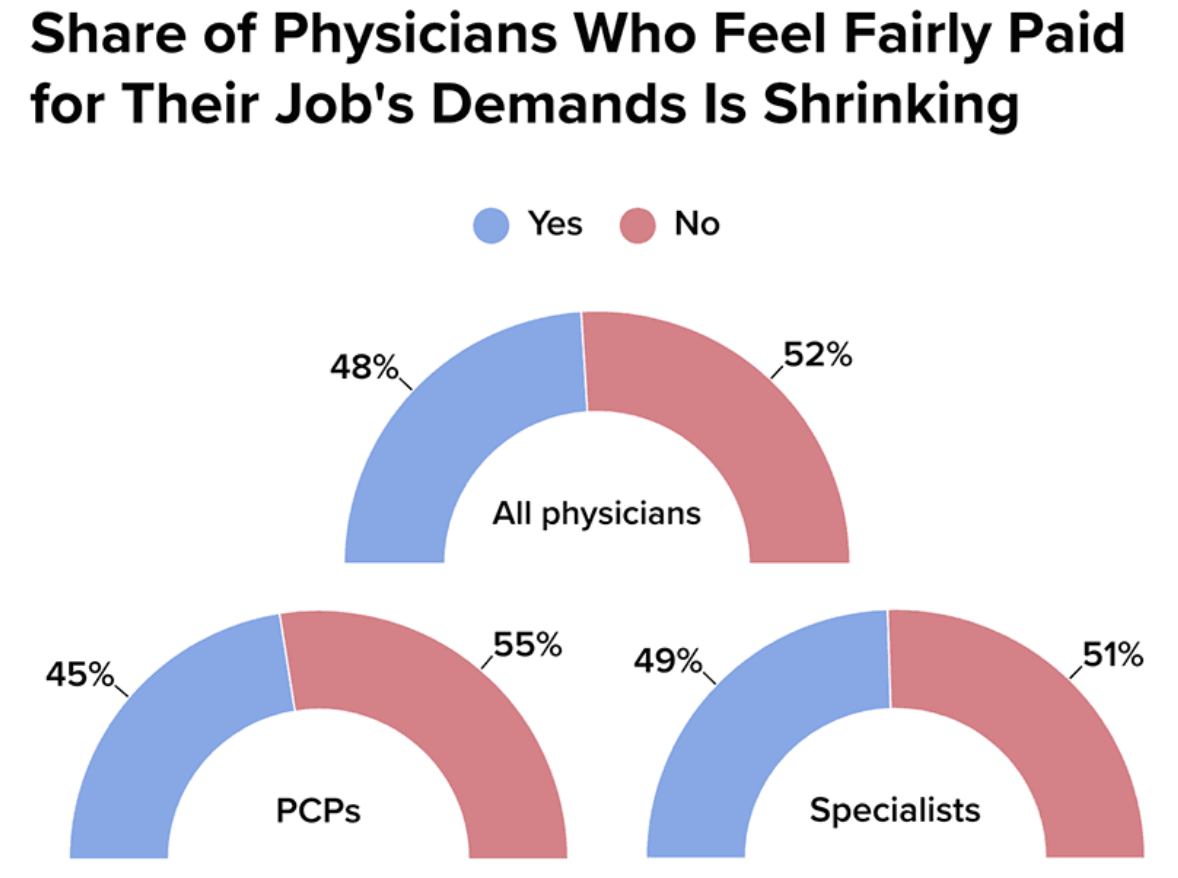
Medscape’s Report reveals only 48% of physicians feel fairly compensated — the lowest figure in a decade. When you feel underpaid at $350K, lifestyle inflation becomes its own logic.
You deserve that BMW.
You earned that $4,500/month apartment.
C’mon, you’ve been deferring gratification since forever.
The compounding effect of that reasoning amounts to:
| Year | Decision | Annual Cost Increase |
| Post-residency | Rent goes from $1,800 to $4,500/month | +$32K/year |
| Year 2 | A $65K BMW vs. the $35K Toyota | +$30K (financing) |
| Year 3 | Vacation budget jumps from $8K to $25K | +$17K/year |
| Year 5 | A $850K house vs. the $500K house | +$25K/year carrying cost |
| Total | +$104K/year |
Once quantified, (over 25 years at 7% real returns) that $104K/year lifestyle inflation costs $6.4M in foregone wealth. Oh boy.
Data shows that 40% of high-earner households earning over $300K still live paycheck to paycheck. Many of us also barely save 15% despite the capacity to save 30–40%. The difference is almost entirely discretionary lifestyle inflation, and it almost always reflects the values of the couple, not just the earner.
In case you missed it: Is Driving a Honda Smarter Than Flexing a Ferrari? Thinking About the “Doctor Car”
3: Career Sacrifices and Specialty Selection
Data shows female physicians in dual-physician marriages are more than twice as likely to interrupt their careers for a partner’s career — 25% versus 11%.
When choosing specialties, if the choice comes down to orthopedic surgery ($564K, high-income but poor work-life balance) or pediatrics ($265K, low-income, better work-life balance), your partner’s flexibility can make all the difference. If your partner is flexible you can go for ortho, match in the right market, optimize earnings and earn a 10-year gross of $5.64M.
If your partner anchors you to a specific city where ortho positions are limited to academic medicine, you can earn $379K in academic ortho (10-year gross income of $4.25M). Or you could pivot to pediatrics for better work-life balance (10-year gross of $2.65M).
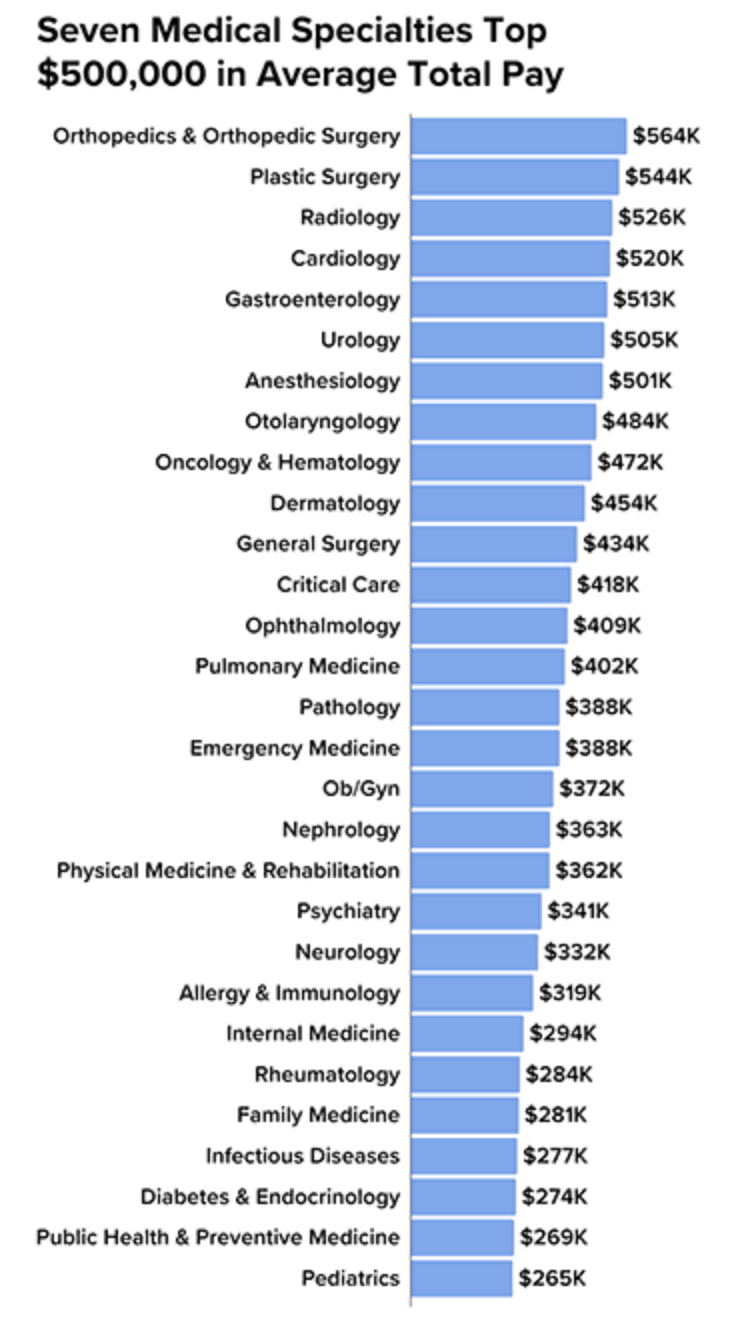
The specialty plus geography gap at the worst case means a loss of $2.99M over 10 years (before tax). Across a full career, partner-driven career constraints account for $1M–$3M in foregone lifetime earnings for physicians who never ran the explicit calculation.
It’s a conversation most couples don’t have. If one spouse takes path XYZ instead of ABC for the other’s career, there is an exact dollar amount you are choosing to trade away. Are you both genuinely okay with that?
Also read: Physician Compensation 2025: Modest Gains and Deeper Financial Pressures
4: Retirement Timeline Misalignment
This is where FIRE dreams go to die. You spend fifteen years building toward a specific vision of freedom. Your partner has built a different life entirely. Neither of you knew about the other.
You’re 45. You’ve hit $3.8M. You’re done.
Your partner is 43, genuinely loves their job, and has given zero thought to retiring before 62. That’s another 19 years.
Now, you’ve got three options, each with their own trade-offs:
- Option 1: You retire, they keep working. You get freedom. The household retains income. But that asymmetry can breed resentment — theirs at watching you relax while they commute, and yours at feeling guilty for something you spent fifteen years earning.
- Option 2: Both go part-time. This compromise feels fair. The problem is…you’re still working when you’re financially free, and part-time medicine frequently involves more administrative friction with less of the clinical satisfaction that made the work tolerable.
- Option 3: Keep working until they’re ready. Relationship harmony. A larger nest egg. But also 15–19 additional years of your best physical health spent in a building you were ready to leave.
A JAMA Internal Medicine study found that physician couples with children (youngest child aged 1–2 years) work a combined average of 96.8 hours per week. The last thing such a household needs is ambiguity about the finish line.
If you’ve been transparently pursuing FIRE for fifteen years and your partner has attended every net worth conversation and every annual goal review but they still pull the “I’m not ready” card at the finish line — you’ve got a problem. And this one can’t be solved by a financial planner.
The Money Conversations You Need
Every phase of a physician’s financial life has a conversation that belongs in it. Skip them and you spend the rest of your career making up for it.
The early stages of a relationship give you a chance to calibrate.
You can listen for how someone thinks about money, without judging their net worth.
Questions like “How did your family talk about money growing up?” “What does financial security mean to you?” and “What does your dream retirement look like — and when?” help you gauge the long-term viability of your relationship.
Complete avoidance of these topics is a red flag. So is significant undisclosed debt mentioned casually, as if it belongs to a past version of them that no longer applies.
Of course, don’t pull out a spreadsheet on the third date. But…you need to know if your financial thinking aligns with theirs before things get serious. It’s not easy to come by a perfect match but should be rowing in the same general direction at the very least.
Six to twelve months before marriage is where you pull back the curtain entirely.
Do a complete debt inventory, both credit reports need to pulled and discussed candidly, honestly discuss income and career trajectory projections, write down a FIRE goal with a specific number and a specific age, and have a heart-to-heart about kids and college funding (how many, who takes career hits, who funds the 529s).
Note that for 2026, the backdoor Roth IRA phase-out for married couples filing jointly now begins at $242,000–$252,000 MAGI. Getting married doesn’t just change your relationship status — it restructures your entire tax optimization architecture overnight. It’s best to run the numbers before the wedding, not after.
Real-World Case Studies
We stand on the shoulders of those who came before us. Physician on FIRE has always been a community where we’ve talked openly about our ups and downs. This candor has led to the accumulation of a treasure trove of wisdom that stands the test of time.
The following case studies are drawn from interviews in Physician on FIRE Q&As, where physicians document their financial journeys. These profiles were published in 2022–23, so specific figures like salaries, net worth, and account balances reflect that moment in time and will look different in today’s market.
The dynamics, and decisions of these couples, however, are evergreen. If your numbers are in the same ballpark, their experience is still directly relevant to yours.
Case Study 1: Dual-Physician Couple
A dual-physician couple profiled in FIRE Crossroads 034 (a neurologist and a gastroenterologist, both in their mid-40s, living in rural Tennessee) arrived at a $4.2M net worth with $40,000 per month in take-home pay and a crystal-clear plan.
Their minimum FI number was $3M (which they’d already surpassed), but they were targeting $5M or more before fully stepping back.
Both were first-generation immigrants who attended public universities on full scholarships, lived well below their means throughout training, and invested consistently across 401(a), 401(k), 403(b), and Roth IRA accounts.
Their only debt was a mortgage and car payment totaling $400K at rates below 4%, which they chose to carry rather than pay off — preferring to keep the investment arbitrage working in their favor.
What makes their story instructive for partnership dynamics is the transparency of their ongoing negotiation. The husband planned to work five more years then reassess. The wife was already exploring part-time and locums work. They’d had regular, explicit conversations about how long they each wanted to continue practicing. Not a one-time retirement discussion, but an evolving dialogue that kept both partners oriented to the same destination even as the timeline shifted.
They’d also gone through the classic physician spending arc of rewarding themselves with material things early in their careers together. Recognizing the diminishing returns, they slowly started simplifying — a choice that required both partners to arrive at the same realization.
Case Study 2: Dual-Physician Academic Couple
The couple profiled in FIRE Crossroads 024 are both academic medicine physicians, mid-40s, with three school-age kids and a net worth of approximately $5.5M — already at Coast FI. Their portfolio consists of 81% equities across maxed 403(b), 457, and backdoor Roth accounts.
The friction in their household was that one spouse planned to retire earlier; the other, who genuinely enjoyed patient care, planned to work until at least 55.
They’ve navigated this openly. The earlier-retiring partner kept the other updated throughout accumulation, so there’s no finish-line surprise waiting. They also planned to open a franchise in retirement, giving the partner who wants to keep busy a meaningful post-medicine chapter.
Their approach to the retirement timeline mismatch should be the template: no pressure, full transparency, a shared understanding of the numbers, and individual flexibility on the exit date. This couple disagreed on when to retire but still made it work — because they talked about it for years rather than saving the conversation for the moment one of them was ready to quit.
Case Study 3: Pediatrician Retired at 53 After 23 Years in Private Practice
The physician profiled in Post-FI Notes 020 retired after 23 years in pediatric private practice, the last 18 as a co-owner with partners. Her spouse is a software engineer; they’re based in the Southwest in what has become a high-cost-of-living market. Together they tracked 12 years of precise expense data, with annual spending ranging from $125K to $270K depending on home and travel costs.
Two details stand out for the partnership dynamic. First, her flexible co-ownership structure (negotiated with her family situation in mind) allowed the couple to travel several weeks per year throughout accumulation, rather than deferring all quality of life to retirement.
Second, she explicitly noted that FIRE made her a better spouse. With her attention no longer divided, she became more present in ways that benefited their marriage. Her husband diplomatically agreed.
They waited until their last child left for college before pulling the trigger — two financially independent peas in a pod.
Case Study 4: Retired Cardiologist
The couple in Post-FI Notes 024 retired to Florida with 35 times their annual expenses in the bank. He was 66, a retired cardiologist; she was 61 and had worked as an office billing manager. Their core annual spending ran around $103K, with total spending including taxes, gifts, and home improvements around $189K.
Their portfolio could support $250K in annual withdrawals and still be under 4% — a comfortable margin.
What their story illustrates is a staggered retirement reality that many couples don’t plan for. When he retired, so did she. They had the money, so why not? Most couples won’t have that structural simultaneity. Most will need to plan the timing explicitly, together, well in advance.
The post-retirement challenge he documented is also the one nobody talks about enough: boredom. Every post-FIRE physician eventually figures out that you need to have something to retire to, something to look forward to. As in his case it turned out to be volunteering at a free clinic, gardening and RV road trips across the country.
That something, like everything else in this article, requires both partners to have been part of the conversation.
Structures That Work
If you think couples who don’t fight about money just got lucky, think again.
Most of them built structures that removed the ambiguity money fights feed on. Here are four frameworks that do exactly that, followed by questions that address the situations most of us are too polite to touch directly.
The “Yours, Mine, Ours” Account Structure
The single most effective structural fix for dual-income physician couples is also the simplest: three accounts, one rule.
Both partners contribute 60–75% of gross income into a shared “Ours” account that covers the mortgage, utilities, groceries, kids’ expenses, and all shared savings goals. What’s left remains separate for personal discretionary spending, entirely autonomous, zero reporting required, zero judgment extended.
Take Dr. A earning $320K and Dr. B earning $210K. That’s $530K combined. At a 70% joint contribution rate, $371K flows into the shared pool. Dr. A keeps $96K personal; Dr. B keeps $63K. The dollar amounts differ, but the structure is identical. Neither partner needs to ask permission to buy something. Neither is silently resenting the other’s spending. The joint contributions are sacred and non-negotiable. Everything else is yours to do with as you please.
The Monthly Money Date
Thirty minutes. First Sunday of every month (or whatever works). Same time, same comfortable setting. Don’t mistake this for a budget review or performance evaluation. It’s a date. A standing check-in that keeps both partners oriented to the GPS.
- The first five minutes cover last month: any spending surprises, any wins, anything that felt off.
- The next five cover what’s coming: large purchases, annual bills, anything on the horizon that needs coordination.
- The middle ten are the most important: FIRE progress, net worth update, runway calculation, debt status.
- The final ten are for concerns and adjustments, the things one partner has been carrying quietly that need to be said out loud before they turn into resentment.
Two operating rules are required to make it work smoothly. First, no blame, and second, no major decisions made during the meeting itself. Discuss, then decide separately. Also, end on something positive.
This practice, maintained consistently, does more for long-term financial alignment than any one-time planning session or annual review ever will.
A Written Goal Alignment Document
We don’t give enough credit to writing stuff down anymore. Call me old-school but it works.
Both partners write down specifically, numerically, with actual dollar amounts what their one-year, five-year, and ten-year goals look like.
- One year: pay off $X in debt, max all retirement accounts, build $X emergency fund.
- Five years: reach $X net worth, make the housing decision, consider career shifts.
- Ten years: hit the FIRE number, resolve college funding, clarify mortgage status.
Both partners sign it. Put it somewhere visible — in a shared notes app, or somewhere it becomes ambient rather than filed away and forgotten. When you’re arguing about a $15K kitchen renovation six months from now, you pull it out and ask, “Does this help or hurt our five-year goal?” The argument either ends or becomes a genuine conversation about values, which is the only version of that argument worth having.
The Geographic Decision Matrix
When a job offer requires a decision about location, run the financial calculation first and completely. This means a ten-year salary differential after-tax, signing bonuses, loan repayment offers, cost of living adjustment, one-time relocation costs. Get to a single number.
Then, separately, score the non-financial factors on a 1–10 scale. Career advancement for both partners, family proximity, schools, quality of life, partner’s career options, overall happiness.
A financial gap above $500K over ten years with a neutral-to-positive non-financial score is a strong signal to move.
A moderate gap between $100K and $400K means that non-financial factors carry more weight.
A gap below $100K means the non-financial aspects decide for you. It’s a straightforward way to quantify a decision that could otherwise easily degrade into nostalgia or inertia.
Also read:
FIRE vs. Fat FIRE: Ditch the Dogma, Find Your Path to Freedom
How FIRE Made Me a Better Parent