



The average physician salary in the US is $386,000 in 2026, according to the Medscape Physician Compensation Report. Eight specialties now average above $500,000, led by orthopedic surgery at $611,000. Family medicine sits at $288,000. But these averages hide a more important story.

Key Takeaways:
|
According to the 2026 Medscape Physician Compensation Report, physician pay in the US rose around 3% in 2025, for primary care physicians and specialists both. Eight specialties now average over $500,000 a year, and more doctors say they feel fairly compensated at the highest level seen in the past three years.
But averages hardly ever tell the whole story.
Somewhere in Texas, a primary care physician is barely treading water, bringing in less than $100,000 after accounting for overhead, malpractice premiums, and the pinch of Medicare reimbursement cuts. That side of the story rarely shows up in survey averages.
In this article, I’ll pull data from the 2026 Medscape Physician Compensation Report, the 2025 Doximity Physician Compensation Report (which covers 2024 compensation data from over 37,000 physicians), and Marit’s continuously updated community-sourced salary database to give you something more useful than a single number.
This is the only article you’ll find on the web comparing all three reports.
Important articles you shouldn’t miss:
- Understanding RVU Compensation Models: What Physicians Need to Know
- Why Most Doctors Retire With Too Much Money (And What to Do About It)
- Is the 4% Rule Too Frugal for Doctors?
How Much Does the Average Physician Make in 2026?
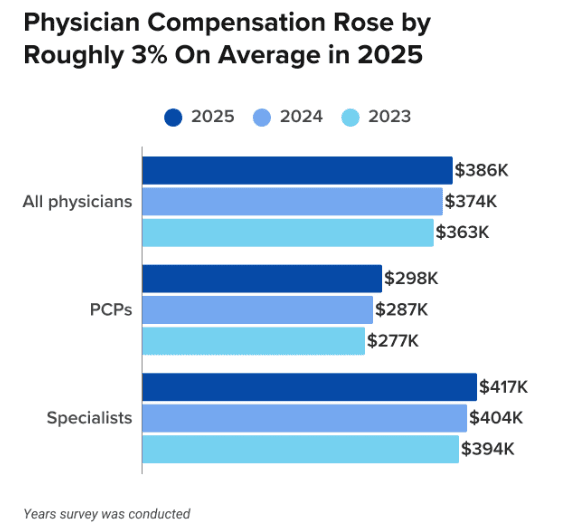
The 2026 Medscape survey shows average physician compensation at $386,000 — up from $374,000 in 2025 and $363,000 the year before. That’s a legitimate two-year trend in the right direction. It also outpaced the annualized core US inflation rate of 2.7% at the end of 2025, at least modestly.
Source: Medscape
But that average buries the lede on a $500,000+ spread between the top and bottom of the profession.
According to Doximity’s data from 2024 (published in 2025), the average pediatric endocrinologist makes $230,426 per year.
The average neurosurgeon makes $749,140. That’s a difference of roughly $520,000 but both count toward the same “average physician salary.” Knowing that average tells you almost nothing useful about an actual doctor’s compensation from either specialty.
Individual circumstances only aggravate this disparity.
A solo primary care physician in a low-reimbursement state, carrying overhead for staff, rent, and malpractice, seeing a predominantly Medicare and Medicaid panel, can net under $100,000 (sometimes significantly under) after expenses.
No survey captures that because most ask about total gross compensation before practice costs.
Doximity’s data shows that average physician compensation grew 3.7% in 2024, but that modest growth “comes amid several consecutive years of reimbursement cuts — a trend that many physicians worry could impact their ability to care for Medicare and Medicaid patients.”
According to the American Medical Association, Medicare physician payment has dropped 33% since 2001 after adjusting for inflation.
A 3% raise means something very different depending on your starting point and your cost structure.
Per Becker’s coverage, of the Medscape report, pathology had the lowest pay growth at 1% while cardiology had the highest at 10%, and seven specialties saw outright pay decreases (PM&R, nephrology, dermatology, oncology, pulmonary, allergy, psychiatry).
Medscape’s 2026 report shows the primary care vs. specialist divide clearly. On average primary care physicians make $298,000, while specialists average $417,000. That’s a $119,000 gap at the average — at the extremes, it’s a different profession entirely.
Learn more: Why High Income Doesn’t Guarantee Financial Security
Why 53% Physicians Saying They’re “Fairly Paid” Is Both Good and Not Good Enough
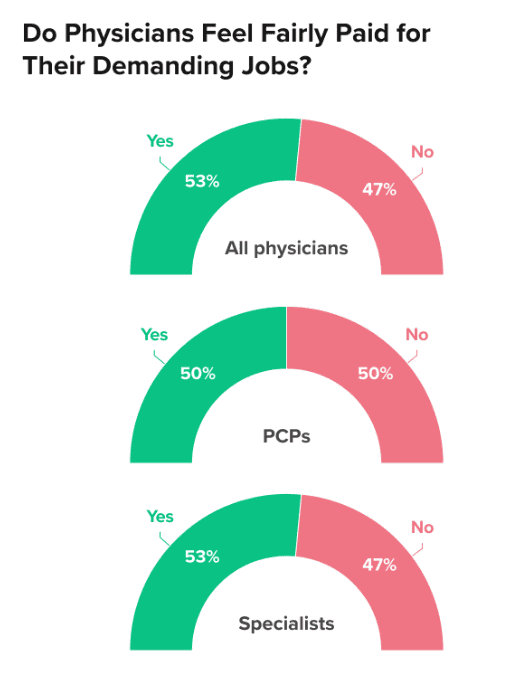
When Medscape asked in last year’s report whether doctors felt fairly compensated, only 48% answered yes (45% of PCPs and 49% of specialists). Medscape called it “the most dispirited response we had received in 10 years.”
In the 2025 survey, 53% said yes. Medscape associates this rebound with the broader “return to normalization” in physician compensation. But 47% of physicians still don’t feel fairly paid.
Source: Medscape
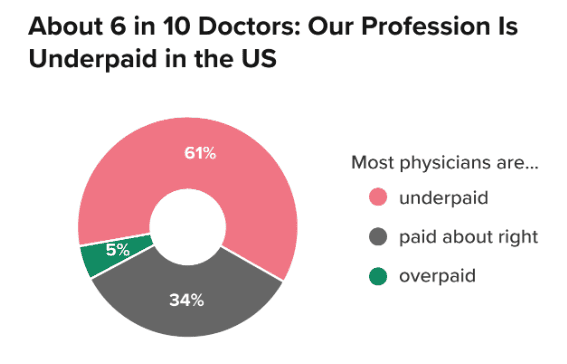
When asked whether the medical profession as a whole is underpaid in the US, 61% said yes, the same figure as last year.
Source: Medscape
Pathologists and public health specialists were among the specialties that most often answered yes to the fairness question (69% and 66%, respectively), even though both ranked in the bottom half of compensation growth in 2025.
Ultimately, satisfaction goes beyond income to autonomy, patient relationships, and administrative burden.
Also read: Why Saving The First $10,000 Is Critical
Physician Specialty Salary Data: Three Sources, Three Different Numbers
Medscape, Doximity, and Marit use different methodologies, different sample sizes, and different definitions of “compensation.” They’ll give you different numbers for the same specialty, sometimes by 10-15%.
Medscape puts the average orthopedist at $611,000. Doximity puts the same specialty at $679,000, around 10% higher. For infectious disease, Medscape reports $282,000 while Doximity reports $320,000.
As of late May 2026, Marit’s overall physician average is $461,844, based on thousands of anonymous salaries from verified clinicians.
That’s higher than Medscape’s $386,000 figure, partly due to a difference in methodology, partly due to the fact that Marit’s respondents skew toward higher-earning specialists and physicians who are actively benchmarking their pay.
Here’s what the major specialties look like across sources:
| Specialty | Medscape | Doximity | Marit |
| Neurosurgery | — | $749,000 | $955,833 |
| Orthopedic surgery | $611,000 | $679,000 | $792,991 |
| Cardiology | $575,000 | $587,000 | $615,554 |
| Radiology | $571,000 | $572,000 | $691,687 |
| Plastic surgery | $554,000 | $621,000 | $759,963 |
| Anesthesiology | $543,000 | $523,000 | $563,377 |
| Urology | $535,000 | $559,000 | $603,928 |
| Gastroenterology | $530,000 | $538,000 | $614,947 |
| ENT (otolaryngology) | $508,000 | $523,000 | $583,364 |
| Oncology | $464,000 | $502,000 | $655,236 |
| Dermatology | $448,000 | $508,000 | $541,739 |
| General surgery | $442,000 | $483,000 | $492,527 |
| Critical care | $427,000 | — | — |
| Emergency medicine | $421,000 | $411,000 | $431,423 |
| Pulmonology | $395,000 | $426,000 | $488,030 |
| Pathology | $394,000 | $373,000 | $412,213 |
| OB/GYN | $390,000 | $390,000 | $412,502 |
| Nephrology | $359,000 | $367,000 | $388,103 |
| Neurology | $341,000 | $361,000 | $363,686 |
| Psychiatry | $331,000 | $342,000 | $348,280 |
| Allergy/Immunology | $310,000 | $309,000 | $345,581 |
| Internal medicine | $307,000 | $326,000 | $320,601 |
| Family medicine | $288,000 | $319,000 | $310,529 |
| Endocrinology | $284,000 | $291,000 | $326,178 |
| Rheumatology | $284,000 | $325,000 | $317,319 |
| Infectious disease | $282,000 | $321,000 | $327,981 |
| Pediatrics | $266,000 | $265,000 | $262,060 |
In case you missed it: Dual Physician Households and FIRE Planning – How You Can Have Your Cake (And Eat It Too)
Neurosurgery
Marit puts the average neurosurgeon compensation at $955,833, with a median of $941,384. Most fall in the $800,000–$1,109,875 range. Regional variation is significant with the Great Lakes averaging $1,065,500, and the Plains coming in at $818,500.
Entry-level neurosurgeons start around $799,000, while those with 11+ years average $951,500. Doximity’s figure sits lower at $749,140, while Medscape doesn’t report on this specialty at all. The range between the different sources reflects the methodological differences, but either way, neurosurgery is at the top of the profession in terms of compensation.
99% of neurosurgeons on Marit say they’d choose their specialty again.
Orthopedic Surgery
Marit reports that orthopedic surgeons earn around $792,991 on average, with a median of $730,000. The band from the 25th to 75th percentile runs from $624,341 to $933,819. Medscape reports $611,000 while Doximity says $679,000.
When negotiating a contract, these figures are useful for physicians to make informed decisions.
Cardiology
Cardiologists earn on Marit averages $615,554 with most earning between $490,600 and $716,000. Medscape and Doximity both report lower averages of $575,000 and $587,000, respectively.
Radiology
Radiologist earnings on Marit average around $691,687, with a median of $658,030. The 25th-to-75th-percentile band ranges from $550,000 to $800,000.
Interventional neuroradiology comes in highest at $711,500 among subspecialties while nuclear radiologists earn the lowest at $578,000.
Radiologists in the Plains region get paid the highest at $770,000, while in the Northeast, compensation trails at $619,500. Interestingly, smaller markets pay more with radiologists in small metros, averaging $745,500.
Medscape reports an average compensation for radiologists as $571,000. Doximity reported radiology compensation growth of 7.5% in 2024, making it one of the fastest-rising specialties that year.
Plastic Surgery
According to Marit, plastic surgeons earn an average of $759,963, with a median of $704,454. Cosmetic plastic surgeons pull significantly higher at $991,000, while hand surgeons in plastics bring in $551,000.
Non-academic settings pay about 5.8% more — $765,000 versus $723,000.
Medscape and Doximity both report lower compensations of $554,000 and $621,000, respectively.
Anesthesiology
Anesthesiologists average $563,377 on Marit, with a median of $550,000 and a 25th-to-75th range of $500,000 to $624,624.
The Plains regions pay the highest at $591,500 and smaller markets consistently outpay major metros ($584,000 vs. $553,000). Doximity reported 5.8% compensation growth in 2024, among the top 10 specialties for that year.
Dermatology
Dermatologists earn an average of $541,739, according to Marit, with a median of $503,077. Non-academic settings pay about 10.7% more. Compensation peaks in the 6–10 year experience window at $572,500.
91% of dermatologists on Marit say they’d choose the specialty again.
Family Medicine
According to Marit, family medicine physicians earn an average of $310,529. The pay scale runs from $280,000 at 0-2 years of experience to $315,000 at 11+ years. 77% say they’d choose the specialty again.
Doximity reported a 6.0% compensation growth for family medicine in 2024, which is a better-than-average year for the specialty. While that’s the encouraging news, it’s less encouraging that family medicine was also the second most-recruited specialty by job postings in 2024, which signals demand outstripping supply and the financial pressure that comes with it.
Physician Intraspecialty Variation
Within a given specialty, the spread from bottom earner to top earner routinely exceeds the spread between the highest-paid and lowest-paid specialties.
An emergency physician at the 90th percentile of earnings may net more than an orthopedic surgeon at the 10th percentile.
This calls for active planning regarding your negotiating posture, your practice setting, your willingness to move to a smaller market, and your understanding of how wRVU-based compensation works all affect your income at least as much as which specialty you chose.
Cardiologists show one of the wider intraspecialty spreads on Marit: 25th percentile at $490,600, 90th percentile at $716,000. That’s nearly a $225,400 gap within one specialty. Neurosurgeons span from $800,000 at the 25th percentile to $1,109,875 at the 75th. CT surgeons range from $847,600 to $1,146,521.
Knowing the average for your specialty is table stakes. Knowing the 75th percentile in your region and practice setting — and knowing how to get there — is the actual goal.
Where Physicians Practice Matters Significantly
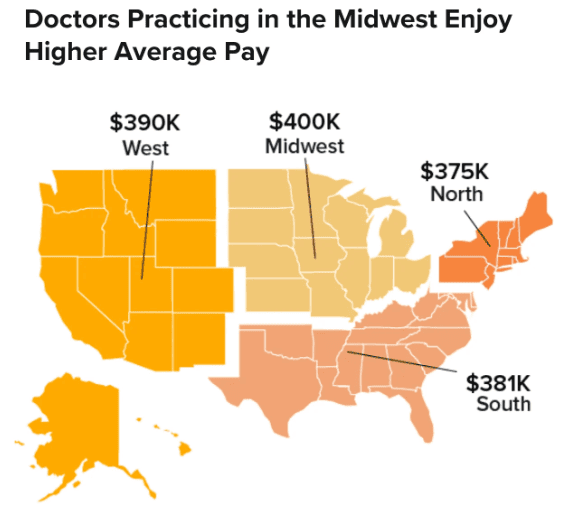
Marit’s regional data shows physician salaries are highest in the Plains at $476,500 and the Rocky Mountain region at $472,000, while New England trails at $423,000.
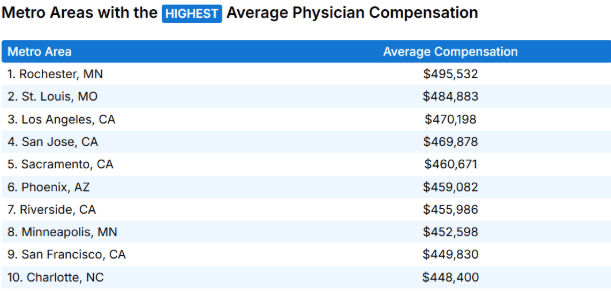
Doximity’s metro-level data for 2024 shows Rochester, MN, at the top for both nominal and cost-of-living-adjusted compensation.
On the nominal side, Rochester ($495,532), St. Louis ($484,883), Los Angeles ($470,198), San Jose ($469,878), and Sacramento ($460,671) take the lead.
On the cost-of-living-adjusted side, Boston and Washington DC sit at the very bottom, simply because the cost of living erodes the purchasing power of even a hefty paycheck.
Source: Doximity
Source: Medscape
As Medscape has noted, hospitals in rural states with fewer physicians per capita typically ramp up base salary, signing bonuses, and loan repayment offers to compete with urban markets that offer lifestyle advantages.
Geographic arbitrage (earning a higher salary in a lower-cost-of-living area) remains one of the most reliable and underused ways physicians have to accelerate their path to financial independence.
Learn more: Rich, Rich-ish, and the $650,000 Between Them
Employment Setting: A $173,000 Swing
Where you practice matters almost as much as what you practice. Doximity’s 2024 data shows a roughly $173,000 gap between the highest and lowest-paying employment settings:
- Single specialty group: $477,000
- Multi-specialty group: $462,000
- Solo practice: $458,000
- Hospital: $439,000
- Health system/IDN/ACO: $439,000
- HMO: $412,000
- Academic: $382,000
- Urgent care: $308,000
- Government: $303,000
Academic medicine consistently comes in near the bottom of the compensation ladder. For plastic surgeons, the non-academic premium is about $42 000 per year.
For dermatologists, it’s roughly $54,000. For anesthesiologists, about $16,500.
Protected research time, teaching, and intellectual environment are worth something, but if the financial plan requires maximizing income, private practice or a single-specialty group is almost always the better bet.
wRVUs Coming in Clutch
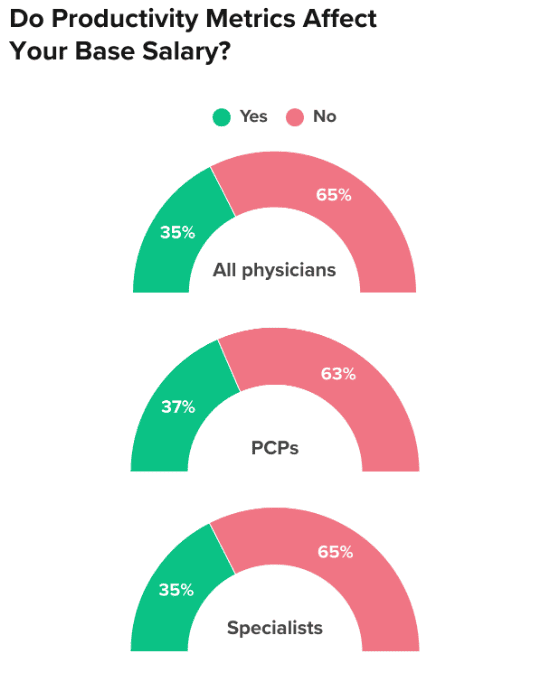
35% of physicians in Medscape’s 2026 survey said that quantifiable metrics like wRVUs now influence their base pay, not just their bonus. About 85% of physicians have some opportunity for productivity-based pay, whether a bonus or another plan structure.
Source: Medscape
This means that the average salary figure for your specialty is partly a function of how hard the average physician in that specialty is working, with room to move.
AMGA’s Matthew Wells attributed much of the recent compensation growth to rising individual physician productivity: seeing more patients and generating more wRVUs, combined with technology-driven efficiency gains in business operations.
That’s not a reason to grind yourself into burnout, though. Just take it as a sign to understand your compensation structure well enough so that you can optimize it.
Read more: Understanding RVU forIncreased Productivity and Income
The Gender Pay Gap, Wider Than It Was
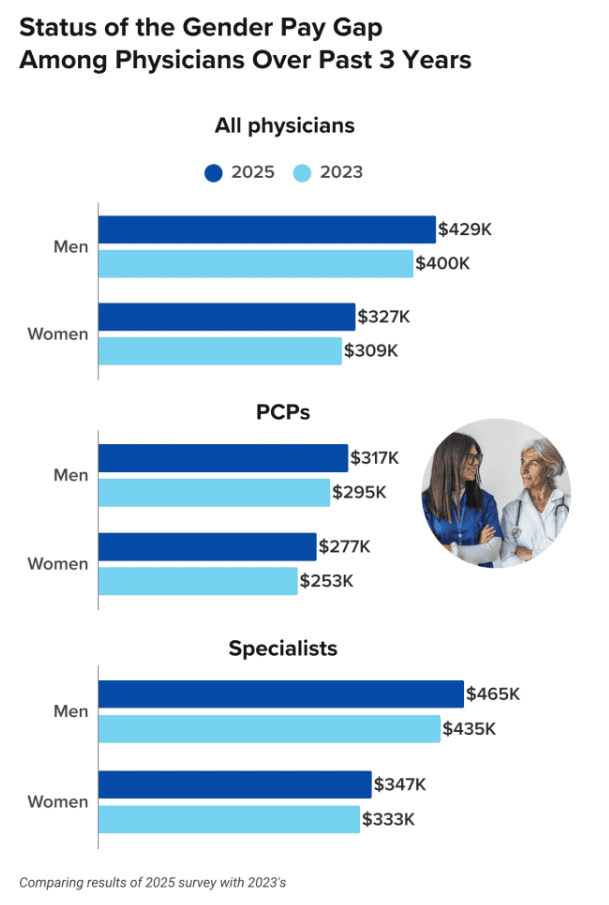
The 2026 Medscape report puts the gender gap at just over $102,000 in favor of male physicians — a 31% advantage, compared with roughly $91,000 and 29% two years prior. The gap is more pronounced among specialists than PCPs. Medscape bluntly states that for those looking for progress on pay equity for female physicians, “you won’t find it in these data.”
Source: Medscape
Doximity’s 2024 data tells a similar story. Men’s pay rose 5.7% in 2024, while women’s rose just 1.7%, widening the gender pay gap to 26%, up from 23% in 2023. On average, women physicians earned $120,917 less than men after adjusting for specialty, location, and years of experience.
An analysis of Doximity’s data estimated that, on average, men earn over $2 million more than women over a simulated 40-year career.
Marit’s specialty-level data shows the gap playing out concretely. Among dermatologists, men earn 21.5% more than women. Among plastic surgeons, men average $782,000 vs. $630,500 for women — a 24% difference.
Chad Stutelberg, national managing director of healthcare compensation at Arthur J. Gallagher & Co., says he still sees medical employers with gender equity problems in physician base pay and bias toward men in awarding signing bonuses. “The overall issue is not getting better.”
The Pediatric Pay Gap Is A Separate Problem
Doximity’s 2024 data shows that in hematology and oncology, adult specialists earned 93% more than their pediatric counterparts. In gastroenterology, the gap was 80%. Cardiology, pulmonology, and rheumatology all showed substantial pediatric-to-adult pay gaps.
In a Doximity survey of over 1,200 pediatricians and pediatric subspecialists, 87% said they are not fairly compensated relative to the complexity and importance of their work.
The same percentage said the lower pay has affected their ability to repay educational debt, save for retirement, or meet other financial goals. 69% said it has led them to consider a career change.
This is the other side of the physician compensation story that survey averages obscure. A pediatric cardiologist and an adult interventional cardiologist completed comparable training. Yet one of them may be struggling to make their student loan payments.
There is one small signal that the gap might be starting to correct. Pediatric nephrology grew 15.6%, the highest growth rate of any specialty in Doximity’s 2025 report.
Whether that reflects a genuine reimbursement adjustment or just sharp demand for an underserved subspecialty is too early to say.
But it is the only specialty in the pediatric set that grew faster than the broader physician average, and it is worth watching to see if other pediatric subspecialties follow.
Physician Burnout and Overwork
In a Doximity poll of nearly 2,000 physicians conducted in May 2025, 85% said they are overworked, up from 81% in 2023. About 68% said they are looking for an employment change or considering early retirement as a result.
Medscape connects this directly to compensation. The rebound in physicians feeling fairly paid may partly reflect a broader rebound from burnout, documentation overload, and pressure to see more patients.
That’s not the same as the problem being solved, it just means that physicians are recalibrating their expectations after a rough few years.
Medscape’s 2026 data shows physicians work an average of 49 hours per week — down one hour from the prior year, which is hardly a meaningful shift.
AMGA’s research puts patient-facing time at 36–40 hours per week, with charting adding at least 4–6 hours on top in primary care, before accounting for administrative work and call duties.
About 38% of physicians told Medscape in their prior year survey that they found time to take on paid work outside their regular hours, which means a significant share of physicians are already working more than their primary job demands, not less.
As Angie Caldwell, a Tampa, Florida-based principal with PYA Accountants & Advisors notes, specialists in orthopedics and cardiology frequently pick up key opinion leader roles; primary care physicians are increasingly being asked to extend their days to absorb patient demand.
77% of physicians said they would accept, or have already accepted, lower compensation in exchange for more autonomy or better work-life balance — up from 75% in 2024 and 71% in 2023.
So the real salary negotiation happening in medicine right now is not between doctors and hospital administrators over base pay, it’s between physicians and themselves, over whether the money is worth it.
Which Salary Figures Should I Use?
No single salary survey should be treated as gospel. Use all three of the major sources, understand their limitations, and anchor to the one that works in your favor when negotiating.
Medscape surveys nearly 6,000 physicians across 29+ specialties and tends to run lower than other sources.
Doximity draws from over 37,000 physicians and uses multivariate regression to control for specialty, geography, gender, and experience, and tends to produce higher figures making it the better tool at the negotiating table.
Marit collects anonymous, self-reported salaries from verified clinicians in real time and skews highest of all, but offers something neither Medscape nor Doximity provides: subspecialty-level breakdown, regional filtering, and MGMA benchmark data.
Marit licensed MGMA’s 2025 compensation data and made it free for verified clinicians who contribute their own anonymous salary, giving physicians access to the same benchmarks employers use to set starting offers.
Before any contract negotiation, pull Marit data for your specialty, region, and experience level, then cross-reference with Doximity for a methodology-adjusted figure. Know your wRVU conversion rate and whether your contract structure rewards or penalizes high productivity.
“And whatever you do, benchmark against the 75th percentile, not the average. The average is what everyone else is settling for.”
If you’re in primary care, solo practice, or a high-Medicare-volume setting, factor overhead and reimbursement trends into your net picture. The gross number on paper can look very different after costs. And whatever you do, benchmark against the 75th percentile, not the average. The average is what everyone else is settling for.
Finally, it needs to be said that while these figures are useful anchors, they don’t represent every physician’s reality.
A number on a Medscape chart means something different to a burned-out hospitalist carrying a panel of 2,500 patients than it does to a proceduralist in a single-specialty group.
Physician on FIRE has covered nearly every angle of this, compensation negotiation, tax strategy, contract red flags, geographic arbitrage, and what financial independence actually looks like on a physician’s timeline. The resources are here when you need them.
And if you’re a physician reading these numbers like they are the stuff of fiction, drop a comment. The Physician on FIRE community is full of physicians who’ve been exactly where you are, figured some of it out, and are genuinely willing to talk through it. You’re not in this alone.
Check out the Best Financial Books for New Doctors Who Don’t Have Time To Waste
Frequently Asked Questions
What is the average physician salary in the US in 2026?
According to the 2026 Medscape Physician Compensation Report, the average physician salary in the US is $386,000, up from $374,000 in 2025. Marit, which collects real-time anonymous salary data from verified clinicians, puts the overall physician average higher at $461,844 as of May 2026. The difference comes down to methodology and respondent mix. Neither figure tells you much without knowing your specialty, region, practice setting, and experience level.
Which medical specialty gets paid the most?
Cardiothoracic surgery and neurosurgery consistently sit at the top. Marit’s 2026 data puts the average cardiothoracic surgeon at $986,000 and the average neurosurgeon at $955,833. Orthopedic surgery, plastic surgery, and radiology round out the top five. Eight specialties now average above $500,000 according to Medscape’s 2026 report, up from four the year prior.
Which doctors get paid the least?
Pediatric subspecialists and primary care physicians occupy the bottom of the pay scale. Doximity’s 2024 data shows pediatric endocrinologists averaging $230,426. General pediatrics averages $262,000 to $295,000 depending on the source. Family medicine and internal medicine both come in under $320,000 on most surveys. When you factor in overhead for physicians in solo or small-group primary care, take-home pay can fall well below what any published survey average would suggest.
Does where you practice affect how much you earn as a doctor?
Significantly. Marit’s regional data shows physicians in the Plains earning an average of $476,500 compared to $423,000 in New England. Doximity’s cost-of-living-adjusted data for 2024 shows Rochester, MN topping the list, while Boston and Washington DC rank last once housing and living costs are factored in. Hospitals in rural and underserved areas routinely offer higher base salaries, signing bonuses, and loan repayment packages to compete with the lifestyle appeal of major metros. Geographic arbitrage is one of the most underused levers a physician has for reaching financial independence faster.
Why do different salary surveys show such different numbers for doctors?
Medscape, Doximity, and Marit all use different methodologies, sample sizes, and definitions of total compensation. Medscape surveys around 6,000 physicians and tends to run lower. Doximity draws from over 37,000 physicians and applies multivariate regression to control for specialty, geography, gender, and experience. Marit collects real-time, self-reported anonymous salaries from verified clinicians and skews highest. For contract negotiations, Doximity and Marit are the more useful benchmarks. Medscape’s value is in the breadth of specialties covered and the supplementary data on fairness, hours, and burnout.
Is there a gender pay gap in physician compensation?
Yes, and it is getting wider. The 2026 Medscape report puts the gap at $102,000 in favor of male physicians, a 31% advantage, up from $91,000 and 29% two years earlier. Doximity’s 2024 data shows men’s pay grew 5.7% that year while women’s grew 1.7%, widening the gap to 26%. An analysis of Doximity’s historical data estimated that men earn over $2 million more than women over a simulated 40-year career. The gap is wider among specialists than primary care physicians, and shows no sign of narrowing.
Are physicians experiencing burnout in 2026?
85% of physicians in a May 2025 Doximity poll said they are overworked, up from 81% in 2023. About 68% said they are looking for an employment change or considering early retirement. 77% said they would accept lower compensation for more autonomy or better work-life balance, the highest share recorded in three years of tracking. Women physicians are disproportionately affected, with 91% reporting overwork compared to 80% of men. Medscape’s data adds that nearly 1 in 5 physicians expected a pay cut in 2025 relative to 2024, mostly those in private practice absorbing flat Medicare reimbursements against rising overhead.
Do doctors in private practice earn more than employed physicians?
Generally, yes. Doximity’s 2024 data shows single-specialty group physicians averaging $477,000 compared to $382,000 for academic physicians and $303,000 for government-employed physicians. Solo practice averages $458,000. The trade-off is that private practice physicians absorb business risk, overhead, and administrative burden that employed physicians do not. For physicians in high-reimbursement specialties with strong patient volume, private practice is often the higher-earning path. For primary care in lower-reimbursement environments, the math is less clear.









1 thought on “Physician Salary by Specialty 2026: A Full Breakdown Across Medscape, Doximity, and Marit”
Thank you for providing this detailed analysis of physician wages by specialization! It’s intriguing to notice how patterns alter across different industries. As someone who has worked in healthcare administration, I have seen personally how specialization can have a significant impact on salaries and job satisfaction.